

Thermal Plasma Processes and Nanomaterial Preparation
85
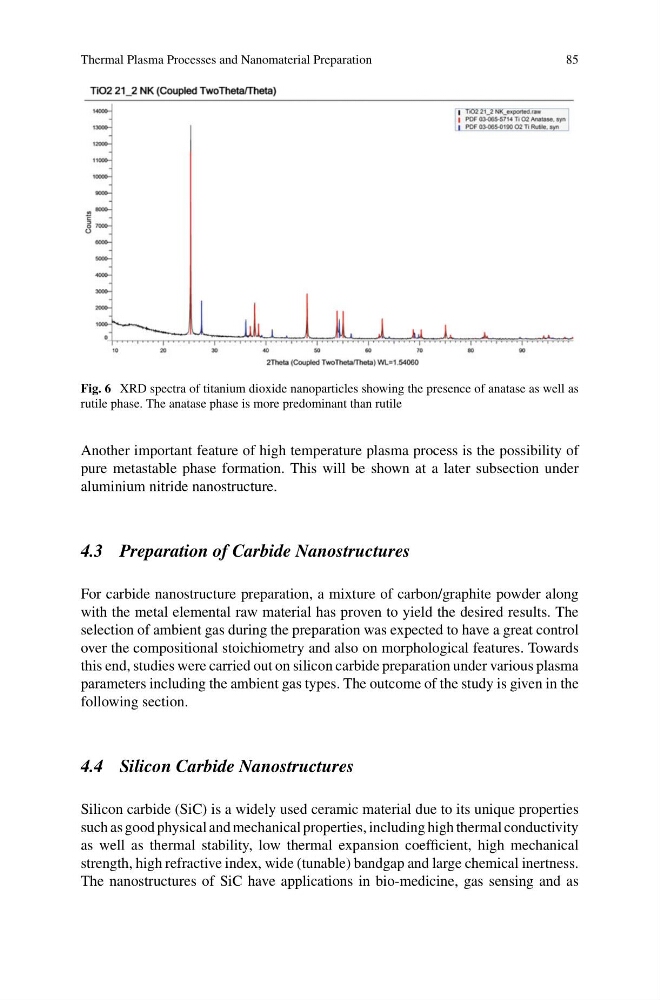
Fig. 6 XRD spectra of titanium dioxide nanoparticles showing the presence of anatase as well as
rutile phase. The anatase phase is more predominant than rutile
Another important feature of high temperature plasma process is the possibility of
pure metastable phase formation. This will be shown at a later subsection under
aluminium nitride nanostructure.
4.3 Preparation of Carbide Nanostructures
For carbide nanostructure preparation, a mixture of carbon/graphite powder along
with the metal elemental raw material has proven to yield the desired results. The
selection of ambient gas during the preparation was expected to have a great control
over the compositional stoichiometry and also on morphological features. Towards
this end, studies were carried out on silicon carbide preparation under various plasma
parameters including the ambient gas types. The outcome of the study is given in the
following section.
4.4 Silicon Carbide Nanostructures
Silicon carbide (SiC) is a widely used ceramic material due to its unique properties
such as good physical and mechanical properties, including high thermal conductivity
as well as thermal stability, low thermal expansion coefficient, high mechanical
strength, high refractive index, wide (tunable) bandgap and large chemical inertness.
The nanostructures of SiC have applications in bio-medicine, gas sensing and as
85
Fig. 6 XRD spectra of titanium dioxide nanoparticles showing the presence of anatase as well as
rutile phase. The anatase phase is more predominant than rutile
Another important feature of high temperature plasma process is the possibility of
pure metastable phase formation. This will be shown at a later subsection under
aluminium nitride nanostructure.
4.3 Preparation of Carbide Nanostructures
For carbide nanostructure preparation, a mixture of carbon/graphite powder along
with the metal elemental raw material has proven to yield the desired results. The
selection of ambient gas during the preparation was expected to have a great control
over the compositional stoichiometry and also on morphological features. Towards
this end, studies were carried out on silicon carbide preparation under various plasma
parameters including the ambient gas types. The outcome of the study is given in the
following section.
4.4 Silicon Carbide Nanostructures
Silicon carbide (SiC) is a widely used ceramic material due to its unique properties
such as good physical and mechanical properties, including high thermal conductivity
as well as thermal stability, low thermal expansion coefficient, high mechanical
strength, high refractive index, wide (tunable) bandgap and large chemical inertness.
The nanostructures of SiC have applications in bio-medicine, gas sensing and as