

32
X-Machines for Agent-Based Modeling: FLAME Perspectives
the gene itself. This can be an arithmetic expression represented as string
which can be combined with other expressions to find a solution gene.
Automatically defined functions. These ADFs represent a tree structure
of a program, and can be of two kinds:
• The result-producing branch evaluated using fitness for that
branch.
• Function-defining branch which contains a number of ADFs.
P r o g r a m
F u n c t i o n 1
V a l u e s
X
1
2
R e s u l t p r o d u c i n g
b r a n c h
A D F 1
A D F 2
1 + 2
2 / 1
1 x 2
L i b r a r y
M o d u l e s
E n c a p s u l a t e
C a n r e p r e s e n t
a t e r m i n a l v a l u e
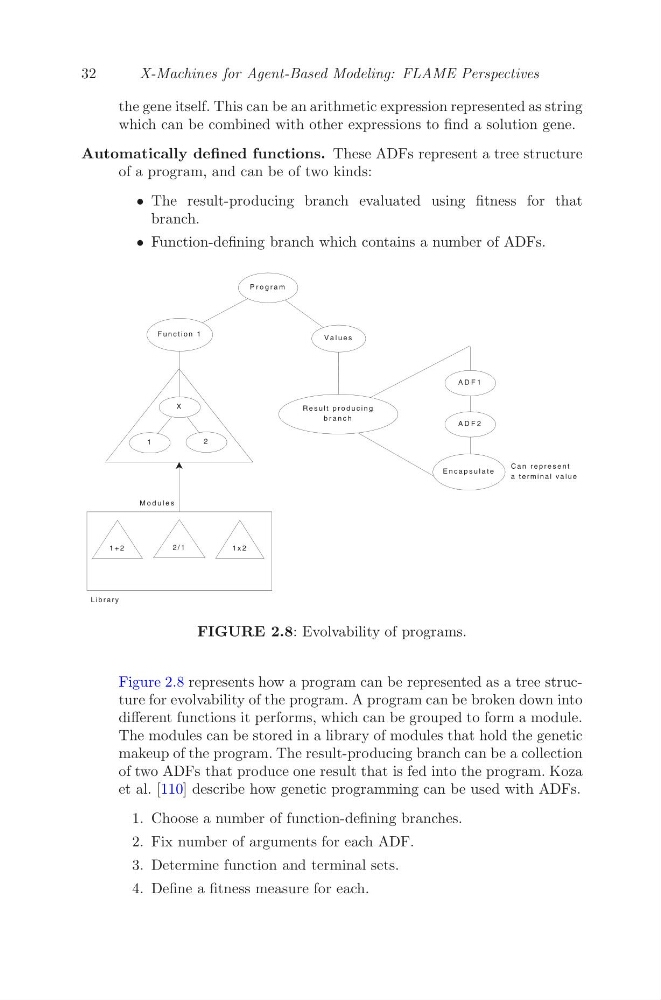
FIGURE 2.8: Evolvability of programs.
Figure 2.8 represents how a program can be represented as a tree structure for evolvability of the program. A program can be broken down into
different functions it performs, which can be grouped to form a module.
The modules can be stored in a library of modules that hold the genetic
makeup of the program. The result-producing branch can be a collection
of two ADFs that produce one result that is fed into the program. Koza
et al. [110] describe how genetic programming can be used with ADFs.
1. Choose a number of function-defining branches.
2. Fix number of arguments for each ADF.
3. Determine function and terminal sets.
4. Define a fitness measure for each.
X-Machines for Agent-Based Modeling: FLAME Perspectives
the gene itself. This can be an arithmetic expression represented as string
which can be combined with other expressions to find a solution gene.
Automatically defined functions. These ADFs represent a tree structure
of a program, and can be of two kinds:
• The result-producing branch evaluated using fitness for that
branch.
• Function-defining branch which contains a number of ADFs.
P r o g r a m
F u n c t i o n 1
V a l u e s
X
1
2
R e s u l t p r o d u c i n g
b r a n c h
A D F 1
A D F 2
1 + 2
2 / 1
1 x 2
L i b r a r y
M o d u l e s
E n c a p s u l a t e
C a n r e p r e s e n t
a t e r m i n a l v a l u e
FIGURE 2.8: Evolvability of programs.
Figure 2.8 represents how a program can be represented as a tree structure for evolvability of the program. A program can be broken down into
different functions it performs, which can be grouped to form a module.
The modules can be stored in a library of modules that hold the genetic
makeup of the program. The result-producing branch can be a collection
of two ADFs that produce one result that is fed into the program. Koza
et al. [110] describe how genetic programming can be used with ADFs.
1. Choose a number of function-defining branches.
2. Fix number of arguments for each ADF.
3. Determine function and terminal sets.
4. Define a fitness measure for each.