

184
X-Machines for Agent-Based Modeling: FLAME Perspectives
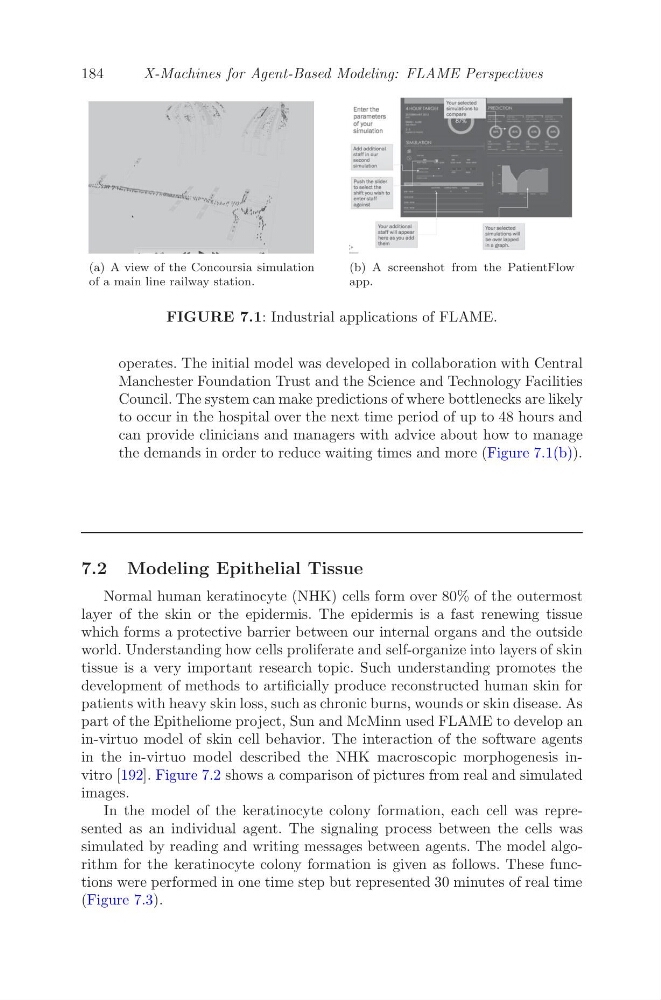
(a) A view of the Concoursia simulation
of a main line railway station.
(b) A screenshot from the PatientFlow
app.
FIGURE 7.1: Industrial applications of FLAME.
operates. The initial model was developed in collaboration with Central
Manchester Foundation Trust and the Science and Technology Facilities
Council. The system can make predictions of where bottlenecks are likely
to occur in the hospital over the next time period of up to 48 hours and
can provide clinicians and managers with advice about how to manage
the demands in order to reduce waiting times and more (Figure 7.1(b)).
7.2 Modeling Epithelial Tissue
Normal human keratinocyte (NHK) cells form over 80% of the outermost
layer of the skin or the epidermis. The epidermis is a fast renewing tissue
which forms a protective barrier between our internal organs and the outside
world. Understanding how cells proliferate and self-organize into layers of skin
tissue is a very important research topic. Such understanding promotes the
development of methods to artificially produce reconstructed human skin for
patients with heavy skin loss, such as chronic burns, wounds or skin disease. As
part of the Epitheliome project, Sun and McMinn used FLAME to develop an
in-virtuo model of skin cell behavior. The interaction of the software agents
in the in-virtuo model described the NHK macroscopic morphogenesis invitro [192]. Figure 7.2 shows a comparison of pictures from real and simulated
images.
In the model of the keratinocyte colony formation, each cell was represented as an individual agent. The signaling process between the cells was
simulated by reading and writing messages between agents. The model algorithm for the keratinocyte colony formation is given as follows. These functions were performed in one time step but represented 30 minutes of real time
(Figure 7.3).
X-Machines for Agent-Based Modeling: FLAME Perspectives
(a) A view of the Concoursia simulation
of a main line railway station.
(b) A screenshot from the PatientFlow
app.
FIGURE 7.1: Industrial applications of FLAME.
operates. The initial model was developed in collaboration with Central
Manchester Foundation Trust and the Science and Technology Facilities
Council. The system can make predictions of where bottlenecks are likely
to occur in the hospital over the next time period of up to 48 hours and
can provide clinicians and managers with advice about how to manage
the demands in order to reduce waiting times and more (Figure 7.1(b)).
7.2 Modeling Epithelial Tissue
Normal human keratinocyte (NHK) cells form over 80% of the outermost
layer of the skin or the epidermis. The epidermis is a fast renewing tissue
which forms a protective barrier between our internal organs and the outside
world. Understanding how cells proliferate and self-organize into layers of skin
tissue is a very important research topic. Such understanding promotes the
development of methods to artificially produce reconstructed human skin for
patients with heavy skin loss, such as chronic burns, wounds or skin disease. As
part of the Epitheliome project, Sun and McMinn used FLAME to develop an
in-virtuo model of skin cell behavior. The interaction of the software agents
in the in-virtuo model described the NHK macroscopic morphogenesis invitro [192]. Figure 7.2 shows a comparison of pictures from real and simulated
images.
In the model of the keratinocyte colony formation, each cell was represented as an individual agent. The signaling process between the cells was
simulated by reading and writing messages between agents. The model algorithm for the keratinocyte colony formation is given as follows. These functions were performed in one time step but represented 30 minutes of real time
(Figure 7.3).