

Agents in Economic Markets and Games
167
C
d
c
s
(a) Always cooperate.
D
d
c
s
(b) Always defect.
C
c
d
s
D
d
c
(c) Tit for tat.
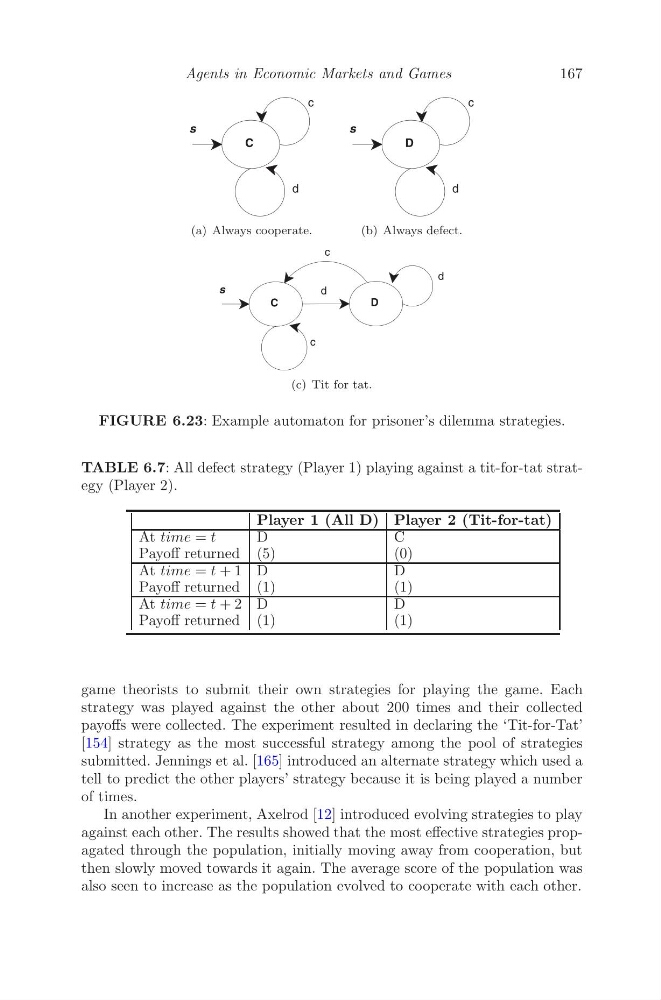
FIGURE 6.23: Example automaton for prisoner’s dilemma strategies.
TABLE 6.7: All defect strategy (Player 1) playing against a tit-for-tat strategy (Player 2).
Player 1 (All D) Player 2 (Tit-for-tat)
At time = t
D
C
Payoff returned (5)
(0)
At time = t + 1 D
D
Payoff returned (1)
(1)
At time = t + 2 D
D
Payoff returned (1)
(1)
game theorists to submit their own strategies for playing the game. Each
strategy was played against the other about 200 times and their collected
payoffs were collected. The experiment resulted in declaring the ‘Tit-for-Tat’
[154] strategy as the most successful strategy among the pool of strategies
submitted. Jennings et al. [165] introduced an alternate strategy which used a
tell to predict the other players’ strategy because it is being played a number
of times.
In another experiment, Axelrod [12] introduced evolving strategies to play
against each other. The results showed that the most effective strategies propagated through the population, initially moving away from cooperation, but
then slowly moved towards it again. The average score of the population was
also seen to increase as the population evolved to cooperate with each other.
167
C
d
c
s
(a) Always cooperate.
D
d
c
s
(b) Always defect.
C
c
d
s
D
d
c
(c) Tit for tat.
FIGURE 6.23: Example automaton for prisoner’s dilemma strategies.
TABLE 6.7: All defect strategy (Player 1) playing against a tit-for-tat strategy (Player 2).
Player 1 (All D) Player 2 (Tit-for-tat)
At time = t
D
C
Payoff returned (5)
(0)
At time = t + 1 D
D
Payoff returned (1)
(1)
At time = t + 2 D
D
Payoff returned (1)
(1)
game theorists to submit their own strategies for playing the game. Each
strategy was played against the other about 200 times and their collected
payoffs were collected. The experiment resulted in declaring the ‘Tit-for-Tat’
[154] strategy as the most successful strategy among the pool of strategies
submitted. Jennings et al. [165] introduced an alternate strategy which used a
tell to predict the other players’ strategy because it is being played a number
of times.
In another experiment, Axelrod [12] introduced evolving strategies to play
against each other. The results showed that the most effective strategies propagated through the population, initially moving away from cooperation, but
then slowly moved towards it again. The average score of the population was
also seen to increase as the population evolved to cooperate with each other.