

124
X-Machines for Agent-Based Modeling: FLAME Perspectives
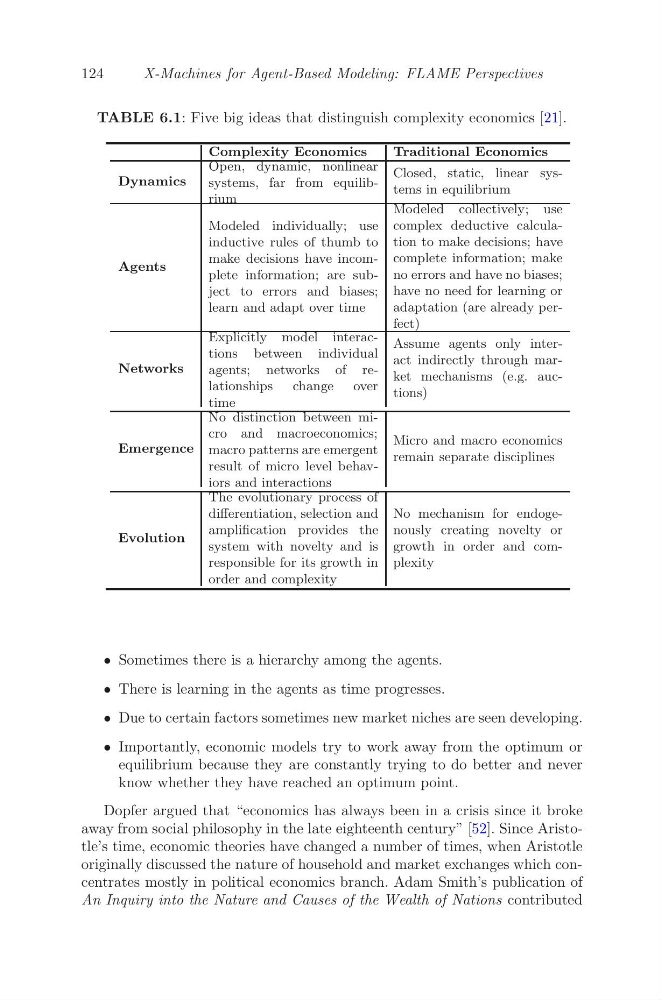
TABLE 6.1: Five big ideas that distinguish complexity economics [21].
Complexity Economics
Traditional Economics
Dynamics
Open, dynamic, nonlinear
systems, far from equilibrium
Closed, static, linear systems in equilibrium
Agents
Modeled individually; use
inductive rules of thumb to
make decisions have incomplete information; are subject to errors and biases;
learn and adapt over time
Modeled collectively; use
complex deductive calculation to make decisions; have
complete information; make
no errors and have no biases;
have no need for learning or
adaptation (are already perfect)
Networks
Explicitly model interactions between individual
agents; networks of relationships change over
time
Assume agents only interact indirectly through market mechanisms (e.g. auctions)
Emergence
No distinction between micro and macroeconomics;
macro patterns are emergent
result of micro level behaviors and interactions
Micro and macro economics
remain separate disciplines
Evolution
The evolutionary process of
differentiation, selection and
amplification provides the
system with novelty and is
responsible for its growth in
order and complexity
No mechanism for endogenously creating novelty or
growth in order and complexity
• Sometimes there is a hierarchy among the agents.
• There is learning in the agents as time progresses.
• Due to certain factors sometimes new market niches are seen developing.
• Importantly, economic models try to work away from the optimum or
equilibrium because they are constantly trying to do better and never
know whether they have reached an optimum point.
Dopfer argued that “economics has always been in a crisis since it broke
away from social philosophy in the late eighteenth century” [52]. Since Aristotle’s time, economic theories have changed a number of times, when Aristotle
originally discussed the nature of household and market exchanges which concentrates mostly in political economics branch. Adam Smith’s publication of
An Inquiry into the Nature and Causes of the Wealth of Nations contributed
X-Machines for Agent-Based Modeling: FLAME Perspectives
TABLE 6.1: Five big ideas that distinguish complexity economics [21].
Complexity Economics
Traditional Economics
Dynamics
Open, dynamic, nonlinear
systems, far from equilibrium
Closed, static, linear systems in equilibrium
Agents
Modeled individually; use
inductive rules of thumb to
make decisions have incomplete information; are subject to errors and biases;
learn and adapt over time
Modeled collectively; use
complex deductive calculation to make decisions; have
complete information; make
no errors and have no biases;
have no need for learning or
adaptation (are already perfect)
Networks
Explicitly model interactions between individual
agents; networks of relationships change over
time
Assume agents only interact indirectly through market mechanisms (e.g. auctions)
Emergence
No distinction between micro and macroeconomics;
macro patterns are emergent
result of micro level behaviors and interactions
Micro and macro economics
remain separate disciplines
Evolution
The evolutionary process of
differentiation, selection and
amplification provides the
system with novelty and is
responsible for its growth in
order and complexity
No mechanism for endogenously creating novelty or
growth in order and complexity
• Sometimes there is a hierarchy among the agents.
• There is learning in the agents as time progresses.
• Due to certain factors sometimes new market niches are seen developing.
• Importantly, economic models try to work away from the optimum or
equilibrium because they are constantly trying to do better and never
know whether they have reached an optimum point.
Dopfer argued that “economics has always been in a crisis since it broke
away from social philosophy in the late eighteenth century” [52]. Since Aristotle’s time, economic theories have changed a number of times, when Aristotle
originally discussed the nature of household and market exchanges which concentrates mostly in political economics branch. Adam Smith’s publication of
An Inquiry into the Nature and Causes of the Wealth of Nations contributed