

Agents in Social Science
95
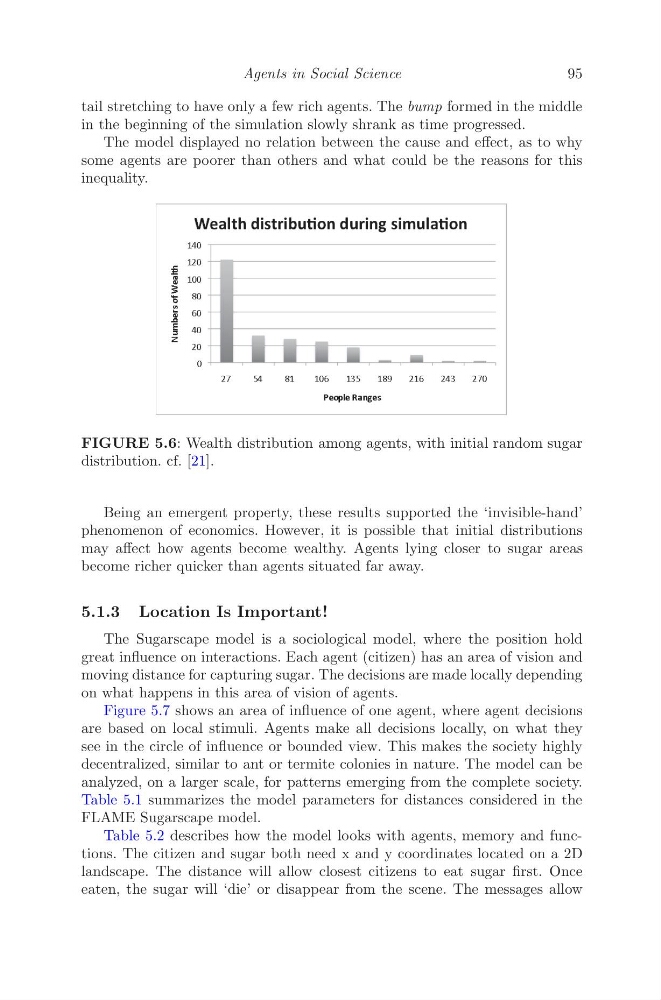
tail stretching to have only a few rich agents. The bump formed in the middle
in the beginning of the simulation slowly shrank as time progressed.
The model displayed no relation between the cause and effect, as to why
some agents are poorer than others and what could be the reasons for this
inequality.
FIGURE 5.6: Wealth distribution among agents, with initial random sugar
distribution. cf. [21].
Being an emergent property, these results supported the ‘invisible-hand’
phenomenon of economics. However, it is possible that initial distributions
may affect how agents become wealthy. Agents lying closer to sugar areas
become richer quicker than agents situated far away.
5.1.3 Location Is Important!
The Sugarscape model is a sociological model, where the position hold
great influence on interactions. Each agent (citizen) has an area of vision and
moving distance for capturing sugar. The decisions are made locally depending
on what happens in this area of vision of agents.
Figure 5.7 shows an area of influence of one agent, where agent decisions
are based on local stimuli. Agents make all decisions locally, on what they
see in the circle of influence or bounded view. This makes the society highly
decentralized, similar to ant or termite colonies in nature. The model can be
analyzed, on a larger scale, for patterns emerging from the complete society.
Table 5.1 summarizes the model parameters for distances considered in the
FLAME Sugarscape model.
Table 5.2 describes how the model looks with agents, memory and functions. The citizen and sugar both need x and y coordinates located on a 2D
landscape. The distance will allow closest citizens to eat sugar first. Once
eaten, the sugar will ‘die’ or disappear from the scene. The messages allow
95
tail stretching to have only a few rich agents. The bump formed in the middle
in the beginning of the simulation slowly shrank as time progressed.
The model displayed no relation between the cause and effect, as to why
some agents are poorer than others and what could be the reasons for this
inequality.
FIGURE 5.6: Wealth distribution among agents, with initial random sugar
distribution. cf. [21].
Being an emergent property, these results supported the ‘invisible-hand’
phenomenon of economics. However, it is possible that initial distributions
may affect how agents become wealthy. Agents lying closer to sugar areas
become richer quicker than agents situated far away.
5.1.3 Location Is Important!
The Sugarscape model is a sociological model, where the position hold
great influence on interactions. Each agent (citizen) has an area of vision and
moving distance for capturing sugar. The decisions are made locally depending
on what happens in this area of vision of agents.
Figure 5.7 shows an area of influence of one agent, where agent decisions
are based on local stimuli. Agents make all decisions locally, on what they
see in the circle of influence or bounded view. This makes the society highly
decentralized, similar to ant or termite colonies in nature. The model can be
analyzed, on a larger scale, for patterns emerging from the complete society.
Table 5.1 summarizes the model parameters for distances considered in the
FLAME Sugarscape model.
Table 5.2 describes how the model looks with agents, memory and functions. The citizen and sugar both need x and y coordinates located on a 2D
landscape. The distance will allow closest citizens to eat sugar first. Once
eaten, the sugar will ‘die’ or disappear from the scene. The messages allow