

94
X-Machines for Agent-Based Modeling: FLAME Perspectives
If agents were credit worthy they can borrow sugar.
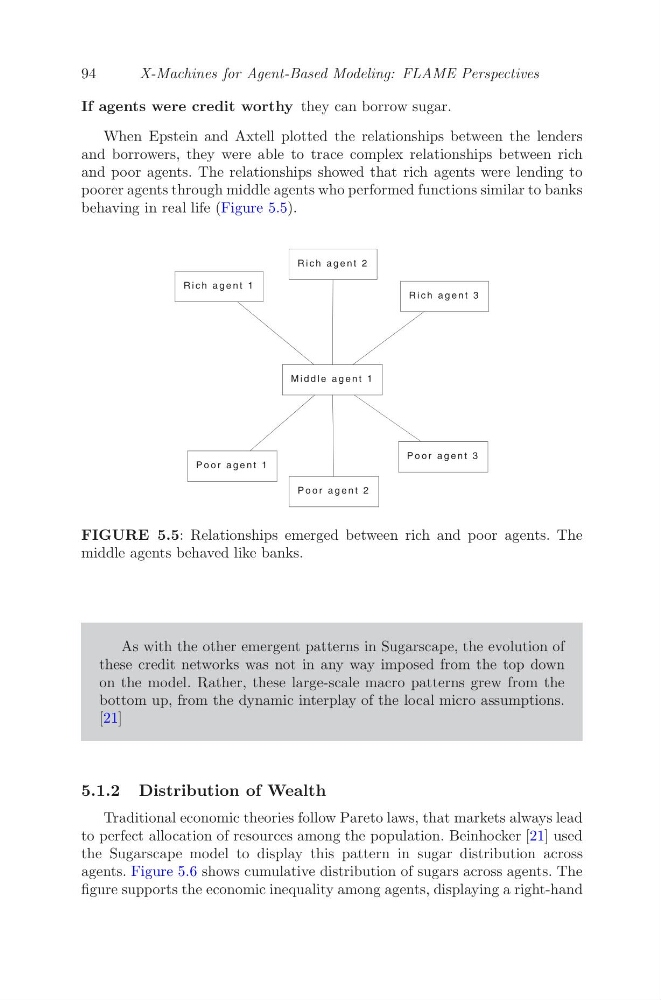
When Epstein and Axtell plotted the relationships between the lenders
and borrowers, they were able to trace complex relationships between rich
and poor agents. The relationships showed that rich agents were lending to
poorer agents through middle agents who performed functions similar to banks
behaving in real life (Figure 5.5).
R i c h a g e n t 1
R i c h a g e n t 2
R i c h a g e n t 3
M i d d l e a g e n t 1
P o o r a g e n t 1
P o o r a g e n t 2
P o o r a g e n t 3
FIGURE 5.5: Relationships emerged between rich and poor agents. The
middle agents behaved like banks.
As with the other emergent patterns in Sugarscape, the evolution of
these credit networks was not in any way imposed from the top down
on the model. Rather, these large-scale macro patterns grew from the
bottom up, from the dynamic interplay of the local micro assumptions.
[21]
5.1.2 Distribution of Wealth
Traditional economic theories follow Pareto laws, that markets always lead
to perfect allocation of resources among the population. Beinhocker [21] used
the Sugarscape model to display this pattern in sugar distribution across
agents. Figure 5.6 shows cumulative distribution of sugars across agents. The
figure supports the economic inequality among agents, displaying a right-hand
X-Machines for Agent-Based Modeling: FLAME Perspectives
If agents were credit worthy they can borrow sugar.
When Epstein and Axtell plotted the relationships between the lenders
and borrowers, they were able to trace complex relationships between rich
and poor agents. The relationships showed that rich agents were lending to
poorer agents through middle agents who performed functions similar to banks
behaving in real life (Figure 5.5).
R i c h a g e n t 1
R i c h a g e n t 2
R i c h a g e n t 3
M i d d l e a g e n t 1
P o o r a g e n t 1
P o o r a g e n t 2
P o o r a g e n t 3
FIGURE 5.5: Relationships emerged between rich and poor agents. The
middle agents behaved like banks.
As with the other emergent patterns in Sugarscape, the evolution of
these credit networks was not in any way imposed from the top down
on the model. Rather, these large-scale macro patterns grew from the
bottom up, from the dynamic interplay of the local micro assumptions.
[21]
5.1.2 Distribution of Wealth
Traditional economic theories follow Pareto laws, that markets always lead
to perfect allocation of resources among the population. Beinhocker [21] used
the Sugarscape model to display this pattern in sugar distribution across
agents. Figure 5.6 shows cumulative distribution of sugars across agents. The
figure supports the economic inequality among agents, displaying a right-hand