

M-SERVE and P-SERVE
65
2.3 Generating Intragranular Statistically Equivalent Virtual
Microstructures
The parametrically represented γ precipitates or GSEs are next dispersed in the
computational volume to generate statistically equivalent virtual microstructures or
(SEVMs). A first step is the initialization of SEVMs with N p GSE precipitates.
For each N p , distributions of morphological parameters, viz., aspect ratios (
a
b ,
b
c ),
the intermediate axis length b, shape exponent n, and the orientation distribution
functions (φ 1 , ,, φ 2 ), are sampled from the distribution functions created. The
aspect ratio
a
c can be determined in terms of the other two aspect ratios. However,
a
c can be matched to its representative distribution by swapping the relative
position of the aspect ratio
a
b . In a similar manner, the cross-correlations of the
sampled parameters are aligned with those of the ODM obtained statistics by a
shuffling method. Finally, the N p precipitates are spatially dispersed inside the
cubic computational domain with a volume fraction known from the experimental
statistics. The placement of GSEs in the computational domain is done by an
iterative algorithm. It initially disperses the statistically equivalent GSE at a very
low volume fraction and subsequently conducts gradual dilation and shuffling to
avoid precipitate contact, until the target volume fraction is reached.
2.3.1 Finalizing SEVMs Through Optimization of the Two-Point
Correlation Function
Following initialization of the SEVM with matching volume fraction, the spatial
positions of the γ precipitates are optimized with respect to the two-point correlation function S 2 . A genetic algorithm (GA) optimization method [51] is employed
to determine the optimal placement of the GSEs, with the objective of matching S 2
of the SEVM to that of the 6000 precipitates in the experimental microstructure.
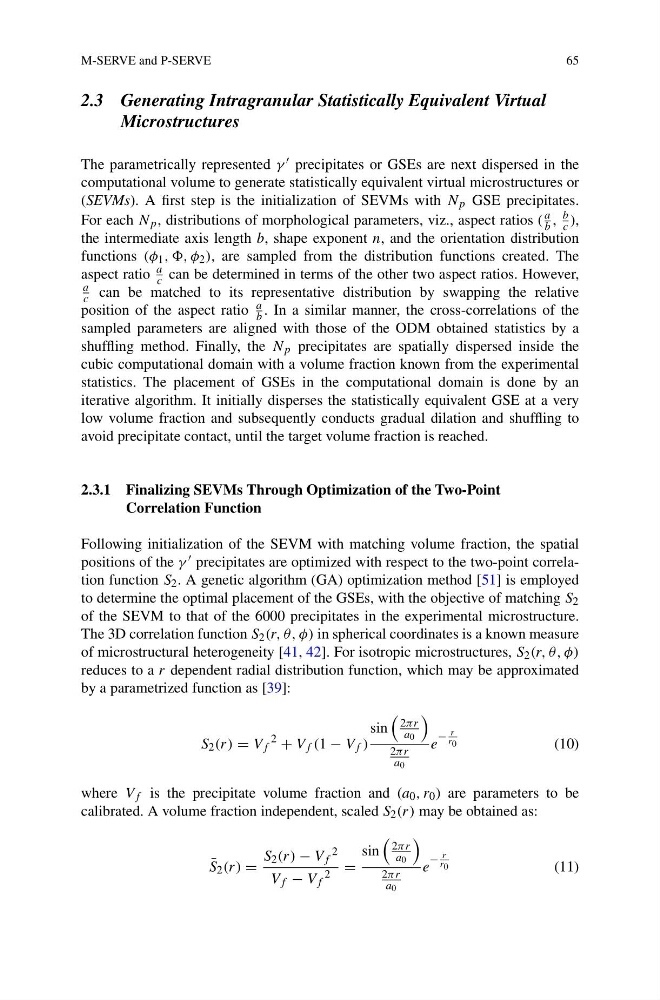
The 3D correlation function S 2 (r, θ, φ) in spherical coordinates is a known measure
of microstructural heterogeneity [41, 42]. For isotropic microstructures, S 2 (r, θ, φ)
reduces to a r dependent radial distribution function, which may be approximated
by a parametrized function as [39]:
S 2 (r) = V f
2
+ V f (1 − V f )
sin
2πr
a 0
2πr
a 0
e
−
r
r 0
(10)
where V f is the precipitate volume fraction and (a 0 , r 0 ) are parameters to be
calibrated. A volume fraction independent, scaled S 2 (r) may be obtained as:
¯
S 2 (r) =
S 2 (r) − V f
2
V f − V f
2
=
sin
2πr
a 0
2πr
a 0
e
−
r
r 0
(11)
65
2.3 Generating Intragranular Statistically Equivalent Virtual
Microstructures
The parametrically represented γ precipitates or GSEs are next dispersed in the
computational volume to generate statistically equivalent virtual microstructures or
(SEVMs). A first step is the initialization of SEVMs with N p GSE precipitates.
For each N p , distributions of morphological parameters, viz., aspect ratios (
a
b ,
b
c ),
the intermediate axis length b, shape exponent n, and the orientation distribution
functions (φ 1 , ,, φ 2 ), are sampled from the distribution functions created. The
aspect ratio
a
c can be determined in terms of the other two aspect ratios. However,
a
c can be matched to its representative distribution by swapping the relative
position of the aspect ratio
a
b . In a similar manner, the cross-correlations of the
sampled parameters are aligned with those of the ODM obtained statistics by a
shuffling method. Finally, the N p precipitates are spatially dispersed inside the
cubic computational domain with a volume fraction known from the experimental
statistics. The placement of GSEs in the computational domain is done by an
iterative algorithm. It initially disperses the statistically equivalent GSE at a very
low volume fraction and subsequently conducts gradual dilation and shuffling to
avoid precipitate contact, until the target volume fraction is reached.
2.3.1 Finalizing SEVMs Through Optimization of the Two-Point
Correlation Function
Following initialization of the SEVM with matching volume fraction, the spatial
positions of the γ precipitates are optimized with respect to the two-point correlation function S 2 . A genetic algorithm (GA) optimization method [51] is employed
to determine the optimal placement of the GSEs, with the objective of matching S 2
of the SEVM to that of the 6000 precipitates in the experimental microstructure.
The 3D correlation function S 2 (r, θ, φ) in spherical coordinates is a known measure
of microstructural heterogeneity [41, 42]. For isotropic microstructures, S 2 (r, θ, φ)
reduces to a r dependent radial distribution function, which may be approximated
by a parametrized function as [39]:
S 2 (r) = V f
2
+ V f (1 − V f )
sin
2πr
a 0
2πr
a 0
e
−
r
r 0
(10)
where V f is the precipitate volume fraction and (a 0 , r 0 ) are parameters to be
calibrated. A volume fraction independent, scaled S 2 (r) may be obtained as:
¯
S 2 (r) =
S 2 (r) − V f
2
V f − V f
2
=
sin
2πr
a 0
2πr
a 0
e
−
r
r 0
(11)