

48
S. P. Donegan and M. A. Groeber
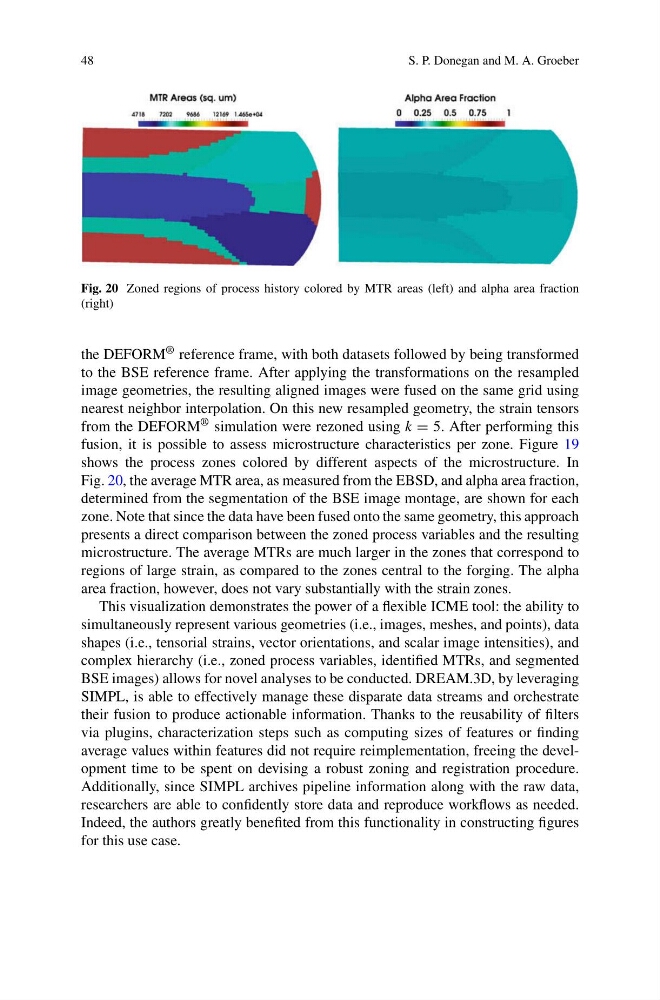
Fig. 20 Zoned regions of process history colored by MTR areas (left) and alpha area fraction
(right)
the DEFORM ® reference frame, with both datasets followed by being transformed
to the BSE reference frame. After applying the transformations on the resampled
image geometries, the resulting aligned images were fused on the same grid using
nearest neighbor interpolation. On this new resampled geometry, the strain tensors
from the DEFORM ® simulation were rezoned using k = 5. After performing this
fusion, it is possible to assess microstructure characteristics per zone. Figure 19
shows the process zones colored by different aspects of the microstructure. In
Fig. 20, the average MTR area, as measured from the EBSD, and alpha area fraction,
determined from the segmentation of the BSE image montage, are shown for each
zone. Note that since the data have been fused onto the same geometry, this approach
presents a direct comparison between the zoned process variables and the resulting
microstructure. The average MTRs are much larger in the zones that correspond to
regions of large strain, as compared to the zones central to the forging. The alpha
area fraction, however, does not vary substantially with the strain zones.
This visualization demonstrates the power of a flexible ICME tool: the ability to
simultaneously represent various geometries (i.e., images, meshes, and points), data
shapes (i.e., tensorial strains, vector orientations, and scalar image intensities), and
complex hierarchy (i.e., zoned process variables, identified MTRs, and segmented
BSE images) allows for novel analyses to be conducted. DREAM.3D, by leveraging
SIMPL, is able to effectively manage these disparate data streams and orchestrate
their fusion to produce actionable information. Thanks to the reusability of filters
via plugins, characterization steps such as computing sizes of features or finding
average values within features did not require reimplementation, freeing the development time to be spent on devising a robust zoning and registration procedure.
Additionally, since SIMPL archives pipeline information along with the raw data,
researchers are able to confidently store data and reproduce workflows as needed.
Indeed, the authors greatly benefited from this functionality in constructing figures
for this use case.
S. P. Donegan and M. A. Groeber
Fig. 20 Zoned regions of process history colored by MTR areas (left) and alpha area fraction
(right)
the DEFORM ® reference frame, with both datasets followed by being transformed
to the BSE reference frame. After applying the transformations on the resampled
image geometries, the resulting aligned images were fused on the same grid using
nearest neighbor interpolation. On this new resampled geometry, the strain tensors
from the DEFORM ® simulation were rezoned using k = 5. After performing this
fusion, it is possible to assess microstructure characteristics per zone. Figure 19
shows the process zones colored by different aspects of the microstructure. In
Fig. 20, the average MTR area, as measured from the EBSD, and alpha area fraction,
determined from the segmentation of the BSE image montage, are shown for each
zone. Note that since the data have been fused onto the same geometry, this approach
presents a direct comparison between the zoned process variables and the resulting
microstructure. The average MTRs are much larger in the zones that correspond to
regions of large strain, as compared to the zones central to the forging. The alpha
area fraction, however, does not vary substantially with the strain zones.
This visualization demonstrates the power of a flexible ICME tool: the ability to
simultaneously represent various geometries (i.e., images, meshes, and points), data
shapes (i.e., tensorial strains, vector orientations, and scalar image intensities), and
complex hierarchy (i.e., zoned process variables, identified MTRs, and segmented
BSE images) allows for novel analyses to be conducted. DREAM.3D, by leveraging
SIMPL, is able to effectively manage these disparate data streams and orchestrate
their fusion to produce actionable information. Thanks to the reusability of filters
via plugins, characterization steps such as computing sizes of features or finding
average values within features did not require reimplementation, freeing the development time to be spent on devising a robust zoning and registration procedure.
Additionally, since SIMPL archives pipeline information along with the raw data,
researchers are able to confidently store data and reproduce workflows as needed.
Indeed, the authors greatly benefited from this functionality in constructing figures
for this use case.