

Data Structures and Workflows for ICME
47
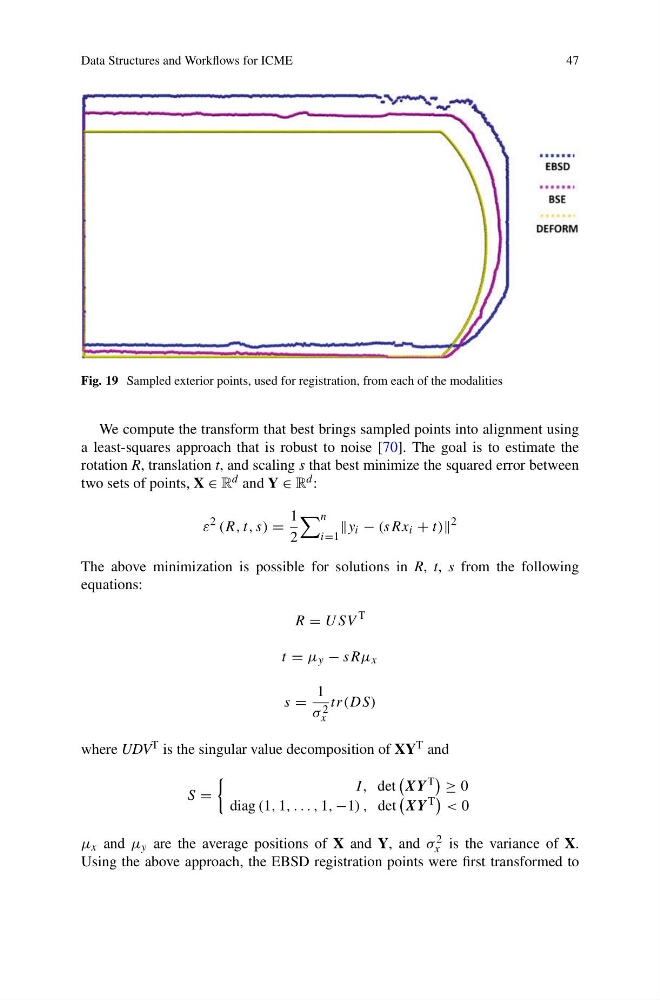
Fig. 19 Sampled exterior points, used for registration, from each of the modalities
We compute the transform that best brings sampled points into alignment using
a least-squares approach that is robust to noise [70]. The goal is to estimate the
rotation R, translation t, and scaling s that best minimize the squared error between
two sets of points, X ∈ R d and Y ∈ R d :
ε
2 (R, t, s) =
1
2
n
i=1
y i − (sRx i + t)
2
The above minimization is possible for solutions in R, t, s from the following
equations:
R = USV
T
t = μ y − sRμ x
s =
1
σ 2
x
tr(DS)
where UDV T is the singular value decomposition of XY T and
S =
I, det
XY T ≥ 0
diag (1, 1, . . . , 1, −1) , det
XY T
< 0
μ x and μ y are the average positions of X and Y, and σ 2
x is the variance of X.
Using the above approach, the EBSD registration points were first transformed to
47
Fig. 19 Sampled exterior points, used for registration, from each of the modalities
We compute the transform that best brings sampled points into alignment using
a least-squares approach that is robust to noise [70]. The goal is to estimate the
rotation R, translation t, and scaling s that best minimize the squared error between
two sets of points, X ∈ R d and Y ∈ R d :
ε
2 (R, t, s) =
1
2
n
i=1
y i − (sRx i + t)
2
The above minimization is possible for solutions in R, t, s from the following
equations:
R = USV
T
t = μ y − sRμ x
s =
1
σ 2
x
tr(DS)
where UDV T is the singular value decomposition of XY T and
S =
I, det
XY T ≥ 0
diag (1, 1, . . . , 1, −1) , det
XY T
< 0
μ x and μ y are the average positions of X and Y, and σ 2
x is the variance of X.
Using the above approach, the EBSD registration points were first transformed to