

44
S. P. Donegan and M. A. Groeber
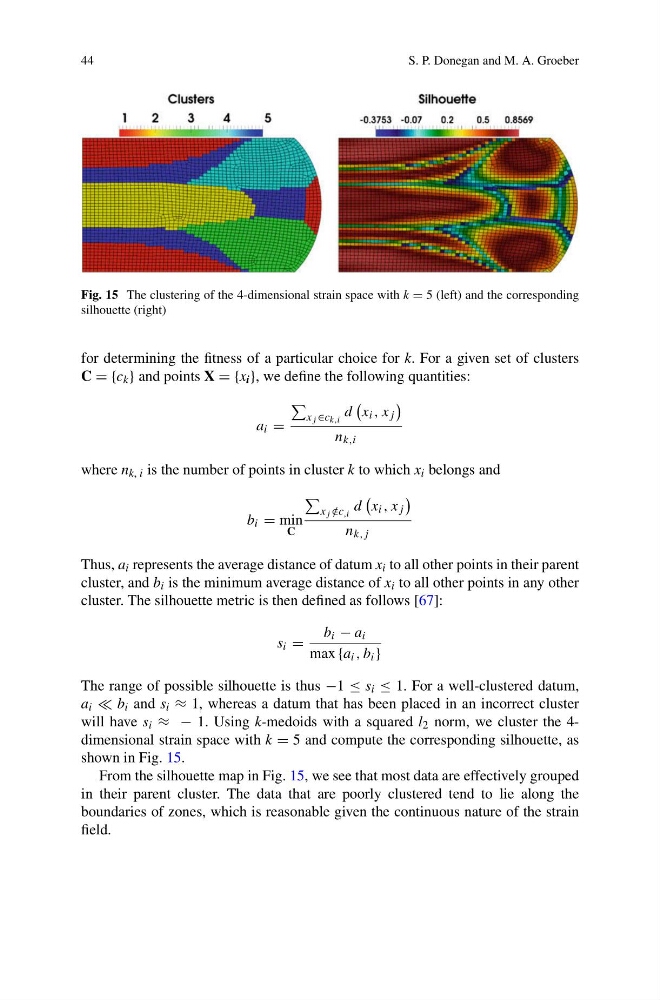
Fig. 15 The clustering of the 4-dimensional strain space with k = 5 (left) and the corresponding
silhouette (right)
for determining the fitness of a particular choice for k. For a given set of clusters
C = {c k } and points X = {x i }, we define the following quantities:
a i =
x j ∈c k,i
d
x i , x j
n k,i
where n k, i is the number of points in cluster k to which x i belongs and
b i = min
C
x j /
∈c ,i
d
x i , x j
n k,j
Thus, a i represents the average distance of datum x i to all other points in their parent
cluster, and b i is the minimum average distance of x i to all other points in any other
cluster. The silhouette metric is then defined as follows [67]:
s i =
b i − a i
max {a i , b i }
The range of possible silhouette is thus −1 ≤ s i ≤ 1. For a well-clustered datum,
a i b i and s i ≈ 1, whereas a datum that has been placed in an incorrect cluster
will have s i ≈ − 1. Using k-medoids with a squared l 2 norm, we cluster the 4dimensional strain space with k = 5 and compute the corresponding silhouette, as
shown in Fig. 15.
From the silhouette map in Fig. 15, we see that most data are effectively grouped
in their parent cluster. The data that are poorly clustered tend to lie along the
boundaries of zones, which is reasonable given the continuous nature of the strain
field.
S. P. Donegan and M. A. Groeber
Fig. 15 The clustering of the 4-dimensional strain space with k = 5 (left) and the corresponding
silhouette (right)
for determining the fitness of a particular choice for k. For a given set of clusters
C = {c k } and points X = {x i }, we define the following quantities:
a i =
x j ∈c k,i
d
x i , x j
n k,i
where n k, i is the number of points in cluster k to which x i belongs and
b i = min
C
x j /
∈c ,i
d
x i , x j
n k,j
Thus, a i represents the average distance of datum x i to all other points in their parent
cluster, and b i is the minimum average distance of x i to all other points in any other
cluster. The silhouette metric is then defined as follows [67]:
s i =
b i − a i
max {a i , b i }
The range of possible silhouette is thus −1 ≤ s i ≤ 1. For a well-clustered datum,
a i b i and s i ≈ 1, whereas a datum that has been placed in an incorrect cluster
will have s i ≈ − 1. Using k-medoids with a squared l 2 norm, we cluster the 4dimensional strain space with k = 5 and compute the corresponding silhouette, as
shown in Fig. 15.
From the silhouette map in Fig. 15, we see that most data are effectively grouped
in their parent cluster. The data that are poorly clustered tend to lie along the
boundaries of zones, which is reasonable given the continuous nature of the strain
field.