

Data Structures and Workflows for ICME
41
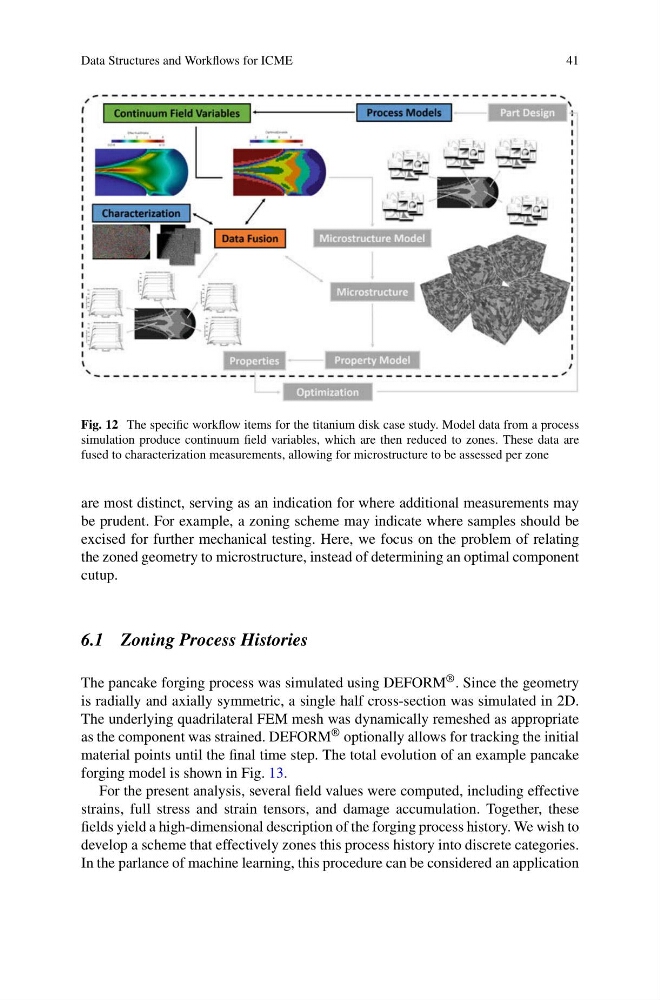
Fig. 12 The specific workflow items for the titanium disk case study. Model data from a process
simulation produce continuum field variables, which are then reduced to zones. These data are
fused to characterization measurements, allowing for microstructure to be assessed per zone
are most distinct, serving as an indication for where additional measurements may
be prudent. For example, a zoning scheme may indicate where samples should be
excised for further mechanical testing. Here, we focus on the problem of relating
the zoned geometry to microstructure, instead of determining an optimal component
cutup.
6.1 Zoning Process Histories
The pancake forging process was simulated using DEFORM ® . Since the geometry
is radially and axially symmetric, a single half cross-section was simulated in 2D.
The underlying quadrilateral FEM mesh was dynamically remeshed as appropriate
as the component was strained. DEFORM ® optionally allows for tracking the initial
material points until the final time step. The total evolution of an example pancake
forging model is shown in Fig. 13.
For the present analysis, several field values were computed, including effective
strains, full stress and strain tensors, and damage accumulation. Together, these
fields yield a high-dimensional description of the forging process history. We wish to
develop a scheme that effectively zones this process history into discrete categories.
In the parlance of machine learning, this procedure can be considered an application
41
Fig. 12 The specific workflow items for the titanium disk case study. Model data from a process
simulation produce continuum field variables, which are then reduced to zones. These data are
fused to characterization measurements, allowing for microstructure to be assessed per zone
are most distinct, serving as an indication for where additional measurements may
be prudent. For example, a zoning scheme may indicate where samples should be
excised for further mechanical testing. Here, we focus on the problem of relating
the zoned geometry to microstructure, instead of determining an optimal component
cutup.
6.1 Zoning Process Histories
The pancake forging process was simulated using DEFORM ® . Since the geometry
is radially and axially symmetric, a single half cross-section was simulated in 2D.
The underlying quadrilateral FEM mesh was dynamically remeshed as appropriate
as the component was strained. DEFORM ® optionally allows for tracking the initial
material points until the final time step. The total evolution of an example pancake
forging model is shown in Fig. 13.
For the present analysis, several field values were computed, including effective
strains, full stress and strain tensors, and damage accumulation. Together, these
fields yield a high-dimensional description of the forging process history. We wish to
develop a scheme that effectively zones this process history into discrete categories.
In the parlance of machine learning, this procedure can be considered an application