

Transverse Failure of Unidirectional Composites: Sensitivity to Interfacial Properties
339
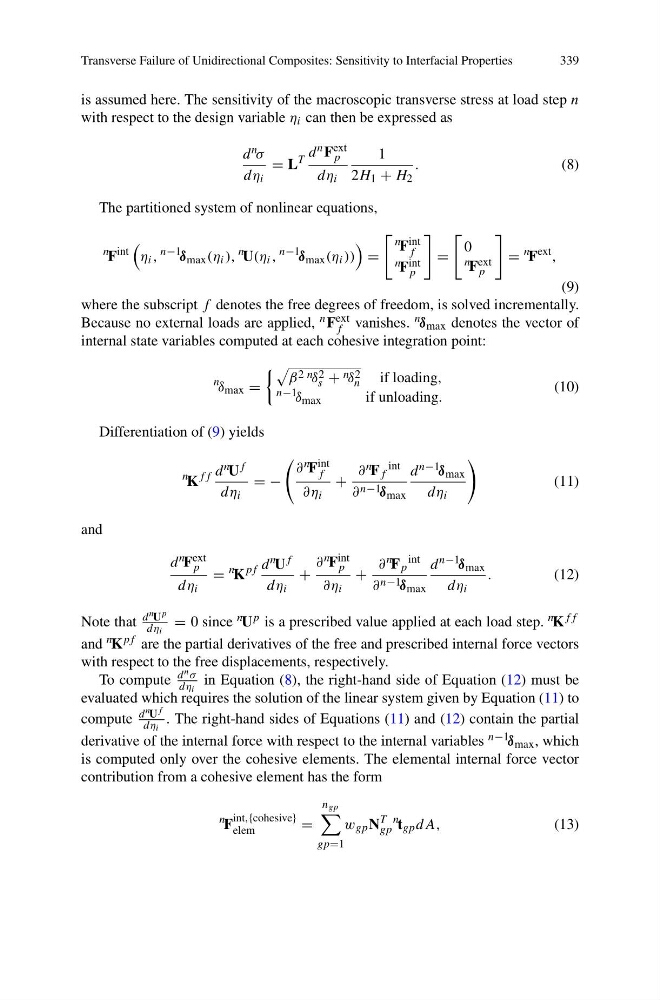
is assumed here. The sensitivity of the macroscopic transverse stress at load step n
with respect to the design variable η i can then be expressed as
d n σ
dη i
= L
T
d n F ext
p
dη i
1
2H 1 + H 2
.
(8)
The partitioned system of nonlinear equations,
n
F
int
η i ,
n−1
δ max (η i ),
n
U(η i ,
n−1
δ max (η i ))
=
n F int
f
n F int
p
=
0
n F ext
p
=
n
F
ext ,
(9)
where the subscript f denotes the free degrees of freedom, is solved incrementally.
Because no external loads are applied, n F ext
f vanishes. n δ max denotes the vector of
internal state variables computed at each cohesive integration point:
n
δ max =
β 2 n δ 2
s + n δ 2
n
if loading,
n−1 δ max
if unloading.
(10)
Differentiation of (9) yields
n
K
ff d n U f
dη i
= −
∂ n F int
f
∂η i
+
∂ n F f
int
∂ n−1 δ max
d n−1 δ max
dη i
(11)
and
d n F ext
p
dη i
=
n
K
pf d n U f
dη i
+
∂ n F int
p
∂η i
+
∂ n F p
int
∂ n−1 δ max
d n−1 δ max
dη i
.
(12)
Note that
d n U p
dη i
= 0 since n U p is a prescribed value applied at each load step. n K ff
and n K pf are the partial derivatives of the free and prescribed internal force vectors
with respect to the free displacements, respectively.
To compute
d n σ
dη i
in Equation (8), the right-hand side of Equation (12) must be
evaluated which requires the solution of the linear system given by Equation (11) to
compute
d n U f
dη i
. The right-hand sides of Equations (11) and (12) contain the partial
derivative of the internal force with respect to the internal variables n−1 δ max , which
is computed only over the cohesive elements. The elemental internal force vector
contribution from a cohesive element has the form
n
F
int,{cohesive}
elem
=
n gp
gp=1
w gp N
T
gp
n
t gp dA,
(13)
339
is assumed here. The sensitivity of the macroscopic transverse stress at load step n
with respect to the design variable η i can then be expressed as
d n σ
dη i
= L
T
d n F ext
p
dη i
1
2H 1 + H 2
.
(8)
The partitioned system of nonlinear equations,
n
F
int
η i ,
n−1
δ max (η i ),
n
U(η i ,
n−1
δ max (η i ))
=
n F int
f
n F int
p
=
0
n F ext
p
=
n
F
ext ,
(9)
where the subscript f denotes the free degrees of freedom, is solved incrementally.
Because no external loads are applied, n F ext
f vanishes. n δ max denotes the vector of
internal state variables computed at each cohesive integration point:
n
δ max =
β 2 n δ 2
s + n δ 2
n
if loading,
n−1 δ max
if unloading.
(10)
Differentiation of (9) yields
n
K
ff d n U f
dη i
= −
∂ n F int
f
∂η i
+
∂ n F f
int
∂ n−1 δ max
d n−1 δ max
dη i
(11)
and
d n F ext
p
dη i
=
n
K
pf d n U f
dη i
+
∂ n F int
p
∂η i
+
∂ n F p
int
∂ n−1 δ max
d n−1 δ max
dη i
.
(12)
Note that
d n U p
dη i
= 0 since n U p is a prescribed value applied at each load step. n K ff
and n K pf are the partial derivatives of the free and prescribed internal force vectors
with respect to the free displacements, respectively.
To compute
d n σ
dη i
in Equation (8), the right-hand side of Equation (12) must be
evaluated which requires the solution of the linear system given by Equation (11) to
compute
d n U f
dη i
. The right-hand sides of Equations (11) and (12) contain the partial
derivative of the internal force with respect to the internal variables n−1 δ max , which
is computed only over the cohesive elements. The elemental internal force vector
contribution from a cohesive element has the form
n
F
int,{cohesive}
elem
=
n gp
gp=1
w gp N
T
gp
n
t gp dA,
(13)