

SERVE-Boundary Conditions
323
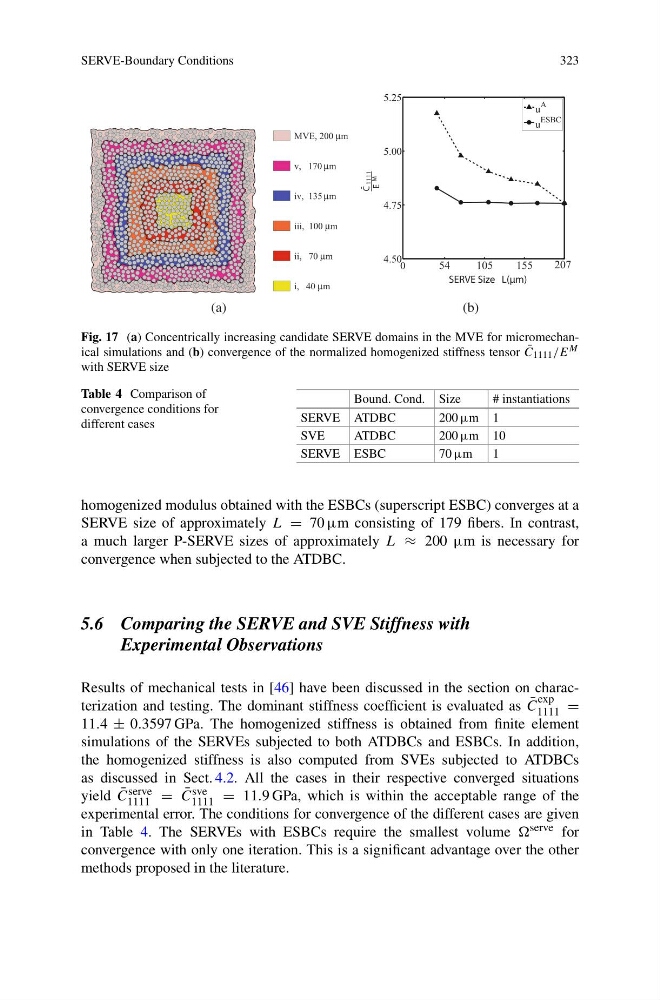
Fig. 17 (a) Concentrically increasing candidate SERVE domains in the MVE for micromechanical simulations and (b) convergence of the normalized homogenized stiffness tensor ¯
C 1111 /E M
with SERVE size
Table 4 Comparison of
convergence conditions for
different cases
Bound. Cond. Size
# instantiations
SERVE ATDBC
200 μm 1
SVE
ATDBC
200 μm 10
SERVE ESBC
70 μm
1
homogenized modulus obtained with the ESBCs (superscript ESBC) converges at a
SERVE size of approximately L = 70 μm consisting of 179 fibers. In contrast,
a much larger P-SERVE sizes of approximately L ≈ 200 μm is necessary for
convergence when subjected to the ATDBC.
5.6 Comparing the SERVE and SVE Stiffness with
Experimental Observations
Results of mechanical tests in [46] have been discussed in the section on characterization and testing. The dominant stiffness coefficient is evaluated as ¯
C
exp
1111 =
11.4 ± 0.3597 GPa. The homogenized stiffness is obtained from finite element
simulations of the SERVEs subjected to both ATDBCs and ESBCs. In addition,
the homogenized stiffness is also computed from SVEs subjected to ATDBCs
as discussed in Sect. 4.2. All the cases in their respective converged situations
yield ¯
C serve
1111 = ¯
C sve
1111 = 11.9 GPa, which is within the acceptable range of the
experimental error. The conditions for convergence of the different cases are given
in Table 4. The SERVEs with ESBCs require the smallest volume serve for
convergence with only one iteration. This is a significant advantage over the other
methods proposed in the literature.
323
Fig. 17 (a) Concentrically increasing candidate SERVE domains in the MVE for micromechanical simulations and (b) convergence of the normalized homogenized stiffness tensor ¯
C 1111 /E M
with SERVE size
Table 4 Comparison of
convergence conditions for
different cases
Bound. Cond. Size
# instantiations
SERVE ATDBC
200 μm 1
SVE
ATDBC
200 μm 10
SERVE ESBC
70 μm
1
homogenized modulus obtained with the ESBCs (superscript ESBC) converges at a
SERVE size of approximately L = 70 μm consisting of 179 fibers. In contrast,
a much larger P-SERVE sizes of approximately L ≈ 200 μm is necessary for
convergence when subjected to the ATDBC.
5.6 Comparing the SERVE and SVE Stiffness with
Experimental Observations
Results of mechanical tests in [46] have been discussed in the section on characterization and testing. The dominant stiffness coefficient is evaluated as ¯
C
exp
1111 =
11.4 ± 0.3597 GPa. The homogenized stiffness is obtained from finite element
simulations of the SERVEs subjected to both ATDBCs and ESBCs. In addition,
the homogenized stiffness is also computed from SVEs subjected to ATDBCs
as discussed in Sect. 4.2. All the cases in their respective converged situations
yield ¯
C serve
1111 = ¯
C sve
1111 = 11.9 GPa, which is within the acceptable range of the
experimental error. The conditions for convergence of the different cases are given
in Table 4. The SERVEs with ESBCs require the smallest volume serve for
convergence with only one iteration. This is a significant advantage over the other
methods proposed in the literature.