

314
S. Ghosh et al.
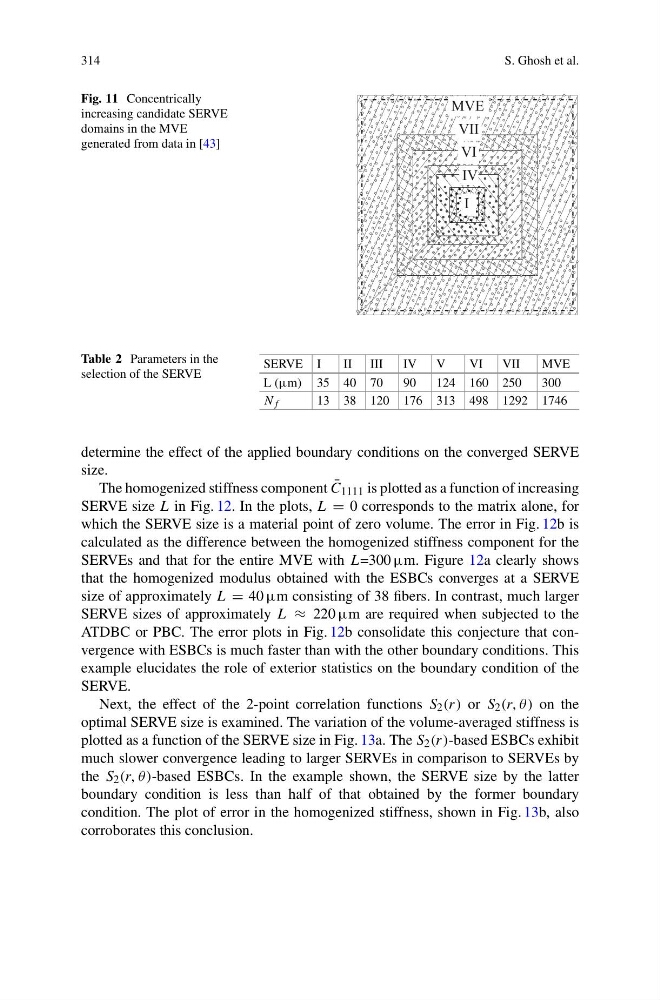
Fig. 11 Concentrically
increasing candidate SERVE
domains in the MVE
generated from data in [43]
Table 2 Parameters in the
selection of the SERVE
SERVE I
II III
IV
V
VI
VII
MVE
L (μm) 35 40 70
90
124 160 250
300
N f
13 38 120 176 313 498 1292 1746
determine the effect of the applied boundary conditions on the converged SERVE
size.
The homogenized stiffness component ¯
C 1111 is plotted as a function of increasing
SERVE size L in Fig. 12. In the plots, L = 0 corresponds to the matrix alone, for
which the SERVE size is a material point of zero volume. The error in Fig. 12b is
calculated as the difference between the homogenized stiffness component for the
SERVEs and that for the entire MVE with L=300 μm. Figure 12a clearly shows
that the homogenized modulus obtained with the ESBCs converges at a SERVE
size of approximately L = 40 μm consisting of 38 fibers. In contrast, much larger
SERVE sizes of approximately L ≈ 220 μm are required when subjected to the
ATDBC or PBC. The error plots in Fig. 12b consolidate this conjecture that convergence with ESBCs is much faster than with the other boundary conditions. This
example elucidates the role of exterior statistics on the boundary condition of the
SERVE.
Next, the effect of the 2-point correlation functions S 2 (r) or S 2 (r, θ ) on the
optimal SERVE size is examined. The variation of the volume-averaged stiffness is
plotted as a function of the SERVE size in Fig. 13a. The S 2 (r)-based ESBCs exhibit
much slower convergence leading to larger SERVEs in comparison to SERVEs by
the S 2 (r, θ )-based ESBCs. In the example shown, the SERVE size by the latter
boundary condition is less than half of that obtained by the former boundary
condition. The plot of error in the homogenized stiffness, shown in Fig. 13b, also
corroborates this conclusion.
S. Ghosh et al.
Fig. 11 Concentrically
increasing candidate SERVE
domains in the MVE
generated from data in [43]
Table 2 Parameters in the
selection of the SERVE
SERVE I
II III
IV
V
VI
VII
MVE
L (μm) 35 40 70
90
124 160 250
300
N f
13 38 120 176 313 498 1292 1746
determine the effect of the applied boundary conditions on the converged SERVE
size.
The homogenized stiffness component ¯
C 1111 is plotted as a function of increasing
SERVE size L in Fig. 12. In the plots, L = 0 corresponds to the matrix alone, for
which the SERVE size is a material point of zero volume. The error in Fig. 12b is
calculated as the difference between the homogenized stiffness component for the
SERVEs and that for the entire MVE with L=300 μm. Figure 12a clearly shows
that the homogenized modulus obtained with the ESBCs converges at a SERVE
size of approximately L = 40 μm consisting of 38 fibers. In contrast, much larger
SERVE sizes of approximately L ≈ 220 μm are required when subjected to the
ATDBC or PBC. The error plots in Fig. 12b consolidate this conjecture that convergence with ESBCs is much faster than with the other boundary conditions. This
example elucidates the role of exterior statistics on the boundary condition of the
SERVE.
Next, the effect of the 2-point correlation functions S 2 (r) or S 2 (r, θ ) on the
optimal SERVE size is examined. The variation of the volume-averaged stiffness is
plotted as a function of the SERVE size in Fig. 13a. The S 2 (r)-based ESBCs exhibit
much slower convergence leading to larger SERVEs in comparison to SERVEs by
the S 2 (r, θ )-based ESBCs. In the example shown, the SERVE size by the latter
boundary condition is less than half of that obtained by the former boundary
condition. The plot of error in the homogenized stiffness, shown in Fig. 13b, also
corroborates this conclusion.