

304
S. Ghosh et al.
2.1 Exterior Statistics-Based Perturbed Fields
The presence of heterogeneities in the form of inclusions or fibers alters the spatially
invariant, homogeneous state of the matrix stress σ M
ij , the matrix strain M
ij , and the
displacement u M
i fields in the MVE domain mve . The perturbed stress σ ∗
ij , strain
∗
ij , and displacement u ∗
i fields due to heterogeneities depend on the morphological
characteristics of the microstructure, viz., inclusion geometry and location. The total
stress σ ij , strain ij , and displacement u i fields in the heterogeneous MVE domain
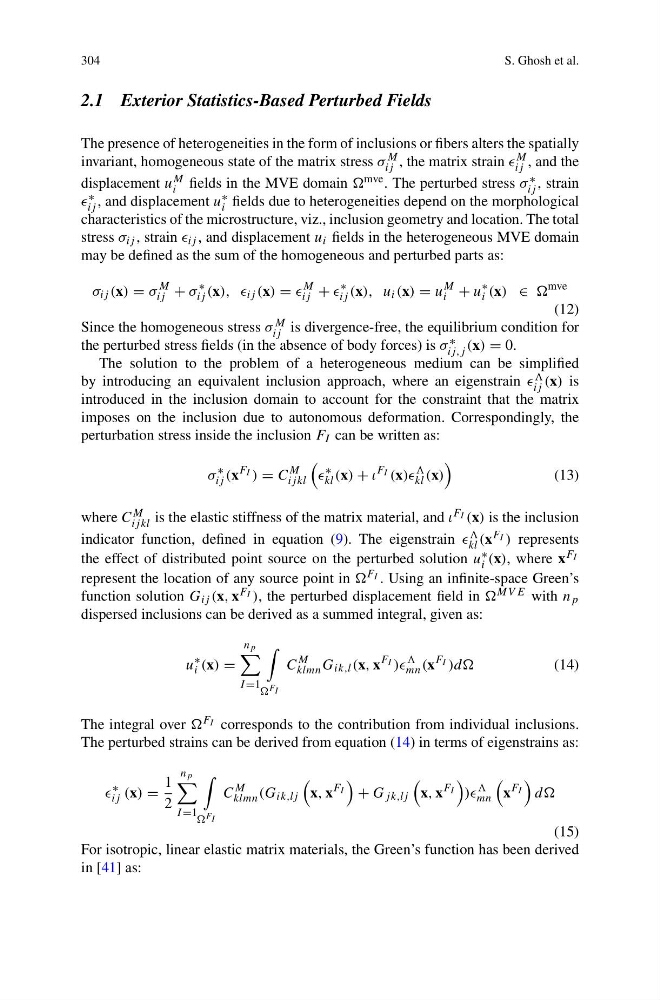
may be defined as the sum of the homogeneous and perturbed parts as:
σ ij (x) = σ
M
ij + σ
∗
ij (x), , ij (x) =
M
ij +
∗
ij (x), u i (x) = u
M
i + u
∗
i (x) ∈
mve
(12)
Since the homogeneous stress σ M
ij is divergence-free, the equilibrium condition for
the perturbed stress fields (in the absence of body forces) is σ ∗
ij,j (x) = 0.
The solution to the problem of a heterogeneous medium can be simplified
by introducing an equivalent inclusion approach, where an eigenstrain
ij (x) is
introduced in the inclusion domain to account for the constraint that the matrix
imposes on the inclusion due to autonomous deformation. Correspondingly, the
perturbation stress inside the inclusion F I can be written as:
σ
∗
ij (x
F I ) = C
M
ij kl
∗
kl (x) + ι
F I (x))
kl (x)
(13)
where C M
ij kl is the elastic stiffness of the matrix material, and ι F I (x) is the inclusion
indicator function, defined in equation (9). The eigenstrain
kl (x F I ) represents
the effect of distributed point source on the perturbed solution u ∗
i (x), where x F I
represent the location of any source point in F I . Using an infinite-space Green’s
function solution G ij (x, x F I ), the perturbed displacement field in MV E with n p
dispersed inclusions can be derived as a summed integral, given as:
u
∗
i (x) =
n p
I =1
F I
C
M
klmn G ik,l (x, x
F I ))
mn (x
F I )d
(14)
The integral over F I corresponds to the contribution from individual inclusions.
The perturbed strains can be derived from equation (14) in terms of eigenstrains as:
∗
ij (x) =
1
2
n p
I =1
F I
C
M
klmn (G ik,lj
x, x
F I
+ G jk,lj
x, x
F I
))
mn
x
F I
dd
(15)
For isotropic, linear elastic matrix materials, the Green’s function has been derived
in [41] as:
S. Ghosh et al.
2.1 Exterior Statistics-Based Perturbed Fields
The presence of heterogeneities in the form of inclusions or fibers alters the spatially
invariant, homogeneous state of the matrix stress σ M
ij , the matrix strain M
ij , and the
displacement u M
i fields in the MVE domain mve . The perturbed stress σ ∗
ij , strain
∗
ij , and displacement u ∗
i fields due to heterogeneities depend on the morphological
characteristics of the microstructure, viz., inclusion geometry and location. The total
stress σ ij , strain ij , and displacement u i fields in the heterogeneous MVE domain
may be defined as the sum of the homogeneous and perturbed parts as:
σ ij (x) = σ
M
ij + σ
∗
ij (x), , ij (x) =
M
ij +
∗
ij (x), u i (x) = u
M
i + u
∗
i (x) ∈
mve
(12)
Since the homogeneous stress σ M
ij is divergence-free, the equilibrium condition for
the perturbed stress fields (in the absence of body forces) is σ ∗
ij,j (x) = 0.
The solution to the problem of a heterogeneous medium can be simplified
by introducing an equivalent inclusion approach, where an eigenstrain
ij (x) is
introduced in the inclusion domain to account for the constraint that the matrix
imposes on the inclusion due to autonomous deformation. Correspondingly, the
perturbation stress inside the inclusion F I can be written as:
σ
∗
ij (x
F I ) = C
M
ij kl
∗
kl (x) + ι
F I (x))
kl (x)
(13)
where C M
ij kl is the elastic stiffness of the matrix material, and ι F I (x) is the inclusion
indicator function, defined in equation (9). The eigenstrain
kl (x F I ) represents
the effect of distributed point source on the perturbed solution u ∗
i (x), where x F I
represent the location of any source point in F I . Using an infinite-space Green’s
function solution G ij (x, x F I ), the perturbed displacement field in MV E with n p
dispersed inclusions can be derived as a summed integral, given as:
u
∗
i (x) =
n p
I =1
F I
C
M
klmn G ik,l (x, x
F I ))
mn (x
F I )d
(14)
The integral over F I corresponds to the contribution from individual inclusions.
The perturbed strains can be derived from equation (14) in terms of eigenstrains as:
∗
ij (x) =
1
2
n p
I =1
F I
C
M
klmn (G ik,lj
x, x
F I
+ G jk,lj
x, x
F I
))
mn
x
F I
dd
(15)
For isotropic, linear elastic matrix materials, the Green’s function has been derived
in [41] as: