

SERVE-Boundary Conditions
303
may be developed. Hence the term exterior statistics-based boundary conditions or
u ESBC
i
. It is expressed as:
u
ESBC
i
(x
serve ) = u
A
i (x
serve ) + u
∗
i (x
serve ) on
serve
(8)
where u ∗
i is an enhancement due to the interaction of the exterior domain ext with
the interior of the SERVE.
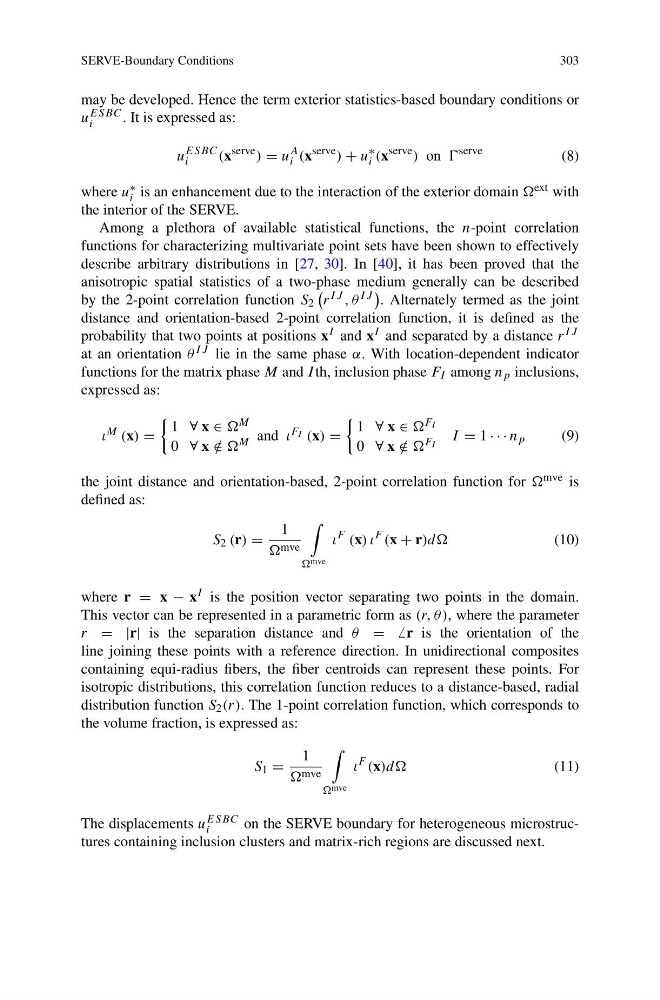
Among a plethora of available statistical functions, the n-point correlation
functions for characterizing multivariate point sets have been shown to effectively
describe arbitrary distributions in [27, 30]. In [40], it has been proved that the
anisotropic spatial statistics of a two-phase medium generally can be described
by the 2-point correlation function S 2
r I J , θ I J
. Alternately termed as the joint
distance and orientation-based 2-point correlation function, it is defined as the
probability that two points at positions x I and x I and separated by a distance r I J
at an orientation θ I J lie in the same phase α. With location-dependent indicator
functions for the matrix phase M and I th, inclusion phase F I among n p inclusions,
expressed as:
ι M (x) =
1 ∀ x ∈ M
0 ∀ x /
∈ M and ι F I (x) =
1 ∀ x ∈ F I
0 ∀ x /
∈ F I I = 1 · · · n p
(9)
the joint distance and orientation-based, 2-point correlation function for mve is
defined as:
S 2 (r) =
1
mve
mve
ι
F (x) ι
F (x + r)dd
(10)
where r = x − x I is the position vector separating two points in the domain.
This vector can be represented in a parametric form as (r, θ ), where the parameter
r = |r| is the separation distance and θ = r is the orientation of the
line joining these points with a reference direction. In unidirectional composites
containing equi-radius fibers, the fiber centroids can represent these points. For
isotropic distributions, this correlation function reduces to a distance-based, radial
distribution function S 2 (r). The 1-point correlation function, which corresponds to
the volume fraction, is expressed as:
S 1 =
1
mve
mve
ι
F (x)d
(11)
The displacements u ESBC
i
on the SERVE boundary for heterogeneous microstructures containing inclusion clusters and matrix-rich regions are discussed next.
303
may be developed. Hence the term exterior statistics-based boundary conditions or
u ESBC
i
. It is expressed as:
u
ESBC
i
(x
serve ) = u
A
i (x
serve ) + u
∗
i (x
serve ) on
serve
(8)
where u ∗
i is an enhancement due to the interaction of the exterior domain ext with
the interior of the SERVE.
Among a plethora of available statistical functions, the n-point correlation
functions for characterizing multivariate point sets have been shown to effectively
describe arbitrary distributions in [27, 30]. In [40], it has been proved that the
anisotropic spatial statistics of a two-phase medium generally can be described
by the 2-point correlation function S 2
r I J , θ I J
. Alternately termed as the joint
distance and orientation-based 2-point correlation function, it is defined as the
probability that two points at positions x I and x I and separated by a distance r I J
at an orientation θ I J lie in the same phase α. With location-dependent indicator
functions for the matrix phase M and I th, inclusion phase F I among n p inclusions,
expressed as:
ι M (x) =
1 ∀ x ∈ M
0 ∀ x /
∈ M and ι F I (x) =
1 ∀ x ∈ F I
0 ∀ x /
∈ F I I = 1 · · · n p
(9)
the joint distance and orientation-based, 2-point correlation function for mve is
defined as:
S 2 (r) =
1
mve
mve
ι
F (x) ι
F (x + r)dd
(10)
where r = x − x I is the position vector separating two points in the domain.
This vector can be represented in a parametric form as (r, θ ), where the parameter
r = |r| is the separation distance and θ = r is the orientation of the
line joining these points with a reference direction. In unidirectional composites
containing equi-radius fibers, the fiber centroids can represent these points. For
isotropic distributions, this correlation function reduces to a distance-based, radial
distribution function S 2 (r). The 1-point correlation function, which corresponds to
the volume fraction, is expressed as:
S 1 =
1
mve
mve
ι
F (x)d
(11)
The displacements u ESBC
i
on the SERVE boundary for heterogeneous microstructures containing inclusion clusters and matrix-rich regions are discussed next.