

SERVE-Boundary Conditions
301
2 Formulation of the Exterior Statistics-Based Boundary
Conditions for a SERVE
A summary of the exterior statistics-based boundary condition formulation that has
been detailed in [35, 38] is given in this section. A microstructural volume element
or MVE for a given macroscopic point occupies a infinite microstructural region
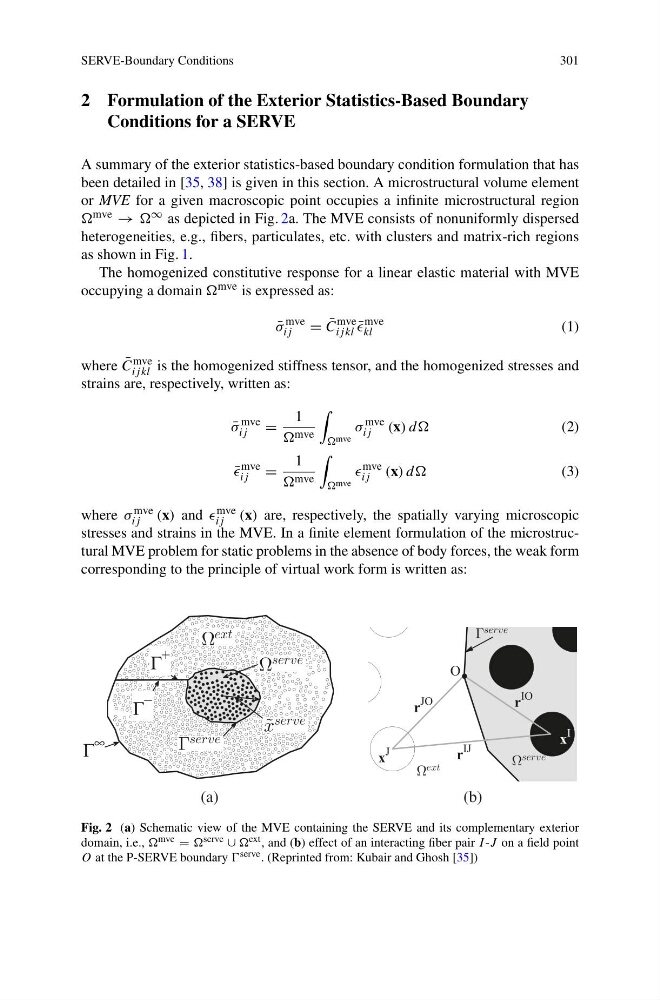
mve → ∞ as depicted in Fig. 2a. The MVE consists of nonuniformly dispersed
heterogeneities, e.g., fibers, particulates, etc. with clusters and matrix-rich regions
as shown in Fig. 1.
The homogenized constitutive response for a linear elastic material with MVE
occupying a domain mve is expressed as:
¯
σ
mve
ij
= ¯
C
mve
ij kl ¯
mve
kl
(1)
where ¯
C mve
ij kl is the homogenized stiffness tensor, and the homogenized stresses and
strains are, respectively, written as:
¯
σ
mve
ij
=
1
mve
mve
σ
mve
ij (x) dd
(2)
¯
mve
ij
=
1
mve
mve
mve
ij (x) dd
(3)
where σ mve
ij (x) and mve
ij (x) are, respectively, the spatially varying microscopic
stresses and strains in the MVE. In a finite element formulation of the microstructural MVE problem for static problems in the absence of body forces, the weak form
corresponding to the principle of virtual work form is written as:
Fig. 2 (a) Schematic view of the MVE containing the SERVE and its complementary exterior
domain, i.e., mve = serve ∪ ext , and (b) effect of an interacting fiber pair I -J on a field point
O at the P-SERVE boundary serve . (Reprinted from: Kubair and Ghosh [35])
301
2 Formulation of the Exterior Statistics-Based Boundary
Conditions for a SERVE
A summary of the exterior statistics-based boundary condition formulation that has
been detailed in [35, 38] is given in this section. A microstructural volume element
or MVE for a given macroscopic point occupies a infinite microstructural region
mve → ∞ as depicted in Fig. 2a. The MVE consists of nonuniformly dispersed
heterogeneities, e.g., fibers, particulates, etc. with clusters and matrix-rich regions
as shown in Fig. 1.
The homogenized constitutive response for a linear elastic material with MVE
occupying a domain mve is expressed as:
¯
σ
mve
ij
= ¯
C
mve
ij kl ¯
mve
kl
(1)
where ¯
C mve
ij kl is the homogenized stiffness tensor, and the homogenized stresses and
strains are, respectively, written as:
¯
σ
mve
ij
=
1
mve
mve
σ
mve
ij (x) dd
(2)
¯
mve
ij
=
1
mve
mve
mve
ij (x) dd
(3)
where σ mve
ij (x) and mve
ij (x) are, respectively, the spatially varying microscopic
stresses and strains in the MVE. In a finite element formulation of the microstructural MVE problem for static problems in the absence of body forces, the weak form
corresponding to the principle of virtual work form is written as:
Fig. 2 (a) Schematic view of the MVE containing the SERVE and its complementary exterior
domain, i.e., mve = serve ∪ ext , and (b) effect of an interacting fiber pair I -J on a field point
O at the P-SERVE boundary serve . (Reprinted from: Kubair and Ghosh [35])