

300
S. Ghosh et al.
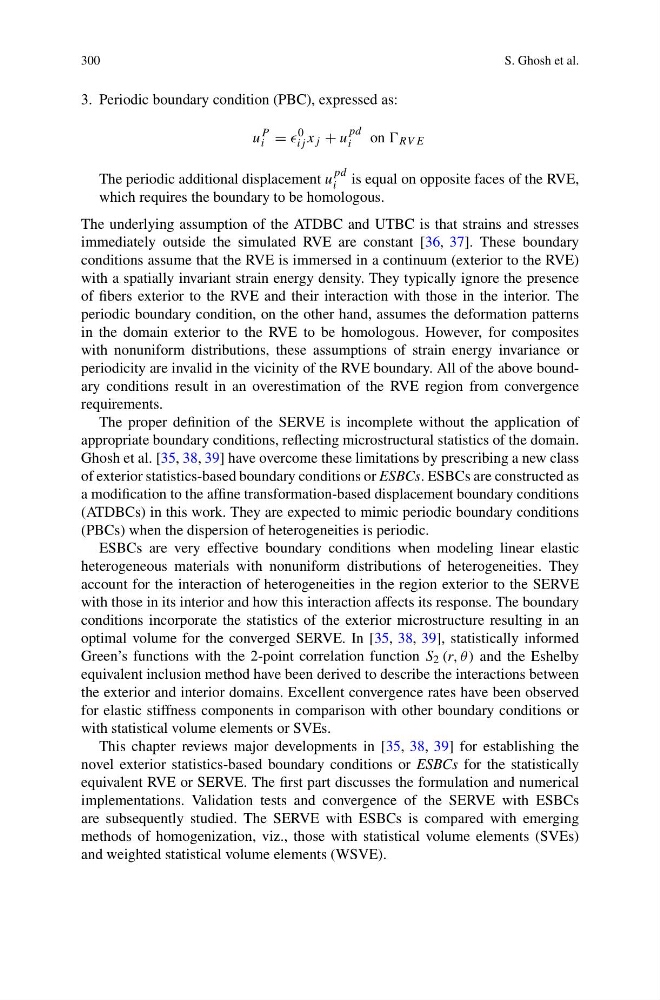
3. Periodic boundary condition (PBC), expressed as:
u
P
i =
0
ij x j + u
pd
i
on RV E
The periodic additional displacement u
pd
i is equal on opposite faces of the RVE,
which requires the boundary to be homologous.
The underlying assumption of the ATDBC and UTBC is that strains and stresses
immediately outside the simulated RVE are constant [36, 37]. These boundary
conditions assume that the RVE is immersed in a continuum (exterior to the RVE)
with a spatially invariant strain energy density. They typically ignore the presence
of fibers exterior to the RVE and their interaction with those in the interior. The
periodic boundary condition, on the other hand, assumes the deformation patterns
in the domain exterior to the RVE to be homologous. However, for composites
with nonuniform distributions, these assumptions of strain energy invariance or
periodicity are invalid in the vicinity of the RVE boundary. All of the above boundary conditions result in an overestimation of the RVE region from convergence
requirements.
The proper definition of the SERVE is incomplete without the application of
appropriate boundary conditions, reflecting microstructural statistics of the domain.
Ghosh et al. [35, 38, 39] have overcome these limitations by prescribing a new class
of exterior statistics-based boundary conditions or ESBCs. ESBCs are constructed as
a modification to the affine transformation-based displacement boundary conditions
(ATDBCs) in this work. They are expected to mimic periodic boundary conditions
(PBCs) when the dispersion of heterogeneities is periodic.
ESBCs are very effective boundary conditions when modeling linear elastic
heterogeneous materials with nonuniform distributions of heterogeneities. They
account for the interaction of heterogeneities in the region exterior to the SERVE
with those in its interior and how this interaction affects its response. The boundary
conditions incorporate the statistics of the exterior microstructure resulting in an
optimal volume for the converged SERVE. In [35, 38, 39], statistically informed
Green’s functions with the 2-point correlation function S 2 (r, θ ) and the Eshelby
equivalent inclusion method have been derived to describe the interactions between
the exterior and interior domains. Excellent convergence rates have been observed
for elastic stiffness components in comparison with other boundary conditions or
with statistical volume elements or SVEs.
This chapter reviews major developments in [35, 38, 39] for establishing the
novel exterior statistics-based boundary conditions or ESBCs for the statistically
equivalent RVE or SERVE. The first part discusses the formulation and numerical
implementations. Validation tests and convergence of the SERVE with ESBCs
are subsequently studied. The SERVE with ESBCs is compared with emerging
methods of homogenization, viz., those with statistical volume elements (SVEs)
and weighted statistical volume elements (WSVE).
S. Ghosh et al.
3. Periodic boundary condition (PBC), expressed as:
u
P
i =
0
ij x j + u
pd
i
on RV E
The periodic additional displacement u
pd
i is equal on opposite faces of the RVE,
which requires the boundary to be homologous.
The underlying assumption of the ATDBC and UTBC is that strains and stresses
immediately outside the simulated RVE are constant [36, 37]. These boundary
conditions assume that the RVE is immersed in a continuum (exterior to the RVE)
with a spatially invariant strain energy density. They typically ignore the presence
of fibers exterior to the RVE and their interaction with those in the interior. The
periodic boundary condition, on the other hand, assumes the deformation patterns
in the domain exterior to the RVE to be homologous. However, for composites
with nonuniform distributions, these assumptions of strain energy invariance or
periodicity are invalid in the vicinity of the RVE boundary. All of the above boundary conditions result in an overestimation of the RVE region from convergence
requirements.
The proper definition of the SERVE is incomplete without the application of
appropriate boundary conditions, reflecting microstructural statistics of the domain.
Ghosh et al. [35, 38, 39] have overcome these limitations by prescribing a new class
of exterior statistics-based boundary conditions or ESBCs. ESBCs are constructed as
a modification to the affine transformation-based displacement boundary conditions
(ATDBCs) in this work. They are expected to mimic periodic boundary conditions
(PBCs) when the dispersion of heterogeneities is periodic.
ESBCs are very effective boundary conditions when modeling linear elastic
heterogeneous materials with nonuniform distributions of heterogeneities. They
account for the interaction of heterogeneities in the region exterior to the SERVE
with those in its interior and how this interaction affects its response. The boundary
conditions incorporate the statistics of the exterior microstructure resulting in an
optimal volume for the converged SERVE. In [35, 38, 39], statistically informed
Green’s functions with the 2-point correlation function S 2 (r, θ ) and the Eshelby
equivalent inclusion method have been derived to describe the interactions between
the exterior and interior domains. Excellent convergence rates have been observed
for elastic stiffness components in comparison with other boundary conditions or
with statistical volume elements or SVEs.
This chapter reviews major developments in [35, 38, 39] for establishing the
novel exterior statistics-based boundary conditions or ESBCs for the statistically
equivalent RVE or SERVE. The first part discusses the formulation and numerical
implementations. Validation tests and convergence of the SERVE with ESBCs
are subsequently studied. The SERVE with ESBCs is compared with emerging
methods of homogenization, viz., those with statistical volume elements (SVEs)
and weighted statistical volume elements (WSVE).