

Multiscale Modeling of Epoxies and Epoxy-Based Composites
283
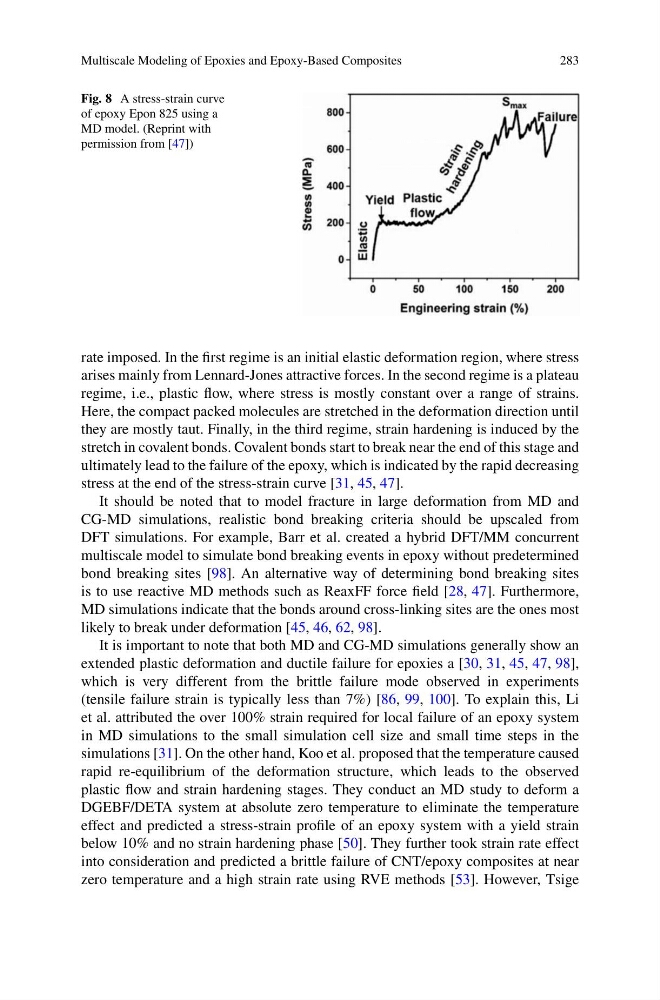
Fig. 8 A stress-strain curve
of epoxy Epon 825 using a
MD model. (Reprint with
permission from [47])
rate imposed. In the first regime is an initial elastic deformation region, where stress
arises mainly from Lennard-Jones attractive forces. In the second regime is a plateau
regime, i.e., plastic flow, where stress is mostly constant over a range of strains.
Here, the compact packed molecules are stretched in the deformation direction until
they are mostly taut. Finally, in the third regime, strain hardening is induced by the
stretch in covalent bonds. Covalent bonds start to break near the end of this stage and
ultimately lead to the failure of the epoxy, which is indicated by the rapid decreasing
stress at the end of the stress-strain curve [31, 45, 47].
It should be noted that to model fracture in large deformation from MD and
CG-MD simulations, realistic bond breaking criteria should be upscaled from
DFT simulations. For example, Barr et al. created a hybrid DFT/MM concurrent
multiscale model to simulate bond breaking events in epoxy without predetermined
bond breaking sites [98]. An alternative way of determining bond breaking sites
is to use reactive MD methods such as ReaxFF force field [28, 47]. Furthermore,
MD simulations indicate that the bonds around cross-linking sites are the ones most
likely to break under deformation [45, 46, 62, 98].
It is important to note that both MD and CG-MD simulations generally show an
extended plastic deformation and ductile failure for epoxies a [30, 31, 45, 47, 98],
which is very different from the brittle failure mode observed in experiments
(tensile failure strain is typically less than 7%) [86, 99, 100]. To explain this, Li
et al. attributed the over 100% strain required for local failure of an epoxy system
in MD simulations to the small simulation cell size and small time steps in the
simulations [31]. On the other hand, Koo et al. proposed that the temperature caused
rapid re-equilibrium of the deformation structure, which leads to the observed
plastic flow and strain hardening stages. They conduct an MD study to deform a
DGEBF/DETA system at absolute zero temperature to eliminate the temperature
effect and predicted a stress-strain profile of an epoxy system with a yield strain
below 10% and no strain hardening phase [50]. They further took strain rate effect
into consideration and predicted a brittle failure of CNT/epoxy composites at near
zero temperature and a high strain rate using RVE methods [53]. However, Tsige
283
Fig. 8 A stress-strain curve
of epoxy Epon 825 using a
MD model. (Reprint with
permission from [47])
rate imposed. In the first regime is an initial elastic deformation region, where stress
arises mainly from Lennard-Jones attractive forces. In the second regime is a plateau
regime, i.e., plastic flow, where stress is mostly constant over a range of strains.
Here, the compact packed molecules are stretched in the deformation direction until
they are mostly taut. Finally, in the third regime, strain hardening is induced by the
stretch in covalent bonds. Covalent bonds start to break near the end of this stage and
ultimately lead to the failure of the epoxy, which is indicated by the rapid decreasing
stress at the end of the stress-strain curve [31, 45, 47].
It should be noted that to model fracture in large deformation from MD and
CG-MD simulations, realistic bond breaking criteria should be upscaled from
DFT simulations. For example, Barr et al. created a hybrid DFT/MM concurrent
multiscale model to simulate bond breaking events in epoxy without predetermined
bond breaking sites [98]. An alternative way of determining bond breaking sites
is to use reactive MD methods such as ReaxFF force field [28, 47]. Furthermore,
MD simulations indicate that the bonds around cross-linking sites are the ones most
likely to break under deformation [45, 46, 62, 98].
It is important to note that both MD and CG-MD simulations generally show an
extended plastic deformation and ductile failure for epoxies a [30, 31, 45, 47, 98],
which is very different from the brittle failure mode observed in experiments
(tensile failure strain is typically less than 7%) [86, 99, 100]. To explain this, Li
et al. attributed the over 100% strain required for local failure of an epoxy system
in MD simulations to the small simulation cell size and small time steps in the
simulations [31]. On the other hand, Koo et al. proposed that the temperature caused
rapid re-equilibrium of the deformation structure, which leads to the observed
plastic flow and strain hardening stages. They conduct an MD study to deform a
DGEBF/DETA system at absolute zero temperature to eliminate the temperature
effect and predicted a stress-strain profile of an epoxy system with a yield strain
below 10% and no strain hardening phase [50]. They further took strain rate effect
into consideration and predicted a brittle failure of CNT/epoxy composites at near
zero temperature and a high strain rate using RVE methods [53]. However, Tsige