

282
X. Wu and J. A. El-Awady
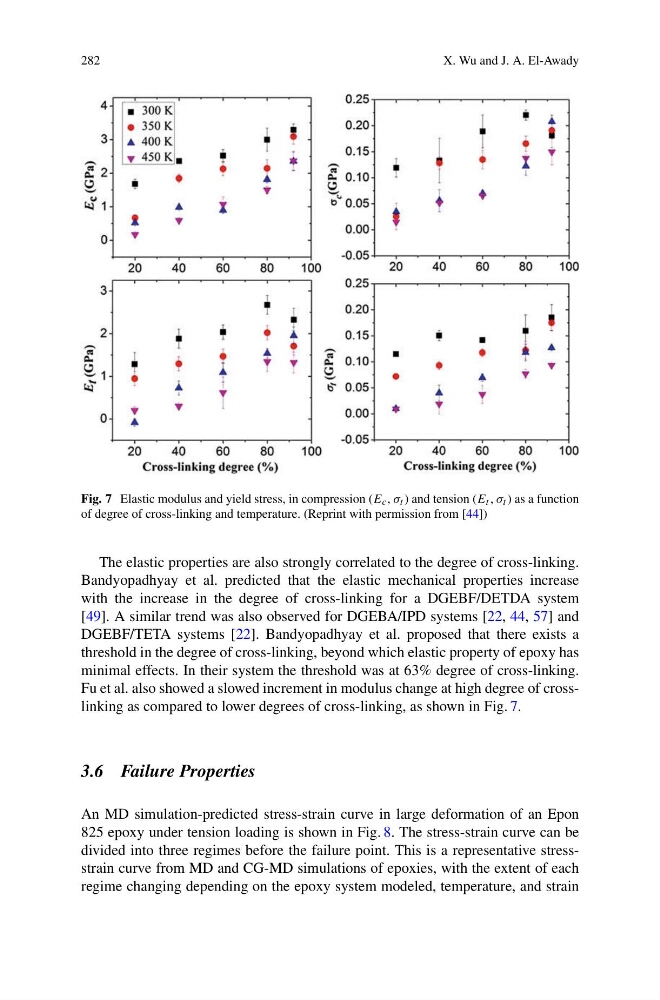
Fig. 7 Elastic modulus and yield stress, in compression (E c , σ t ) and tension (E t , σ t ) as a function
of degree of cross-linking and temperature. (Reprint with permission from [44])
The elastic properties are also strongly correlated to the degree of cross-linking.
Bandyopadhyay et al. predicted that the elastic mechanical properties increase
with the increase in the degree of cross-linking for a DGEBF/DETDA system
[49]. A similar trend was also observed for DGEBA/IPD systems [22, 44, 57] and
DGEBF/TETA systems [22]. Bandyopadhyay et al. proposed that there exists a
threshold in the degree of cross-linking, beyond which elastic property of epoxy has
minimal effects. In their system the threshold was at 63% degree of cross-linking.
Fu et al. also showed a slowed increment in modulus change at high degree of crosslinking as compared to lower degrees of cross-linking, as shown in Fig. 7.
3.6 Failure Properties
An MD simulation-predicted stress-strain curve in large deformation of an Epon
825 epoxy under tension loading is shown in Fig. 8. The stress-strain curve can be
divided into three regimes before the failure point. This is a representative stressstrain curve from MD and CG-MD simulations of epoxies, with the extent of each
regime changing depending on the epoxy system modeled, temperature, and strain
X. Wu and J. A. El-Awady
Fig. 7 Elastic modulus and yield stress, in compression (E c , σ t ) and tension (E t , σ t ) as a function
of degree of cross-linking and temperature. (Reprint with permission from [44])
The elastic properties are also strongly correlated to the degree of cross-linking.
Bandyopadhyay et al. predicted that the elastic mechanical properties increase
with the increase in the degree of cross-linking for a DGEBF/DETDA system
[49]. A similar trend was also observed for DGEBA/IPD systems [22, 44, 57] and
DGEBF/TETA systems [22]. Bandyopadhyay et al. proposed that there exists a
threshold in the degree of cross-linking, beyond which elastic property of epoxy has
minimal effects. In their system the threshold was at 63% degree of cross-linking.
Fu et al. also showed a slowed increment in modulus change at high degree of crosslinking as compared to lower degrees of cross-linking, as shown in Fig. 7.
3.6 Failure Properties
An MD simulation-predicted stress-strain curve in large deformation of an Epon
825 epoxy under tension loading is shown in Fig. 8. The stress-strain curve can be
divided into three regimes before the failure point. This is a representative stressstrain curve from MD and CG-MD simulations of epoxies, with the extent of each
regime changing depending on the epoxy system modeled, temperature, and strain