

Material Agnostic Data-Driven Framework to Develop Structure-Property Linkages
257
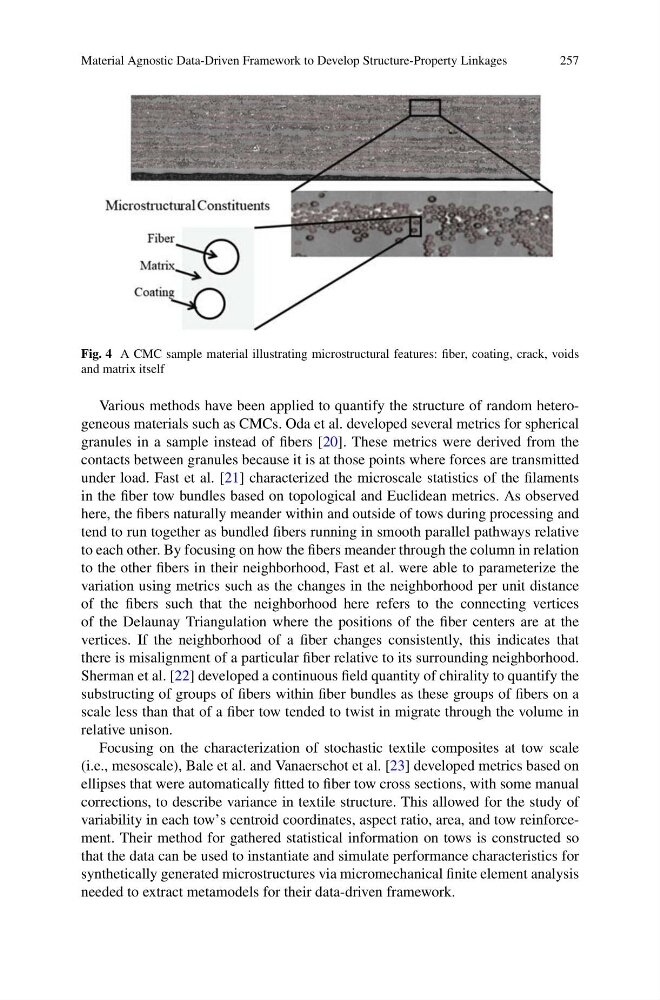
Fig. 4 A CMC sample material illustrating microstructural features: fiber, coating, crack, voids
and matrix itself
Various methods have been applied to quantify the structure of random heterogeneous materials such as CMCs. Oda et al. developed several metrics for spherical
granules in a sample instead of fibers [20]. These metrics were derived from the
contacts between granules because it is at those points where forces are transmitted
under load. Fast et al. [21] characterized the microscale statistics of the filaments
in the fiber tow bundles based on topological and Euclidean metrics. As observed
here, the fibers naturally meander within and outside of tows during processing and
tend to run together as bundled fibers running in smooth parallel pathways relative
to each other. By focusing on how the fibers meander through the column in relation
to the other fibers in their neighborhood, Fast et al. were able to parameterize the
variation using metrics such as the changes in the neighborhood per unit distance
of the fibers such that the neighborhood here refers to the connecting vertices
of the Delaunay Triangulation where the positions of the fiber centers are at the
vertices. If the neighborhood of a fiber changes consistently, this indicates that
there is misalignment of a particular fiber relative to its surrounding neighborhood.
Sherman et al. [22] developed a continuous field quantity of chirality to quantify the
substructing of groups of fibers within fiber bundles as these groups of fibers on a
scale less than that of a fiber tow tended to twist in migrate through the volume in
relative unison.
Focusing on the characterization of stochastic textile composites at tow scale
(i.e., mesoscale), Bale et al. and Vanaerschot et al. [23] developed metrics based on
ellipses that were automatically fitted to fiber tow cross sections, with some manual
corrections, to describe variance in textile structure. This allowed for the study of
variability in each tow’s centroid coordinates, aspect ratio, area, and tow reinforcement. Their method for gathered statistical information on tows is constructed so
that the data can be used to instantiate and simulate performance characteristics for
synthetically generated microstructures via micromechanical finite element analysis
needed to extract metamodels for their data-driven framework.
257
Fig. 4 A CMC sample material illustrating microstructural features: fiber, coating, crack, voids
and matrix itself
Various methods have been applied to quantify the structure of random heterogeneous materials such as CMCs. Oda et al. developed several metrics for spherical
granules in a sample instead of fibers [20]. These metrics were derived from the
contacts between granules because it is at those points where forces are transmitted
under load. Fast et al. [21] characterized the microscale statistics of the filaments
in the fiber tow bundles based on topological and Euclidean metrics. As observed
here, the fibers naturally meander within and outside of tows during processing and
tend to run together as bundled fibers running in smooth parallel pathways relative
to each other. By focusing on how the fibers meander through the column in relation
to the other fibers in their neighborhood, Fast et al. were able to parameterize the
variation using metrics such as the changes in the neighborhood per unit distance
of the fibers such that the neighborhood here refers to the connecting vertices
of the Delaunay Triangulation where the positions of the fiber centers are at the
vertices. If the neighborhood of a fiber changes consistently, this indicates that
there is misalignment of a particular fiber relative to its surrounding neighborhood.
Sherman et al. [22] developed a continuous field quantity of chirality to quantify the
substructing of groups of fibers within fiber bundles as these groups of fibers on a
scale less than that of a fiber tow tended to twist in migrate through the volume in
relative unison.
Focusing on the characterization of stochastic textile composites at tow scale
(i.e., mesoscale), Bale et al. and Vanaerschot et al. [23] developed metrics based on
ellipses that were automatically fitted to fiber tow cross sections, with some manual
corrections, to describe variance in textile structure. This allowed for the study of
variability in each tow’s centroid coordinates, aspect ratio, area, and tow reinforcement. Their method for gathered statistical information on tows is constructed so
that the data can be used to instantiate and simulate performance characteristics for
synthetically generated microstructures via micromechanical finite element analysis
needed to extract metamodels for their data-driven framework.