

Local Stress and Damage Response of Polycrystal Materials to Light Shock. . .
211
The thermal expansion coefficient is given by
A ij = αδ ij .
(33)
The plastic velocity gradient is given as a function of the plastic slip rates ˙
γ α on
the α slip systems
L
p
= ˙
F
p F
p −1 =
α
˙
γ
α S
α
0 ,
(34)
where the Schmid tensor in the reference configuration via the slip direction m α
0 and
slip plane normal n α
0 is given by
S
α
0 = m
α
0 ⊗ n
α
0 .
(35)
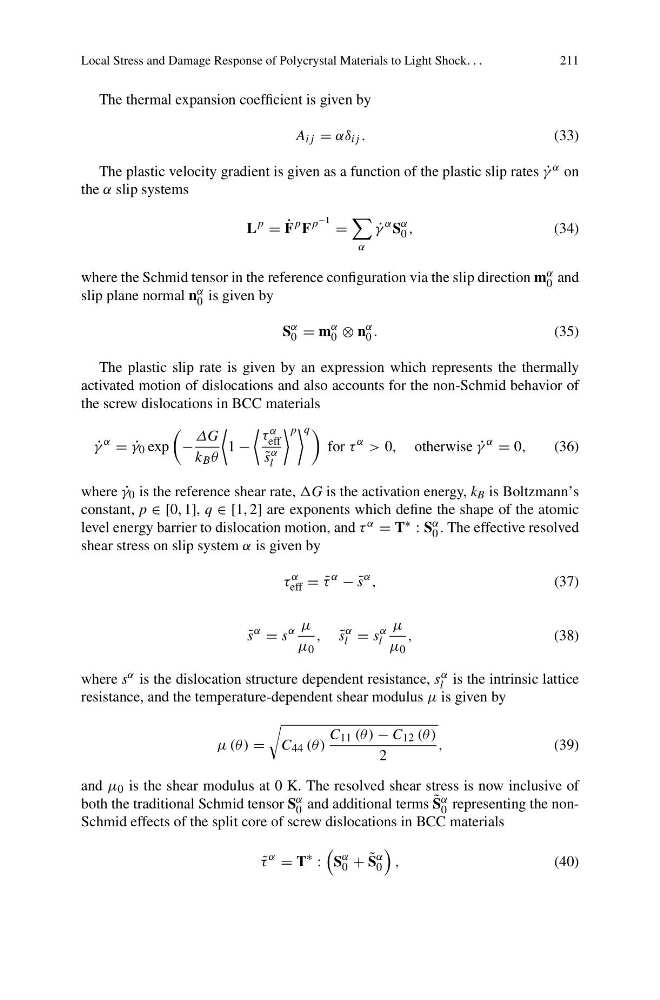
The plastic slip rate is given by an expression which represents the thermally
activated motion of dislocations and also accounts for the non-Schmid behavior of
the screw dislocations in BCC materials
˙
γ
α
= ˙
γ 0 exp
−
ΔG
k B θ
1 −
τ α
eff
˜
s α
l
p q
for τ
α > 0, otherwise ˙
γ
α
= 0,
(36)
where ˙
γ 0 is the reference shear rate, G is the activation energy, k B is Boltzmann’s
constant, p ∈ [0, 1], q ∈ [1, 2] are exponents which define the shape of the atomic
level energy barrier to dislocation motion, and τ α = T ∗ : S α
0 . The effective resolved
shear stress on slip system α is given by
τ
α
eff = ˜
τ
α
− ˜
s
α ,
(37)
˜
s
α
= s
α μ
μ 0
, ˜
s
α
l = s
α
l
μ
μ 0
,
(38)
where s α is the dislocation structure dependent resistance, s α
l is the intrinsic lattice
resistance, and the temperature-dependent shear modulus μ is given by
μ (θ ) =
C 44 (θ )
C 11 (θ ) − C 12 (θ )
2
,
(39)
and μ 0 is the shear modulus at 0 K. The resolved shear stress is now inclusive of
both the traditional Schmid tensor S α
0 and additional terms ˜
S α
0 representing the nonSchmid effects of the split core of screw dislocations in BCC materials
˜
τ
α
= T
∗
:
S
α
0 + ˜
S
α
0
,
(40)
211
The thermal expansion coefficient is given by
A ij = αδ ij .
(33)
The plastic velocity gradient is given as a function of the plastic slip rates ˙
γ α on
the α slip systems
L
p
= ˙
F
p F
p −1 =
α
˙
γ
α S
α
0 ,
(34)
where the Schmid tensor in the reference configuration via the slip direction m α
0 and
slip plane normal n α
0 is given by
S
α
0 = m
α
0 ⊗ n
α
0 .
(35)
The plastic slip rate is given by an expression which represents the thermally
activated motion of dislocations and also accounts for the non-Schmid behavior of
the screw dislocations in BCC materials
˙
γ
α
= ˙
γ 0 exp
−
ΔG
k B θ
1 −
τ α
eff
˜
s α
l
p q
for τ
α > 0, otherwise ˙
γ
α
= 0,
(36)
where ˙
γ 0 is the reference shear rate, G is the activation energy, k B is Boltzmann’s
constant, p ∈ [0, 1], q ∈ [1, 2] are exponents which define the shape of the atomic
level energy barrier to dislocation motion, and τ α = T ∗ : S α
0 . The effective resolved
shear stress on slip system α is given by
τ
α
eff = ˜
τ
α
− ˜
s
α ,
(37)
˜
s
α
= s
α μ
μ 0
, ˜
s
α
l = s
α
l
μ
μ 0
,
(38)
where s α is the dislocation structure dependent resistance, s α
l is the intrinsic lattice
resistance, and the temperature-dependent shear modulus μ is given by
μ (θ ) =
C 44 (θ )
C 11 (θ ) − C 12 (θ )
2
,
(39)
and μ 0 is the shear modulus at 0 K. The resolved shear stress is now inclusive of
both the traditional Schmid tensor S α
0 and additional terms ˜
S α
0 representing the nonSchmid effects of the split core of screw dislocations in BCC materials
˜
τ
α
= T
∗
:
S
α
0 + ˜
S
α
0
,
(40)