

134
A. Cruzado et al.
(a)
(b)
0
0.05
0.1
0.15
0.2
0.25
0.3
0
0.2
0.4
0.6
0.8
1
1.2
1.4
0
0.05
0.1
0.15
0.2
0.25
0.3
0
0.2
0.4
0.6
0.8
1
1.2
1.4
0
0.05
0.1
0.15
0.2
0.25
0.3
0
0.2
0.4
0.6
0.8
1
1.2
1.4
(c)
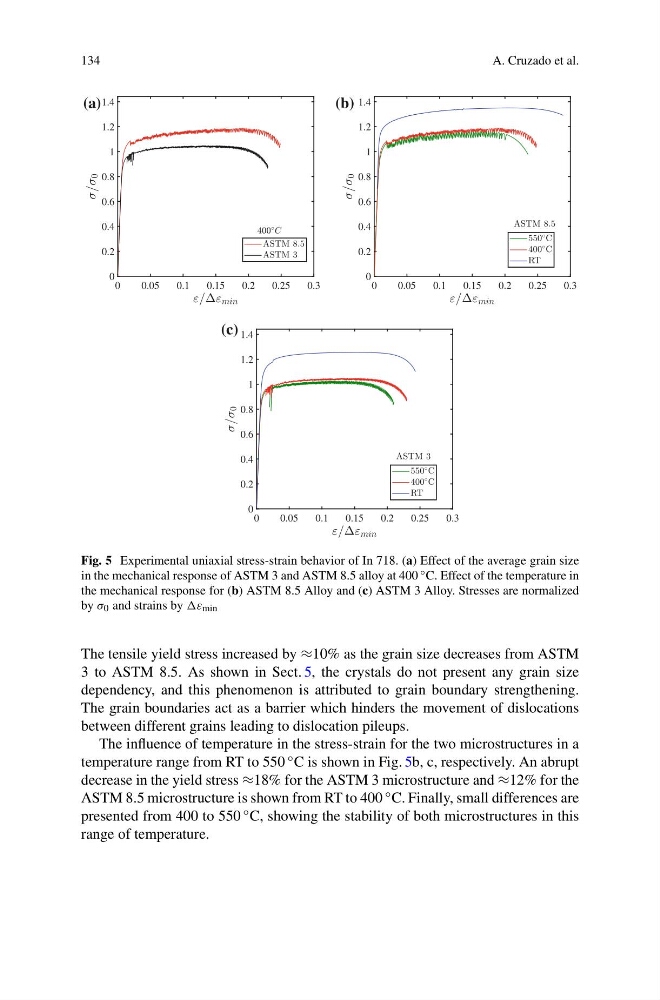
Fig. 5 Experimental uniaxial stress-strain behavior of In 718. (a) Effect of the average grain size
in the mechanical response of ASTM 3 and ASTM 8.5 alloy at 400 ◦ C. Effect of the temperature in
the mechanical response for (b) ASTM 8.5 Alloy and (c) ASTM 3 Alloy. Stresses are normalized
by σ 0 and strains by ε min
The tensile yield stress increased by ≈10% as the grain size decreases from ASTM
3 to ASTM 8.5. As shown in Sect. 5, the crystals do not present any grain size
dependency, and this phenomenon is attributed to grain boundary strengthening.
The grain boundaries act as a barrier which hinders the movement of dislocations
between different grains leading to dislocation pileups.
The influence of temperature in the stress-strain for the two microstructures in a
temperature range from RT to 550 ◦ C is shown in Fig. 5b, c, respectively. An abrupt
decrease in the yield stress ≈18% for the ASTM 3 microstructure and ≈12% for the
ASTM 8.5 microstructure is shown from RT to 400 ◦ C. Finally, small differences are
presented from 400 to 550 ◦ C, showing the stability of both microstructures in this
range of temperature.
A. Cruzado et al.
(a)
(b)
0
0.05
0.1
0.15
0.2
0.25
0.3
0
0.2
0.4
0.6
0.8
1
1.2
1.4
0
0.05
0.1
0.15
0.2
0.25
0.3
0
0.2
0.4
0.6
0.8
1
1.2
1.4
0
0.05
0.1
0.15
0.2
0.25
0.3
0
0.2
0.4
0.6
0.8
1
1.2
1.4
(c)
Fig. 5 Experimental uniaxial stress-strain behavior of In 718. (a) Effect of the average grain size
in the mechanical response of ASTM 3 and ASTM 8.5 alloy at 400 ◦ C. Effect of the temperature in
the mechanical response for (b) ASTM 8.5 Alloy and (c) ASTM 3 Alloy. Stresses are normalized
by σ 0 and strains by ε min
The tensile yield stress increased by ≈10% as the grain size decreases from ASTM
3 to ASTM 8.5. As shown in Sect. 5, the crystals do not present any grain size
dependency, and this phenomenon is attributed to grain boundary strengthening.
The grain boundaries act as a barrier which hinders the movement of dislocations
between different grains leading to dislocation pileups.
The influence of temperature in the stress-strain for the two microstructures in a
temperature range from RT to 550 ◦ C is shown in Fig. 5b, c, respectively. An abrupt
decrease in the yield stress ≈18% for the ASTM 3 microstructure and ≈12% for the
ASTM 8.5 microstructure is shown from RT to 400 ◦ C. Finally, small differences are
presented from 400 to 550 ◦ C, showing the stability of both microstructures in this
range of temperature.