

5.3. Applications of directed networks
63
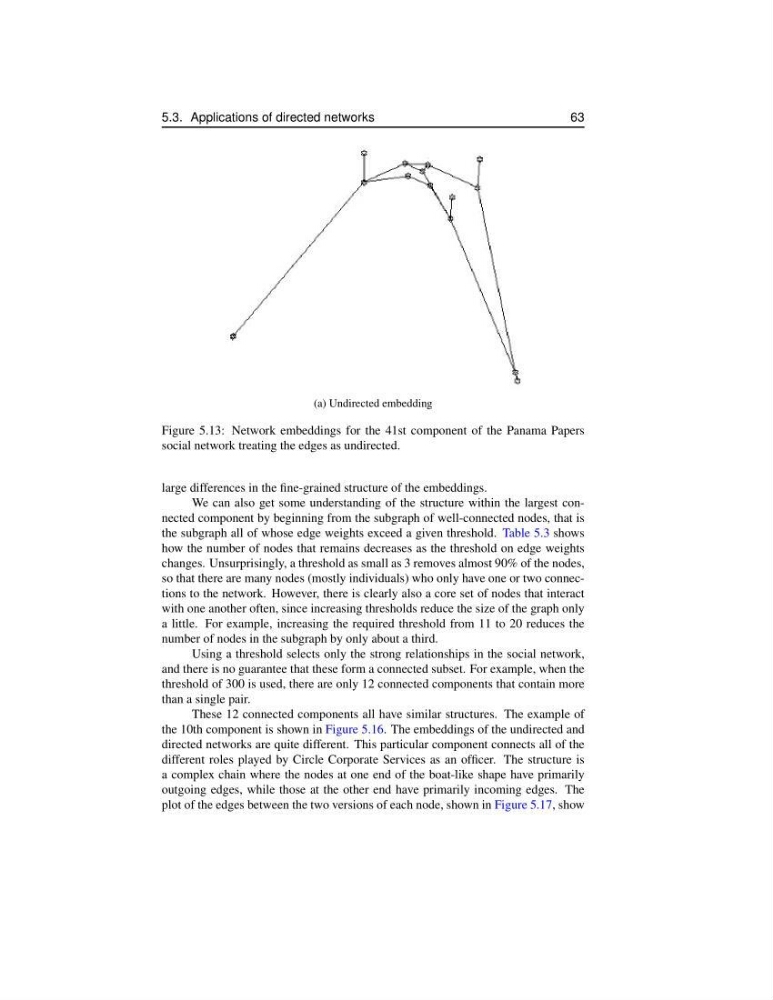
(a) Undirected embedding
Figure 5.13: Network embeddings for the 41st component of the Panama Papers
social network treating the edges as undirected.
large differences in the fine-grained structure of the embeddings.
We can also get some understanding of the structure within the largest connected component by beginning from the subgraph of well-connected nodes, that is
the subgraph all of whose edge weights exceed a given threshold. Table 5.3 shows
how the number of nodes that remains decreases as the threshold on edge weights
changes. Unsurprisingly, a threshold as small as 3 removes almost 90% of the nodes,
so that there are many nodes (mostly individuals) who only have one or two connections to the network. However, there is clearly also a core set of nodes that interact
with one another often, since increasing thresholds reduce the size of the graph only
a little. For example, increasing the required threshold from 11 to 20 reduces the
number of nodes in the subgraph by only about a third.
Using a threshold selects only the strong relationships in the social network,
and there is no guarantee that these form a connected subset. For example, when the
threshold of 300 is used, there are only 12 connected components that contain more
than a single pair.
These 12 connected components all have similar structures. The example of
the 10th component is shown in Figure 5.16. The embeddings of the undirected and
directed networks are quite different. This particular component connects all of the
different roles played by Circle Corporate Services as an officer. The structure is
a complex chain where the nodes at one end of the boat-like shape have primarily
outgoing edges, while those at the other end have primarily incoming edges. The
plot of the edges between the two versions of each node, shown in Figure 5.17, show
63
(a) Undirected embedding
Figure 5.13: Network embeddings for the 41st component of the Panama Papers
social network treating the edges as undirected.
large differences in the fine-grained structure of the embeddings.
We can also get some understanding of the structure within the largest connected component by beginning from the subgraph of well-connected nodes, that is
the subgraph all of whose edge weights exceed a given threshold. Table 5.3 shows
how the number of nodes that remains decreases as the threshold on edge weights
changes. Unsurprisingly, a threshold as small as 3 removes almost 90% of the nodes,
so that there are many nodes (mostly individuals) who only have one or two connections to the network. However, there is clearly also a core set of nodes that interact
with one another often, since increasing thresholds reduce the size of the graph only
a little. For example, increasing the required threshold from 11 to 20 reduces the
number of nodes in the subgraph by only about a third.
Using a threshold selects only the strong relationships in the social network,
and there is no guarantee that these form a connected subset. For example, when the
threshold of 300 is used, there are only 12 connected components that contain more
than a single pair.
These 12 connected components all have similar structures. The example of
the 10th component is shown in Figure 5.16. The embeddings of the undirected and
directed networks are quite different. This particular component connects all of the
different roles played by Circle Corporate Services as an officer. The structure is
a complex chain where the nodes at one end of the boat-like shape have primarily
outgoing edges, while those at the other end have primarily incoming edges. The
plot of the edges between the two versions of each node, shown in Figure 5.17, show