

4.3. Applications of typed networks
35
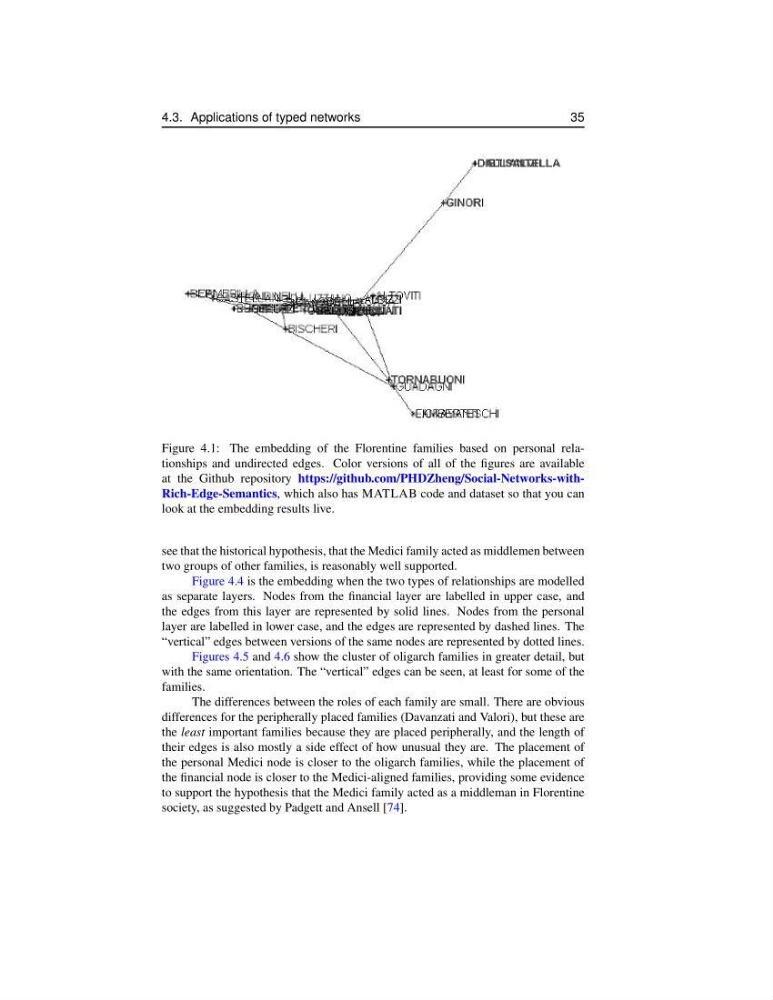
Figure 4.1: The embedding of the Florentine families based on personal relationships and undirected edges. Color versions of all of the figures are available
at the Github repository https://github.com/PHDZheng/Social-Networks-withRich-Edge-Semantics, which also has MATLAB code and dataset so that you can
look at the embedding results live.
see that the historical hypothesis, that the Medici family acted as middlemen between
two groups of other families, is reasonably well supported.
Figure 4.4 is the embedding when the two types of relationships are modelled
as separate layers. Nodes from the financial layer are labelled in upper case, and
the edges from this layer are represented by solid lines. Nodes from the personal
layer are labelled in lower case, and the edges are represented by dashed lines. The
“vertical” edges between versions of the same nodes are represented by dotted lines.
Figures 4.5 and 4.6 show the cluster of oligarch families in greater detail, but
with the same orientation. The “vertical” edges can be seen, at least for some of the
families.
The differences between the roles of each family are small. There are obvious
differences for the peripherally placed families (Davanzati and Valori), but these are
the least important families because they are placed peripherally, and the length of
their edges is also mostly a side effect of how unusual they are. The placement of
the personal Medici node is closer to the oligarch families, while the placement of
the financial node is closer to the Medici-aligned families, providing some evidence
to support the hypothesis that the Medici family acted as a middleman in Florentine
society, as suggested by Padgett and Ansell [74].
35
Figure 4.1: The embedding of the Florentine families based on personal relationships and undirected edges. Color versions of all of the figures are available
at the Github repository https://github.com/PHDZheng/Social-Networks-withRich-Edge-Semantics, which also has MATLAB code and dataset so that you can
look at the embedding results live.
see that the historical hypothesis, that the Medici family acted as middlemen between
two groups of other families, is reasonably well supported.
Figure 4.4 is the embedding when the two types of relationships are modelled
as separate layers. Nodes from the financial layer are labelled in upper case, and
the edges from this layer are represented by solid lines. Nodes from the personal
layer are labelled in lower case, and the edges are represented by dashed lines. The
“vertical” edges between versions of the same nodes are represented by dotted lines.
Figures 4.5 and 4.6 show the cluster of oligarch families in greater detail, but
with the same orientation. The “vertical” edges can be seen, at least for some of the
families.
The differences between the roles of each family are small. There are obvious
differences for the peripherally placed families (Davanzati and Valori), but these are
the least important families because they are placed peripherally, and the length of
their edges is also mostly a side effect of how unusual they are. The placement of
the personal Medici node is closer to the oligarch families, while the placement of
the financial node is closer to the Medici-aligned families, providing some evidence
to support the hypothesis that the Medici family acted as a middleman in Florentine
society, as suggested by Padgett and Ansell [74].