

34
Chapter 4. Modelling relationships of different types
Medici bloc
Oligarch bloc Oligarch bloc
Medici
Bischeri
Guadagni
Fioravanti
Ardinghelli
Da Uzzano
Dietsalvi
Altoviti
Solosmei
Davanzati
Rondinelli
Guasconi
Orlandini
Pepi
Castellani
Cocco-Donati
Peruzzi
Scambrilla
Valori
Benizzi
Strozzi
Guicciardini
Panciatichi
Aldobrandini
Ginori
Rucellai
Lamberteschi
Tornabuoni
Baroncelli
Dall’Antella, Albizzi, Della Casa, Velluti
with divided loyalties.
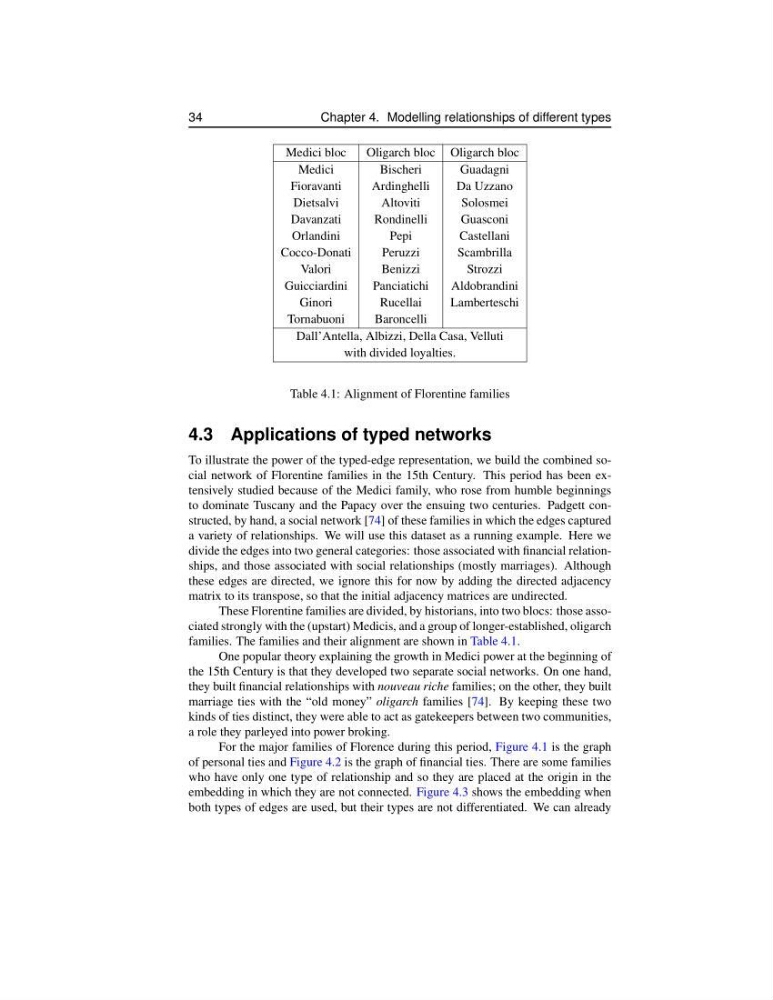
Table 4.1: Alignment of Florentine families
4.3 Applications of typed networks
To illustrate the power of the typed-edge representation, we build the combined social network of Florentine families in the 15th Century. This period has been extensively studied because of the Medici family, who rose from humble beginnings
to dominate Tuscany and the Papacy over the ensuing two centuries. Padgett constructed, by hand, a social network [74] of these families in which the edges captured
a variety of relationships. We will use this dataset as a running example. Here we
divide the edges into two general categories: those associated with financial relationships, and those associated with social relationships (mostly marriages). Although
these edges are directed, we ignore this for now by adding the directed adjacency
matrix to its transpose, so that the initial adjacency matrices are undirected.
These Florentine families are divided, by historians, into two blocs: those associated strongly with the (upstart) Medicis, and a group of longer-established, oligarch
families. The families and their alignment are shown in Table 4.1.
One popular theory explaining the growth in Medici power at the beginning of
the 15th Century is that they developed two separate social networks. On one hand,
they built financial relationships with nouveau riche families; on the other, they built
marriage ties with the “old money” oligarch families [74]. By keeping these two
kinds of ties distinct, they were able to act as gatekeepers between two communities,
a role they parleyed into power broking.
For the major families of Florence during this period, Figure 4.1 is the graph
of personal ties and Figure 4.2 is the graph of financial ties. There are some families
who have only one type of relationship and so they are placed at the origin in the
embedding in which they are not connected. Figure 4.3 shows the embedding when
both types of edges are used, but their types are not differentiated. We can already
Chapter 4. Modelling relationships of different types
Medici bloc
Oligarch bloc Oligarch bloc
Medici
Bischeri
Guadagni
Fioravanti
Ardinghelli
Da Uzzano
Dietsalvi
Altoviti
Solosmei
Davanzati
Rondinelli
Guasconi
Orlandini
Pepi
Castellani
Cocco-Donati
Peruzzi
Scambrilla
Valori
Benizzi
Strozzi
Guicciardini
Panciatichi
Aldobrandini
Ginori
Rucellai
Lamberteschi
Tornabuoni
Baroncelli
Dall’Antella, Albizzi, Della Casa, Velluti
with divided loyalties.
Table 4.1: Alignment of Florentine families
4.3 Applications of typed networks
To illustrate the power of the typed-edge representation, we build the combined social network of Florentine families in the 15th Century. This period has been extensively studied because of the Medici family, who rose from humble beginnings
to dominate Tuscany and the Papacy over the ensuing two centuries. Padgett constructed, by hand, a social network [74] of these families in which the edges captured
a variety of relationships. We will use this dataset as a running example. Here we
divide the edges into two general categories: those associated with financial relationships, and those associated with social relationships (mostly marriages). Although
these edges are directed, we ignore this for now by adding the directed adjacency
matrix to its transpose, so that the initial adjacency matrices are undirected.
These Florentine families are divided, by historians, into two blocs: those associated strongly with the (upstart) Medicis, and a group of longer-established, oligarch
families. The families and their alignment are shown in Table 4.1.
One popular theory explaining the growth in Medici power at the beginning of
the 15th Century is that they developed two separate social networks. On one hand,
they built financial relationships with nouveau riche families; on the other, they built
marriage ties with the “old money” oligarch families [74]. By keeping these two
kinds of ties distinct, they were able to act as gatekeepers between two communities,
a role they parleyed into power broking.
For the major families of Florence during this period, Figure 4.1 is the graph
of personal ties and Figure 4.2 is the graph of financial ties. There are some families
who have only one type of relationship and so they are placed at the origin in the
embedding in which they are not connected. Figure 4.3 shows the embedding when
both types of edges are used, but their types are not differentiated. We can already