

10.1. Composition of directed and signed layer models
141
Equation 10.1 adds the horizontal (dashed) edges in Figure 10.1 by the entries added
to the major diagonal submatrices, and adds the vertical (solid) edges by the submatrices on the minor diagonal. Equation 10.2 adds the diagonal (dotted) edges in
Figure 10.1.
Let
DP and
DN be the matrices whose diagonals are the row sums of the absolute values of the positive and negative entries of M, respectively. Let
D be the sum
of
DP and
DN. Then the desired Laplacian matrix is
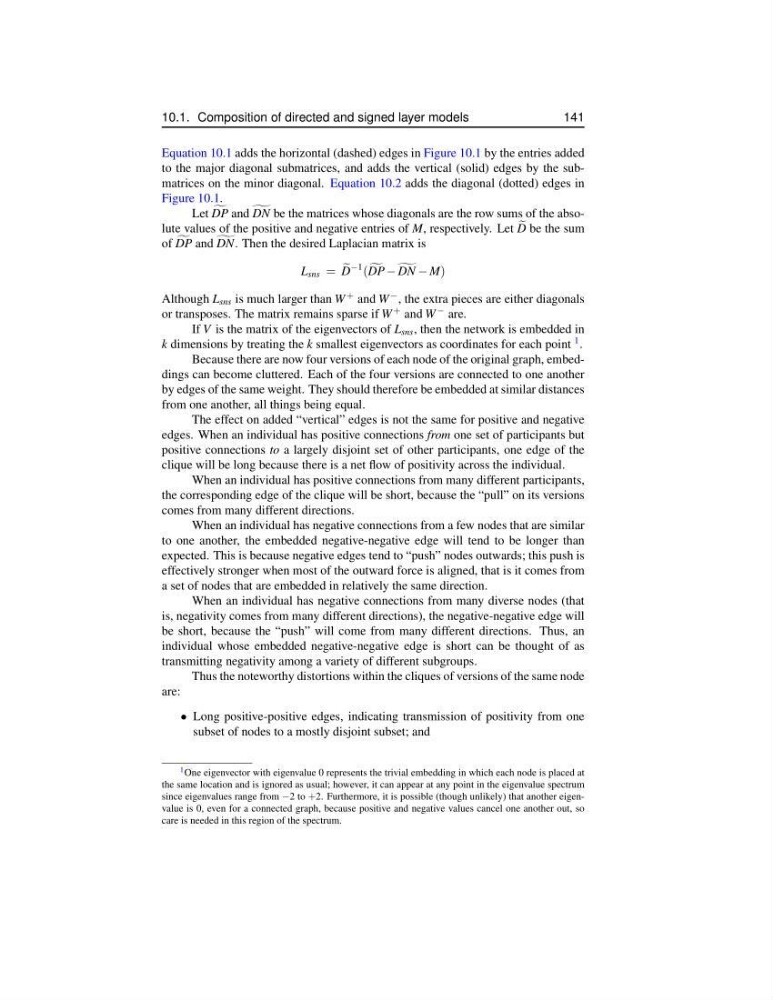
L sns =
D
−1 (
DP −
DN − M)
Although L sns is much larger than W + and W − , the extra pieces are either diagonals
or transposes. The matrix remains sparse if W + and W − are.
If V is the matrix of the eigenvectors of L sns , then the network is embedded in
k dimensions by treating the k smallest eigenvectors as coordinates for each point 1 .
Because there are now four versions of each node of the original graph, embeddings can become cluttered. Each of the four versions are connected to one another
by edges of the same weight. They should therefore be embedded at similar distances
from one another, all things being equal.
The effect on added “vertical” edges is not the same for positive and negative
edges. When an individual has positive connections from one set of participants but
positive connections to a largely disjoint set of other participants, one edge of the
clique will be long because there is a net flow of positivity across the individual.
When an individual has positive connections from many different participants,
the corresponding edge of the clique will be short, because the “pull” on its versions
comes from many different directions.
When an individual has negative connections from a few nodes that are similar
to one another, the embedded negative-negative edge will tend to be longer than
expected. This is because negative edges tend to “push” nodes outwards; this push is
effectively stronger when most of the outward force is aligned, that is it comes from
a set of nodes that are embedded in relatively the same direction.
When an individual has negative connections from many diverse nodes (that
is, negativity comes from many different directions), the negative-negative edge will
be short, because the “push” will come from many different directions. Thus, an
individual whose embedded negative-negative edge is short can be thought of as
transmitting negativity among a variety of different subgroups.
Thus the noteworthy distortions within the cliques of versions of the same node
are:
• Long positive-positive edges, indicating transmission of positivity from one
subset of nodes to a mostly disjoint subset; and
1 One eigenvector with eigenvalue 0 represents the trivial embedding in which each node is placed at
the same location and is ignored as usual; however, it can appear at any point in the eigenvalue spectrum
since eigenvalues range from −2 to +2. Furthermore, it is possible (though unlikely) that another eigenvalue is 0, even for a connected graph, because positive and negative values cancel one another out, so
care is needed in this region of the spectrum.
141
Equation 10.1 adds the horizontal (dashed) edges in Figure 10.1 by the entries added
to the major diagonal submatrices, and adds the vertical (solid) edges by the submatrices on the minor diagonal. Equation 10.2 adds the diagonal (dotted) edges in
Figure 10.1.
Let
DP and
DN be the matrices whose diagonals are the row sums of the absolute values of the positive and negative entries of M, respectively. Let
D be the sum
of
DP and
DN. Then the desired Laplacian matrix is
L sns =
D
−1 (
DP −
DN − M)
Although L sns is much larger than W + and W − , the extra pieces are either diagonals
or transposes. The matrix remains sparse if W + and W − are.
If V is the matrix of the eigenvectors of L sns , then the network is embedded in
k dimensions by treating the k smallest eigenvectors as coordinates for each point 1 .
Because there are now four versions of each node of the original graph, embeddings can become cluttered. Each of the four versions are connected to one another
by edges of the same weight. They should therefore be embedded at similar distances
from one another, all things being equal.
The effect on added “vertical” edges is not the same for positive and negative
edges. When an individual has positive connections from one set of participants but
positive connections to a largely disjoint set of other participants, one edge of the
clique will be long because there is a net flow of positivity across the individual.
When an individual has positive connections from many different participants,
the corresponding edge of the clique will be short, because the “pull” on its versions
comes from many different directions.
When an individual has negative connections from a few nodes that are similar
to one another, the embedded negative-negative edge will tend to be longer than
expected. This is because negative edges tend to “push” nodes outwards; this push is
effectively stronger when most of the outward force is aligned, that is it comes from
a set of nodes that are embedded in relatively the same direction.
When an individual has negative connections from many diverse nodes (that
is, negativity comes from many different directions), the negative-negative edge will
be short, because the “push” will come from many different directions. Thus, an
individual whose embedded negative-negative edge is short can be thought of as
transmitting negativity among a variety of different subgroups.
Thus the noteworthy distortions within the cliques of versions of the same node
are:
• Long positive-positive edges, indicating transmission of positivity from one
subset of nodes to a mostly disjoint subset; and
1 One eigenvector with eigenvalue 0 represents the trivial embedding in which each node is placed at
the same location and is ignored as usual; however, it can appear at any point in the eigenvalue spectrum
since eigenvalues range from −2 to +2. Furthermore, it is possible (though unlikely) that another eigenvalue is 0, even for a connected graph, because positive and negative values cancel one another out, so
care is needed in this region of the spectrum.