

8.4. Applications of signed networks
113
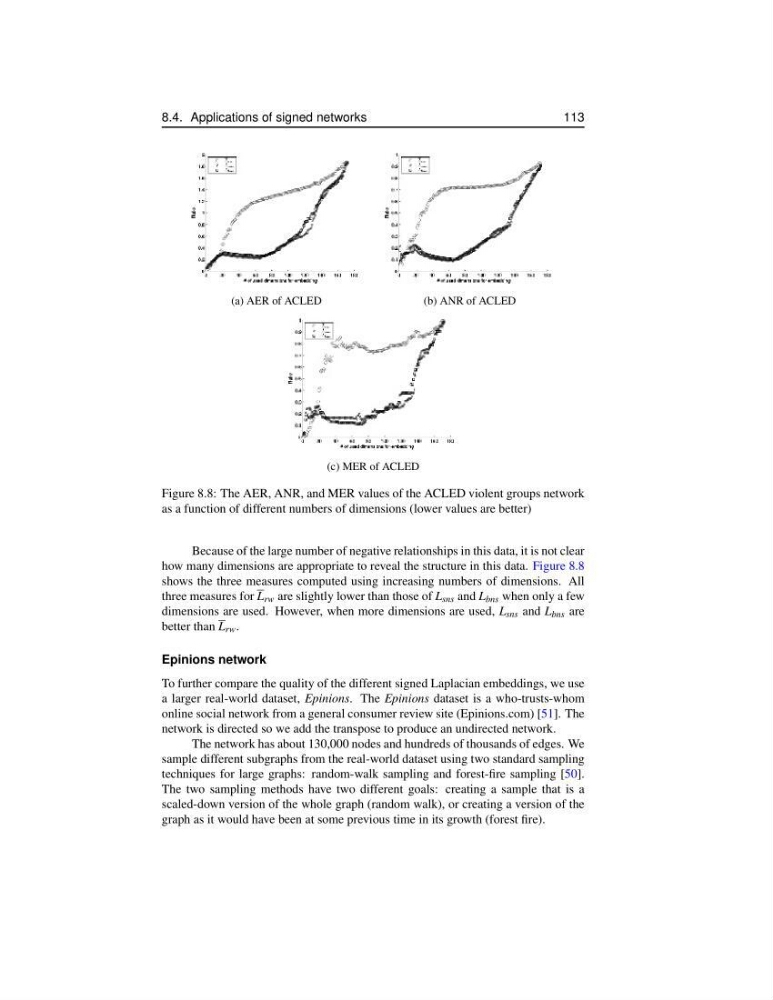
(a) AER of ACLED
(b) ANR of ACLED
(c) MER of ACLED
Figure 8.8: The AER, ANR, and MER values of the ACLED violent groups network
as a function of different numbers of dimensions (lower values are better)
Because of the large number of negative relationships in this data, it is not clear
how many dimensions are appropriate to reveal the structure in this data. Figure 8.8
shows the three measures computed using increasing numbers of dimensions. All
three measures for L rw are slightly lower than those of L sns and L bns when only a few
dimensions are used. However, when more dimensions are used, L sns and L bns are
better than L rw .
Epinions network
To further compare the quality of the different signed Laplacian embeddings, we use
a larger real-world dataset, Epinions. The Epinions dataset is a who-trusts-whom
online social network from a general consumer review site (Epinions.com) [51]. The
network is directed so we add the transpose to produce an undirected network.
The network has about 130,000 nodes and hundreds of thousands of edges. We
sample different subgraphs from the real-world dataset using two standard sampling
techniques for large graphs: random-walk sampling and forest-fire sampling [50].
The two sampling methods have two different goals: creating a sample that is a
scaled-down version of the whole graph (random walk), or creating a version of the
graph as it would have been at some previous time in its growth (forest fire).
113
(a) AER of ACLED
(b) ANR of ACLED
(c) MER of ACLED
Figure 8.8: The AER, ANR, and MER values of the ACLED violent groups network
as a function of different numbers of dimensions (lower values are better)
Because of the large number of negative relationships in this data, it is not clear
how many dimensions are appropriate to reveal the structure in this data. Figure 8.8
shows the three measures computed using increasing numbers of dimensions. All
three measures for L rw are slightly lower than those of L sns and L bns when only a few
dimensions are used. However, when more dimensions are used, L sns and L bns are
better than L rw .
Epinions network
To further compare the quality of the different signed Laplacian embeddings, we use
a larger real-world dataset, Epinions. The Epinions dataset is a who-trusts-whom
online social network from a general consumer review site (Epinions.com) [51]. The
network is directed so we add the transpose to produce an undirected network.
The network has about 130,000 nodes and hundreds of thousands of edges. We
sample different subgraphs from the real-world dataset using two standard sampling
techniques for large graphs: random-walk sampling and forest-fire sampling [50].
The two sampling methods have two different goals: creating a sample that is a
scaled-down version of the whole graph (random walk), or creating a version of the
graph as it would have been at some previous time in its growth (forest fire).