

74
Compact Models for Integrated Circuit Design
C
K
W
j
si
d
=
ε 0
(2.135)
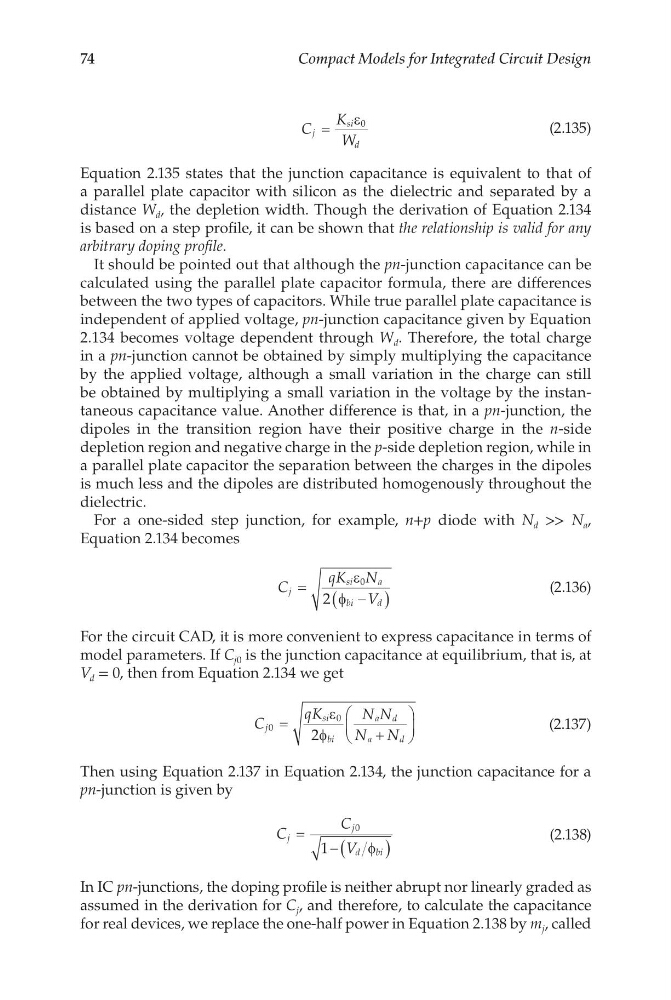
Equation 2.135 states that the junction capacitance is equivalent to that of
a parallel plate capacitor with silicon as the dielectric and separated by a
distance W d , the depletion width. Though the derivation of Equation 2.134
is based on a step profile, it can be shown that the relationship is valid for any
arbitrary doping profile.
It should be pointed out that although the pn-junction capacitance can be
calculated using the parallel plate capacitor formula, there are differences
between the two types of capacitors. While true parallel plate capacitance is
independent of applied voltage, pn-junction capacitance given by Equation
2.134 becomes voltage dependent through W d . Therefore, the total charge
in a pn-junction cannot be obtained by simply multiplying the capacitance
by the applied voltage, although a small variation in the charge can still
be obtained by multiplying a small variation in the voltage by the instantaneous capacitance value. Another difference is that, in a pn-junction, the
dipoles in the transition region have their positive charge in the n-side
depletion region and negative charge in the p-side depletion region, while in
a parallel plate capacitor the separation between the charges in the dipoles
is much less and the dipoles are distributed homogenously throughout the
dielectric.
For a one-sided step junction, for example, n+p diode with N d >> N a ,
Equation 2.134 becomes
C
qK N
V
j
si
a
bi
d
=
−
(
)
ε
φ
0
2
(2.136)
For the circuit CAD, it is more convenient to express capacitance in terms of
model parameters. If C j0 is the junction capacitance at equilibrium, that is, at
V d = 0, then from Equation 2.134 we get
C
qK
N N
N N
j
si
bi
a d
a
d
0
0
2
=
+
ε
φ
(2.137)
Then using Equation 2.137 in Equation 2.134, the junction capacitance for a
pn-junction is given by
C
C
V
j
j
d
bi
=
− (
)
0
1
φ
(2.138)
In IC pn-junctions, the doping profile is neither abrupt nor linearly graded as
assumed in the derivation for C j , and therefore, to calculate the capacitance
for real devices, we replace the one-half power in Equation 2.138 by m j , called
Compact Models for Integrated Circuit Design
C
K
W
j
si
d
=
ε 0
(2.135)
Equation 2.135 states that the junction capacitance is equivalent to that of
a parallel plate capacitor with silicon as the dielectric and separated by a
distance W d , the depletion width. Though the derivation of Equation 2.134
is based on a step profile, it can be shown that the relationship is valid for any
arbitrary doping profile.
It should be pointed out that although the pn-junction capacitance can be
calculated using the parallel plate capacitor formula, there are differences
between the two types of capacitors. While true parallel plate capacitance is
independent of applied voltage, pn-junction capacitance given by Equation
2.134 becomes voltage dependent through W d . Therefore, the total charge
in a pn-junction cannot be obtained by simply multiplying the capacitance
by the applied voltage, although a small variation in the charge can still
be obtained by multiplying a small variation in the voltage by the instantaneous capacitance value. Another difference is that, in a pn-junction, the
dipoles in the transition region have their positive charge in the n-side
depletion region and negative charge in the p-side depletion region, while in
a parallel plate capacitor the separation between the charges in the dipoles
is much less and the dipoles are distributed homogenously throughout the
dielectric.
For a one-sided step junction, for example, n+p diode with N d >> N a ,
Equation 2.134 becomes
C
qK N
V
j
si
a
bi
d
=
−
(
)
ε
φ
0
2
(2.136)
For the circuit CAD, it is more convenient to express capacitance in terms of
model parameters. If C j0 is the junction capacitance at equilibrium, that is, at
V d = 0, then from Equation 2.134 we get
C
qK
N N
N N
j
si
bi
a d
a
d
0
0
2
=
+
ε
φ
(2.137)
Then using Equation 2.137 in Equation 2.134, the junction capacitance for a
pn-junction is given by
C
C
V
j
j
d
bi
=
− (
)
0
1
φ
(2.138)
In IC pn-junctions, the doping profile is neither abrupt nor linearly graded as
assumed in the derivation for C j , and therefore, to calculate the capacitance
for real devices, we replace the one-half power in Equation 2.138 by m j , called