

407
Bipolar Junction Transistor Compact Models
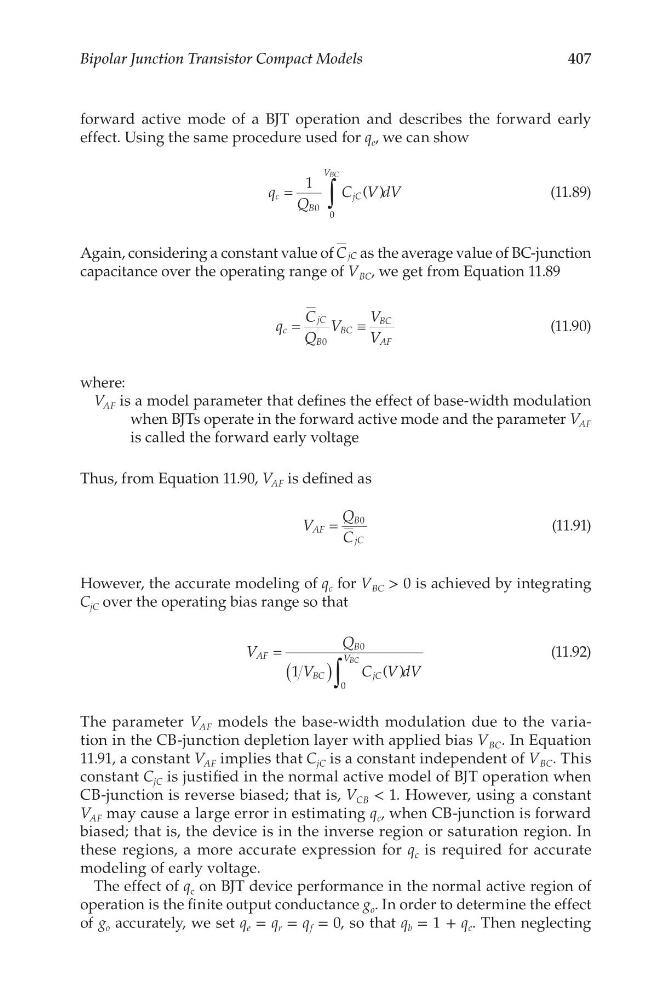
forward active mode of a BJT operation and describes the forward early
effect. Using the same procedure used for q e , we can show
q Q
C V dV
c
B
jC
VBC
=
∫
1
0 0
( )
(11.89)
Again, considering a constant value of CjC as the average value of BC-junction
capacitance over the operating range of V BC , we get from Equation 11.89
q
C
Q
V
V
V
c
jC
B
BC
BC
AF
=
≡
0
(11.90)
where:
V AF is a model parameter that defines the effect of base-width modulation
when BJTs operate in the forward active mode and the parameter V AF
is called the forward early voltage
Thus, from Equation 11.90, V AF is defined as
V
Q
C
AF
B
jC
=
0
(11.91)
However, the accurate modeling of q c for V BC > 0 is achieved by integrating
C jC over the operating bias range so that
V
Q
V
C V dV
AF
B
BC
jC
VBC
= (
) ∫
0
0
1
( )
(11.92)
The parameter V AF models the base-width modulation due to the variation in the CB-junction depletion layer with applied bias V BC . In Equation
11.91, a constant V AF implies that C jC is a constant independent of V BC . This
constant C jC is justified in the normal active model of BJT operation when
CB-junction is reverse biased; that is, V CB < 1. However, using a constant
V AF may cause a large error in estimating q c , when CB-junction is forward
biased; that is, the device is in the inverse region or saturation region. In
these regions, a more accurate expression for q c is required for accurate
modeling of early voltage.
The effect of q c on BJT device performance in the normal active region of
operation is the finite output conductance g o . In order to determine the effect
of g o accurately, we set q e = q r = q f = 0, so that q b = 1 + q c . Then neglecting
Bipolar Junction Transistor Compact Models
forward active mode of a BJT operation and describes the forward early
effect. Using the same procedure used for q e , we can show
q Q
C V dV
c
B
jC
VBC
=
∫
1
0 0
( )
(11.89)
Again, considering a constant value of CjC as the average value of BC-junction
capacitance over the operating range of V BC , we get from Equation 11.89
q
C
Q
V
V
V
c
jC
B
BC
BC
AF
=
≡
0
(11.90)
where:
V AF is a model parameter that defines the effect of base-width modulation
when BJTs operate in the forward active mode and the parameter V AF
is called the forward early voltage
Thus, from Equation 11.90, V AF is defined as
V
Q
C
AF
B
jC
=
0
(11.91)
However, the accurate modeling of q c for V BC > 0 is achieved by integrating
C jC over the operating bias range so that
V
Q
V
C V dV
AF
B
BC
jC
VBC
= (
) ∫
0
0
1
( )
(11.92)
The parameter V AF models the base-width modulation due to the variation in the CB-junction depletion layer with applied bias V BC . In Equation
11.91, a constant V AF implies that C jC is a constant independent of V BC . This
constant C jC is justified in the normal active model of BJT operation when
CB-junction is reverse biased; that is, V CB < 1. However, using a constant
V AF may cause a large error in estimating q c , when CB-junction is forward
biased; that is, the device is in the inverse region or saturation region. In
these regions, a more accurate expression for q c is required for accurate
modeling of early voltage.
The effect of q c on BJT device performance in the normal active region of
operation is the finite output conductance g o . In order to determine the effect
of g o accurately, we set q e = q r = q f = 0, so that q b = 1 + q c . Then neglecting