

405
Bipolar Junction Transistor Compact Models
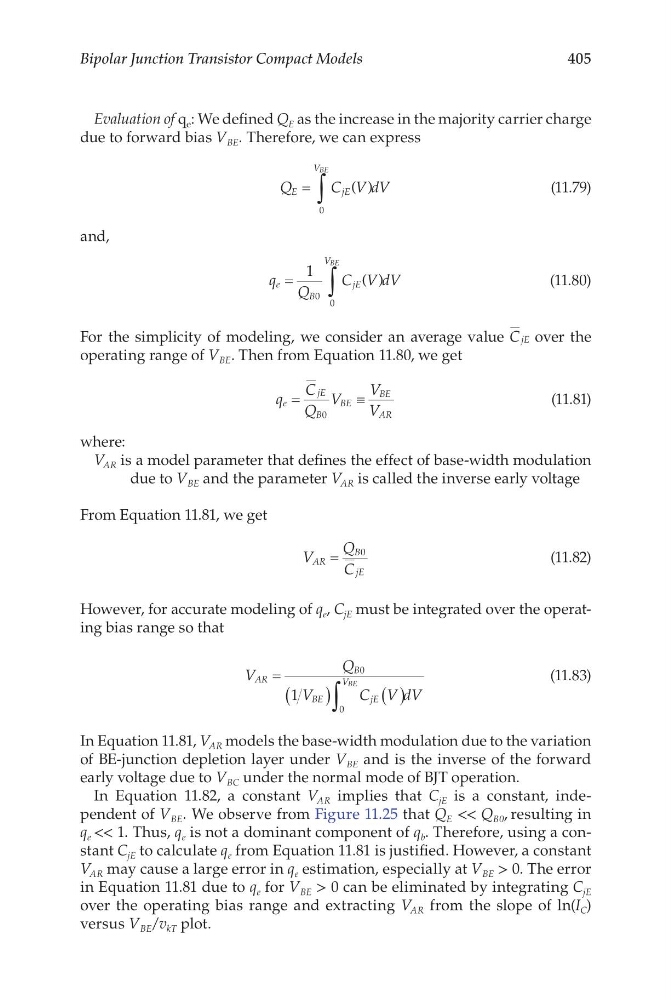
Evaluation of q e : We defined Q E as the increase in the majority carrier charge
due to forward bias V BE . Therefore, we can express
Q
C V dV
E
j E
VBE
=
∫
( )
0
(11.79)
and,
q Q
C V dV
e
B
jE
VBE
=
∫
1
0 0
( )
(11.80)
For the simplicity of modeling, we consider an average value CjE over the
operating range of V BE . Then from Equation 11.80, we get
q
C
Q
V
V
V
e
jE
B
BE
BE
AR
=
≡
0
(11.81)
where:
V AR is a model parameter that defines the effect of base-width modulation
due to V BE and the parameter V AR is called the inverse early voltage
From Equation 11.81, we get
V
Q
C
AR
B
jE
=
0
(11.82)
However, for accurate modeling of q e , C jE must be integrated over the operating bias range so that
V
Q
V
C V dV
AR
B
BE
jE
VBE
= (
)
( )
∫
0
0
1
(11.83)
In Equation 11.81, V AR models the base-width modulation due to the variation
of BE-junction depletion layer under V BE and is the inverse of the forward
early voltage due to V BC under the normal mode of BJT operation.
In Equation 11.82, a constant V AR implies that C jE is a constant, independent of V BE . We observe from Figure 11.25 that Q E << Q B0 , resulting in
q e << 1. Thus, q e is not a dominant component of q b . Therefore, using a constant C jE to calculate q e from Equation 11.81 is justified. However, a constant
V AR may cause a large error in q e estimation, especially at V BE > 0. The error
in Equation 11.81 due to q e for V BE > 0 can be eliminated by integrating C jE
over the operating bias range and extracting V AR from the slope of ln(I C )
versus V BE /v kT plot.
Bipolar Junction Transistor Compact Models
Evaluation of q e : We defined Q E as the increase in the majority carrier charge
due to forward bias V BE . Therefore, we can express
Q
C V dV
E
j E
VBE
=
∫
( )
0
(11.79)
and,
q Q
C V dV
e
B
jE
VBE
=
∫
1
0 0
( )
(11.80)
For the simplicity of modeling, we consider an average value CjE over the
operating range of V BE . Then from Equation 11.80, we get
q
C
Q
V
V
V
e
jE
B
BE
BE
AR
=
≡
0
(11.81)
where:
V AR is a model parameter that defines the effect of base-width modulation
due to V BE and the parameter V AR is called the inverse early voltage
From Equation 11.81, we get
V
Q
C
AR
B
jE
=
0
(11.82)
However, for accurate modeling of q e , C jE must be integrated over the operating bias range so that
V
Q
V
C V dV
AR
B
BE
jE
VBE
= (
)
( )
∫
0
0
1
(11.83)
In Equation 11.81, V AR models the base-width modulation due to the variation
of BE-junction depletion layer under V BE and is the inverse of the forward
early voltage due to V BC under the normal mode of BJT operation.
In Equation 11.82, a constant V AR implies that C jE is a constant, independent of V BE . We observe from Figure 11.25 that Q E << Q B0 , resulting in
q e << 1. Thus, q e is not a dominant component of q b . Therefore, using a constant C jE to calculate q e from Equation 11.81 is justified. However, a constant
V AR may cause a large error in q e estimation, especially at V BE > 0. The error
in Equation 11.81 due to q e for V BE > 0 can be eliminated by integrating C jE
over the operating bias range and extracting V AR from the slope of ln(I C )
versus V BE /v kT plot.