

269
Compact MOSFET Models for RF Applications
f
E E kT
t
f n
= −
−
(
)
{
}
−
1
1
exp
is the trap occupancy function where E fn is the
electron quasi-Fermi level
w = 2πf is the angular frequency
T ox is the oxide thickness
E c − E v is the silicon energy gap
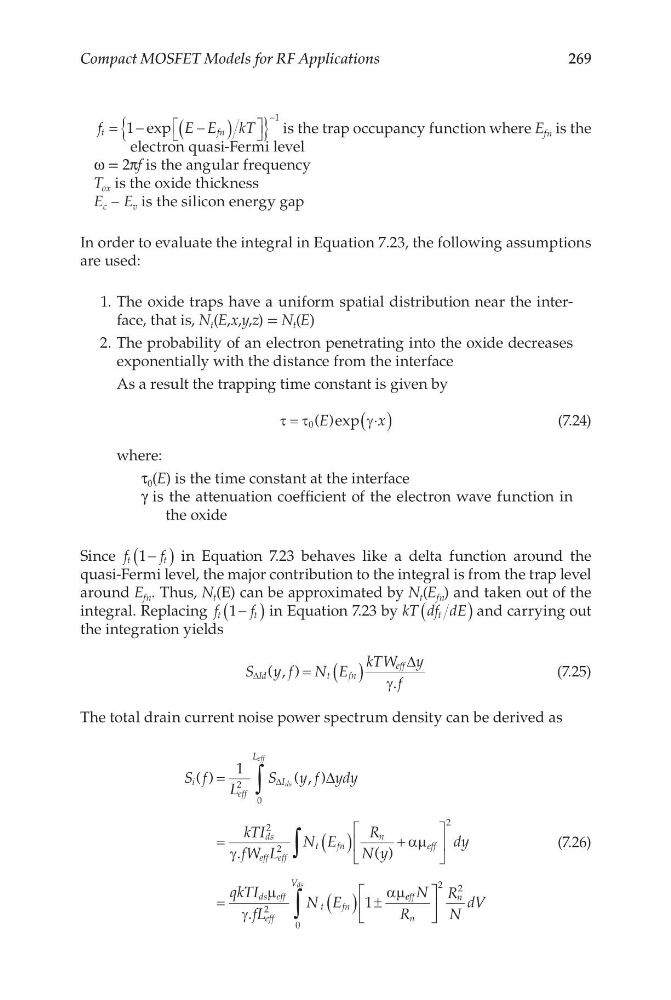
In order to evaluate the integral in Equation 7.23, the following assumptions
are used:
1. The oxide traps have a uniform spatial distribution near the interface, that is, N t (E,x,y,z) = N t (E)
2. The probability of an electron penetrating into the oxide decreases
exponentially with the distance from the interface
As a result the trapping time constant is given by
τ τ
γ
=
⋅
( )
0 ( )exp
E
x
(7.24)
where:
τ 0 (E) is the time constant at the interface
γ is the attenuation coefficient of the electron wave function in
the oxide
Since f
f
t
t
1−
( ) in Equation 7.23 behaves like a delta function around the
quasi-Fermi level, the major contribution to the integral is from the trap level
around E fn . Thus, N t (E) can be approximated by N t (E fn ) and taken out of the
integral. Replacing f
f
t
t
1−
( ) in Equation 7.23 by kT df dE
t
(
) and carrying out
the integration yields
S y f N E
kTW y
f
Id
t
f n
eff
∆
∆
( , )
.
= ( ) γ
(7.25)
The total drain current noise power spectrum density can be derived as
S f
L
S
y f ydy
kTI
fW L
N E
i
eff
I
L
ds
eff eff
t
f n
ds
eff
( )
( , )
.
=
=
( )
∫
1
2
0
2
2
∆
∆
γ
∫ ∫
∫
+
=
( ) ±
R
N y
dy
qkTI
fL
N E
n
eff
ds eff
eff
t
V
fn
ds
( )
.
αµ
µ
γ
αµ
2
2
0
1
e eff
n
n
N
R
R
N
dV
2
2
(7.26)
Compact MOSFET Models for RF Applications
f
E E kT
t
f n
= −
−
(
)
{
}
−
1
1
exp
is the trap occupancy function where E fn is the
electron quasi-Fermi level
w = 2πf is the angular frequency
T ox is the oxide thickness
E c − E v is the silicon energy gap
In order to evaluate the integral in Equation 7.23, the following assumptions
are used:
1. The oxide traps have a uniform spatial distribution near the interface, that is, N t (E,x,y,z) = N t (E)
2. The probability of an electron penetrating into the oxide decreases
exponentially with the distance from the interface
As a result the trapping time constant is given by
τ τ
γ
=
⋅
( )
0 ( )exp
E
x
(7.24)
where:
τ 0 (E) is the time constant at the interface
γ is the attenuation coefficient of the electron wave function in
the oxide
Since f
f
t
t
1−
( ) in Equation 7.23 behaves like a delta function around the
quasi-Fermi level, the major contribution to the integral is from the trap level
around E fn . Thus, N t (E) can be approximated by N t (E fn ) and taken out of the
integral. Replacing f
f
t
t
1−
( ) in Equation 7.23 by kT df dE
t
(
) and carrying out
the integration yields
S y f N E
kTW y
f
Id
t
f n
eff
∆
∆
( , )
.
= ( ) γ
(7.25)
The total drain current noise power spectrum density can be derived as
S f
L
S
y f ydy
kTI
fW L
N E
i
eff
I
L
ds
eff eff
t
f n
ds
eff
( )
( , )
.
=
=
( )
∫
1
2
0
2
2
∆
∆
γ
∫ ∫
∫
+
=
( ) ±
R
N y
dy
qkTI
fL
N E
n
eff
ds eff
eff
t
V
fn
ds
( )
.
αµ
µ
γ
αµ
2
2
0
1
e eff
n
n
N
R
R
N
dV
2
2
(7.26)