

262
Compact Models for Integrated Circuit Design
tends to what is called the power spectral density (PSD) of the current noise,
denoted by S i (f). This quantity has units of square amperes per hertz (A 2 /Hz).
Often the square root of the PSD is used instead, given by A Hz
/
. For a noise
voltage v n , one can similarly define a PSD S v (f) as V 2 /Hz or its square root in
V Hz
/
[4].
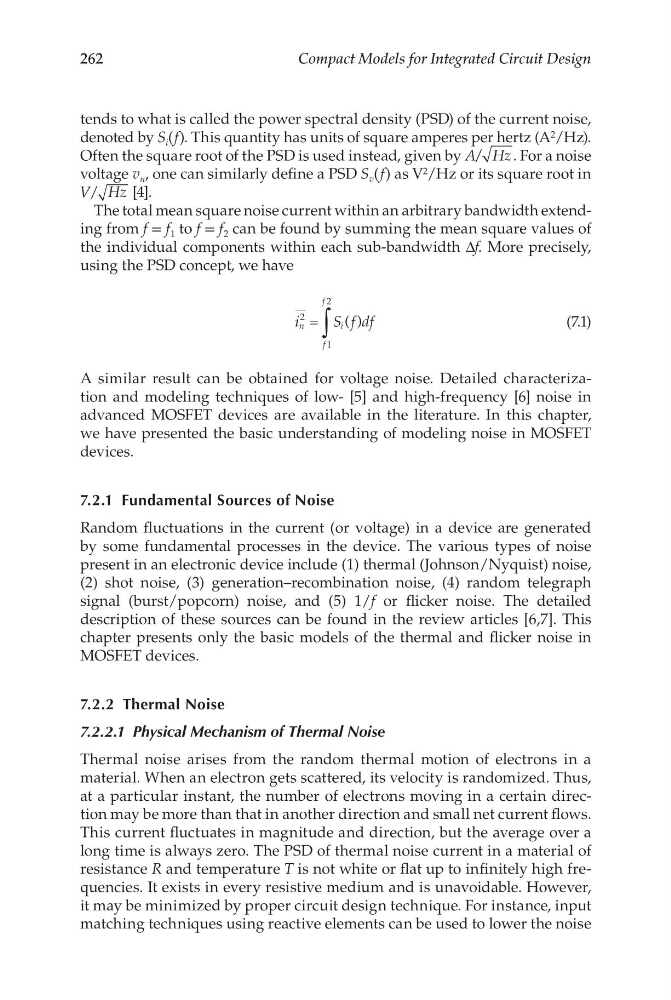
The total mean square noise current within an arbitrary bandwidth extending from f = f 1 to f = f 2 can be found by summing the mean square values of
the individual components within each sub-bandwidth Δf. More precisely,
using the PSD concept, we have
i
S f df
n
i
f
f
2
1
2
=
∫
( )
(7.1)
A similar result can be obtained for voltage noise. Detailed characterization and modeling techniques of low- [5] and high-frequency [6] noise in
advanced MOSFET devices are available in the literature. In this chapter,
we have presented the basic understanding of modeling noise in MOSFET
devices.
7.2.1 Fundamental Sources of Noise
Random fluctuations in the current (or voltage) in a device are generated
by some fundamental processes in the device. The various types of noise
present in an electronic device include (1) thermal (Johnson/Nyquist) noise,
(2) shot noise, (3) generation–recombination noise, (4) random telegraph
signal (burst/popcorn) noise, and (5) 1/f or flicker noise. The detailed
description of these sources can be found in the review articles [6,7]. This
chapter presents only the basic models of the thermal and flicker noise in
MOSFET devices.
7.2.2 Thermal Noise
7.2.2.1 Physical Mechanism of Thermal Noise
Thermal noise arises from the random thermal motion of electrons in a
material. When an electron gets scattered, its velocity is randomized. Thus,
at a particular instant, the number of electrons moving in a certain direction may be more than that in another direction and small net current flows.
This current fluctuates in magnitude and direction, but the average over a
long time is always zero. The PSD of thermal noise current in a material of
resistance R and temperature T is not white or flat up to infinitely high frequencies. It exists in every resistive medium and is unavoidable. However,
it may be minimized by proper circuit design technique. For instance, input
matching techniques using reactive elements can be used to lower the noise
Compact Models for Integrated Circuit Design
tends to what is called the power spectral density (PSD) of the current noise,
denoted by S i (f). This quantity has units of square amperes per hertz (A 2 /Hz).
Often the square root of the PSD is used instead, given by A Hz
/
. For a noise
voltage v n , one can similarly define a PSD S v (f) as V 2 /Hz or its square root in
V Hz
/
[4].
The total mean square noise current within an arbitrary bandwidth extending from f = f 1 to f = f 2 can be found by summing the mean square values of
the individual components within each sub-bandwidth Δf. More precisely,
using the PSD concept, we have
i
S f df
n
i
f
f
2
1
2
=
∫
( )
(7.1)
A similar result can be obtained for voltage noise. Detailed characterization and modeling techniques of low- [5] and high-frequency [6] noise in
advanced MOSFET devices are available in the literature. In this chapter,
we have presented the basic understanding of modeling noise in MOSFET
devices.
7.2.1 Fundamental Sources of Noise
Random fluctuations in the current (or voltage) in a device are generated
by some fundamental processes in the device. The various types of noise
present in an electronic device include (1) thermal (Johnson/Nyquist) noise,
(2) shot noise, (3) generation–recombination noise, (4) random telegraph
signal (burst/popcorn) noise, and (5) 1/f or flicker noise. The detailed
description of these sources can be found in the review articles [6,7]. This
chapter presents only the basic models of the thermal and flicker noise in
MOSFET devices.
7.2.2 Thermal Noise
7.2.2.1 Physical Mechanism of Thermal Noise
Thermal noise arises from the random thermal motion of electrons in a
material. When an electron gets scattered, its velocity is randomized. Thus,
at a particular instant, the number of electrons moving in a certain direction may be more than that in another direction and small net current flows.
This current fluctuates in magnitude and direction, but the average over a
long time is always zero. The PSD of thermal noise current in a material of
resistance R and temperature T is not white or flat up to infinitely high frequencies. It exists in every resistive medium and is unavoidable. However,
it may be minimized by proper circuit design technique. For instance, input
matching techniques using reactive elements can be used to lower the noise