

248
Compact Models for Integrated Circuit Design
6.3.3 Short Channel Charge Model
In the derivation of long channel terminal charges and capacitances in the
previous section, we have neglected the effects of velocity saturation, channel length modulation, and series resistance, since these effects are important only for short channel devices (Chapter 5). As in the case of drain current
modeling, we need to consider these in modeling terminal charges for short
channel devices. However, the final charge equations including these short
channel effects become more complex.
For the simplicity of modeling capacitances for short channel MOSFETs,
the long channel charge model has been used by modifying the body effect
coefficient, α [8]. However, for accurate modeling of terminal charges and
capacitances in short channel devices, short channel effects including carrier velocity saturation, channel length modulation, and S/D series resistance
must be considered. In order to include the short channel effects in modeling
charges and hence capacitances for short channel devices, I ds expression
(Equation 5.72) for short channel devices in the linear region is used. Repeating
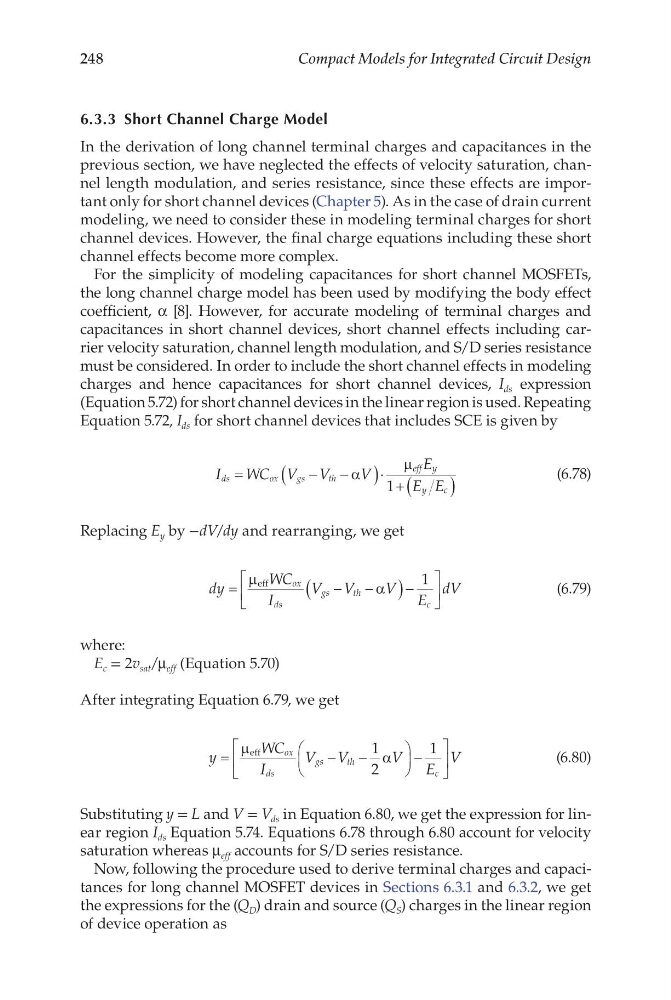
Equation 5.72, I ds for short channel devices that includes SCE is given by
I
WC V V
V
E
E E
ds
ox
gs
th
eff y
y
c
=
−
−
(
) ⋅ + (
)
α
µ
1
(6.78)
Replacing E y by −dV/dy and rearranging, we get
dy
WC
I
V V
V E
dV
ox
ds
gs
th
c
=
−
−
(
) −
µ
α
eff
1
(6.79)
where:
E c = 2v sat /μ eff (Equation 5.70)
After integrating Equation 6.79, we get
y
WC
I
V V
V
E
V
ox
ds
gs
th
c
=
−
−
−
µ
α
eff
1
2
1
(6.80)
Substituting y = L and V = V ds in Equation 6.80, we get the expression for linear region I ds Equation 5.74. Equations 6.78 through 6.80 account for velocity
saturation whereas μ eff accounts for S/D series resistance.
Now, following the procedure used to derive terminal charges and capacitances for long channel MOSFET devices in Sections 6.3.1 and 6.3.2, we get
the expressions for the (Q D ) drain and source (Q S ) charges in the linear region
of device operation as
Compact Models for Integrated Circuit Design
6.3.3 Short Channel Charge Model
In the derivation of long channel terminal charges and capacitances in the
previous section, we have neglected the effects of velocity saturation, channel length modulation, and series resistance, since these effects are important only for short channel devices (Chapter 5). As in the case of drain current
modeling, we need to consider these in modeling terminal charges for short
channel devices. However, the final charge equations including these short
channel effects become more complex.
For the simplicity of modeling capacitances for short channel MOSFETs,
the long channel charge model has been used by modifying the body effect
coefficient, α [8]. However, for accurate modeling of terminal charges and
capacitances in short channel devices, short channel effects including carrier velocity saturation, channel length modulation, and S/D series resistance
must be considered. In order to include the short channel effects in modeling
charges and hence capacitances for short channel devices, I ds expression
(Equation 5.72) for short channel devices in the linear region is used. Repeating
Equation 5.72, I ds for short channel devices that includes SCE is given by
I
WC V V
V
E
E E
ds
ox
gs
th
eff y
y
c
=
−
−
(
) ⋅ + (
)
α
µ
1
(6.78)
Replacing E y by −dV/dy and rearranging, we get
dy
WC
I
V V
V E
dV
ox
ds
gs
th
c
=
−
−
(
) −
µ
α
eff
1
(6.79)
where:
E c = 2v sat /μ eff (Equation 5.70)
After integrating Equation 6.79, we get
y
WC
I
V V
V
E
V
ox
ds
gs
th
c
=
−
−
−
µ
α
eff
1
2
1
(6.80)
Substituting y = L and V = V ds in Equation 6.80, we get the expression for linear region I ds Equation 5.74. Equations 6.78 through 6.80 account for velocity
saturation whereas μ eff accounts for S/D series resistance.
Now, following the procedure used to derive terminal charges and capacitances for long channel MOSFET devices in Sections 6.3.1 and 6.3.2, we get
the expressions for the (Q D ) drain and source (Q S ) charges in the linear region
of device operation as