

90
Compact Models for Integrated Circuit Design
3.2.2.1 Interface-Trapped Charge
The interface-trapped charge density, Q it , also referred to as the surface states, fast
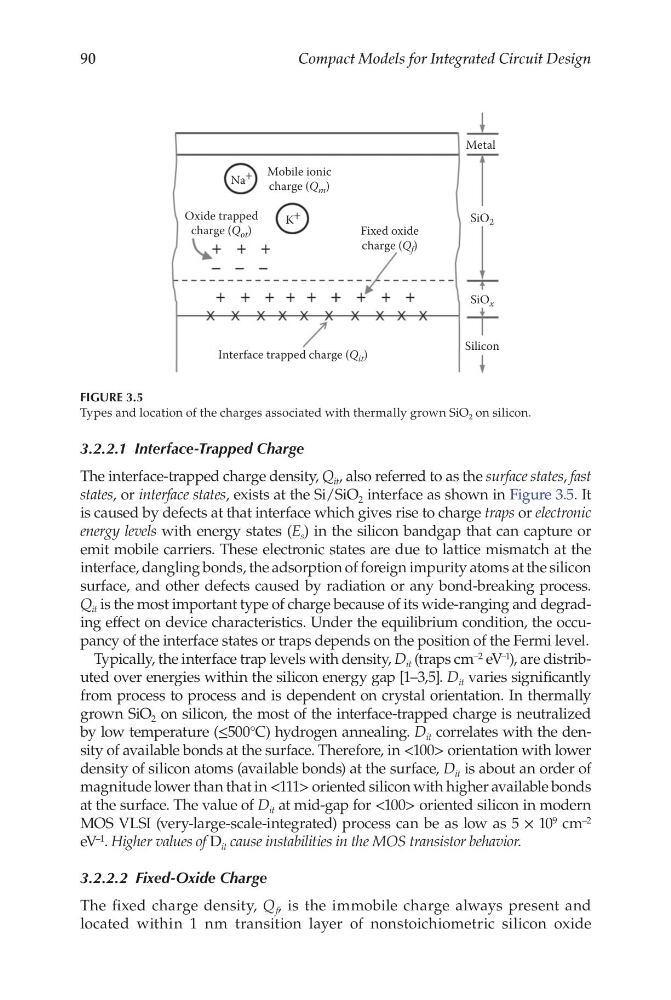
states, or interface states, exists at the Si/SiO 2 interface as shown in Figure 3.5. It
is caused by defects at that interface which gives rise to charge traps or electronic
energy levels with energy states (E s ) in the silicon bandgap that can capture or
emit mobile carriers. These electronic states are due to lattice mismatch at the
interface, dangling bonds, the adsorption of foreign impurity atoms at the silicon
surface, and other defects caused by radiation or any bond-breaking process.
Q it is the most important type of charge because of its wide-ranging and degrading effect on device characteristics. Under the equilibrium condition, the occupancy of the interface states or traps depends on the position of the Fermi level.
Typically, the interface trap levels with density, D it (traps cm –2 eV –1 ), are distributed over energies within the silicon energy gap [1–3,5]. D it varies significantly
from process to process and is dependent on crystal orientation. In thermally
grown SiO 2 on silicon, the most of the interface-trapped charge is neutralized
by low temperature (≤500°C) hydrogen annealing. D it correlates with the density of available bonds at the surface. Therefore, in <100> orientation with lower
density of silicon atoms (available bonds) at the surface, D it is about an order of
magnitude lower than that in <111> oriented silicon with higher available bonds
at the surface. The value of D it at mid-gap for <100> oriented silicon in modern
MOS VLSI (very-large-scale-integrated) process can be as low as 5 × 10 9 cm –2
eV –1 . Higher values of D it cause instabilities in the MOS transistor behavior.
3.2.2.2 Fixed-Oxide Charge
The fixed charge density, Q f , is the immobile charge always present and
located within 1 nm transition layer of nonstoichiometric silicon oxide
Mobile ionic
charge (Q m )
Metal
Oxide trapped
charge (Q ot )
SiO 2
SiO x
Silicon
Fixed oxide
charge (Q f )
Interface trapped charge (Q it )
Na +
K +
FIGURE 3.5
Types and location of the charges associated with thermally grown SiO 2 on silicon.
Compact Models for Integrated Circuit Design
3.2.2.1 Interface-Trapped Charge
The interface-trapped charge density, Q it , also referred to as the surface states, fast
states, or interface states, exists at the Si/SiO 2 interface as shown in Figure 3.5. It
is caused by defects at that interface which gives rise to charge traps or electronic
energy levels with energy states (E s ) in the silicon bandgap that can capture or
emit mobile carriers. These electronic states are due to lattice mismatch at the
interface, dangling bonds, the adsorption of foreign impurity atoms at the silicon
surface, and other defects caused by radiation or any bond-breaking process.
Q it is the most important type of charge because of its wide-ranging and degrading effect on device characteristics. Under the equilibrium condition, the occupancy of the interface states or traps depends on the position of the Fermi level.
Typically, the interface trap levels with density, D it (traps cm –2 eV –1 ), are distributed over energies within the silicon energy gap [1–3,5]. D it varies significantly
from process to process and is dependent on crystal orientation. In thermally
grown SiO 2 on silicon, the most of the interface-trapped charge is neutralized
by low temperature (≤500°C) hydrogen annealing. D it correlates with the density of available bonds at the surface. Therefore, in <100> orientation with lower
density of silicon atoms (available bonds) at the surface, D it is about an order of
magnitude lower than that in <111> oriented silicon with higher available bonds
at the surface. The value of D it at mid-gap for <100> oriented silicon in modern
MOS VLSI (very-large-scale-integrated) process can be as low as 5 × 10 9 cm –2
eV –1 . Higher values of D it cause instabilities in the MOS transistor behavior.
3.2.2.2 Fixed-Oxide Charge
The fixed charge density, Q f , is the immobile charge always present and
located within 1 nm transition layer of nonstoichiometric silicon oxide
Mobile ionic
charge (Q m )
Metal
Oxide trapped
charge (Q ot )
SiO 2
SiO x
Silicon
Fixed oxide
charge (Q f )
Interface trapped charge (Q it )
Na +
K +
FIGURE 3.5
Types and location of the charges associated with thermally grown SiO 2 on silicon.