

89
Metal-Oxide-Semiconductor System
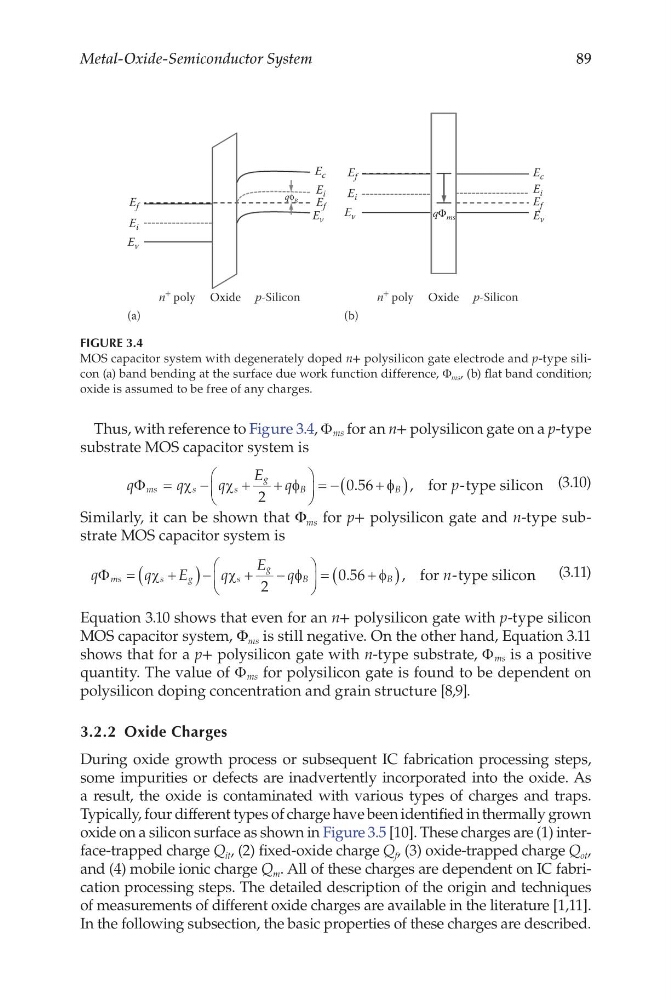
Thus, with reference to Figure 3.4, Φ ms for an n+ polysilicon gate on a p-type
substrate MOS capacitor system is
q
q
q
E q
p
ms
s
s
g
B
B
Φ =
−
+
+
= −
+
(
)
χ
χ
φ
φ
2
0 56
.
, for -type silicon (3.10)
Similarly, it can be shown that Φ ms for p+ polysilicon gate and n-type substrate MOS capacitor system is
q
q
E
q
E q
n
ms
s
g
s
g
B
B
Φ =
+
(
) − + −
=
+
(
)
χ
χ
φ
φ
2
0 56
.
, for -type silicon n
(3.11)
Equation 3.10 shows that even for an n+ polysilicon gate with p-type silicon
MOS capacitor system, Φ ms is still negative. On the other hand, Equation 3.11
shows that for a p+ polysilicon gate with n-type substrate, Φ ms is a positive
quantity. The value of Φ ms for polysilicon gate is found to be dependent on
polysilicon doping concentration and grain structure [8,9].
3.2.2 Oxide Charges
During oxide growth process or subsequent IC fabrication processing steps,
some impurities or defects are inadvertently incorporated into the oxide. As
a result, the oxide is contaminated with various types of charges and traps.
Typically, four different types of charge have been identified in thermally grown
oxide on a silicon surface as shown in Figure 3.5 [10]. These charges are (1) interface-trapped charge Q it , (2) fixed-oxide charge Q f , (3) oxide-trapped charge Q ot ,
and (4) mobile ionic charge Q m . All of these charges are dependent on IC fabrication processing steps. The detailed description of the origin and techniques
of measurements of different oxide charges are available in the literature [1,11].
In the following subsection, the basic properties of these charges are described.
E f
E i
E v
Oxide
n + poly
(a)
(b)
p-Silicon
Oxide
n
+ poly
p-Silicon
E c
E i
qϕ B
qΦ ms
E f
E f
E i
E v
E v
E c
E i
E f
E v
FIGURE 3.4
MOS capacitor system with degenerately doped n+ polysilicon gate electrode and p-type silicon (a) band bending at the surface due work function difference, Φ ms , (b) flat band condition;
oxide is assumed to be free of any charges.
Metal-Oxide-Semiconductor System
Thus, with reference to Figure 3.4, Φ ms for an n+ polysilicon gate on a p-type
substrate MOS capacitor system is
q
q
q
E q
p
ms
s
s
g
B
B
Φ =
−
+
+
= −
+
(
)
χ
χ
φ
φ
2
0 56
.
, for -type silicon (3.10)
Similarly, it can be shown that Φ ms for p+ polysilicon gate and n-type substrate MOS capacitor system is
q
q
E
q
E q
n
ms
s
g
s
g
B
B
Φ =
+
(
) − + −
=
+
(
)
χ
χ
φ
φ
2
0 56
.
, for -type silicon n
(3.11)
Equation 3.10 shows that even for an n+ polysilicon gate with p-type silicon
MOS capacitor system, Φ ms is still negative. On the other hand, Equation 3.11
shows that for a p+ polysilicon gate with n-type substrate, Φ ms is a positive
quantity. The value of Φ ms for polysilicon gate is found to be dependent on
polysilicon doping concentration and grain structure [8,9].
3.2.2 Oxide Charges
During oxide growth process or subsequent IC fabrication processing steps,
some impurities or defects are inadvertently incorporated into the oxide. As
a result, the oxide is contaminated with various types of charges and traps.
Typically, four different types of charge have been identified in thermally grown
oxide on a silicon surface as shown in Figure 3.5 [10]. These charges are (1) interface-trapped charge Q it , (2) fixed-oxide charge Q f , (3) oxide-trapped charge Q ot ,
and (4) mobile ionic charge Q m . All of these charges are dependent on IC fabrication processing steps. The detailed description of the origin and techniques
of measurements of different oxide charges are available in the literature [1,11].
In the following subsection, the basic properties of these charges are described.
E f
E i
E v
Oxide
n + poly
(a)
(b)
p-Silicon
Oxide
n
+ poly
p-Silicon
E c
E i
qϕ B
qΦ ms
E f
E f
E i
E v
E v
E c
E i
E f
E v
FIGURE 3.4
MOS capacitor system with degenerately doped n+ polysilicon gate electrode and p-type silicon (a) band bending at the surface due work function difference, Φ ms , (b) flat band condition;
oxide is assumed to be free of any charges.