

208
Mathematical Aspects of Logic Programming Semantics
0. ¯ 3
0. ¯ 3
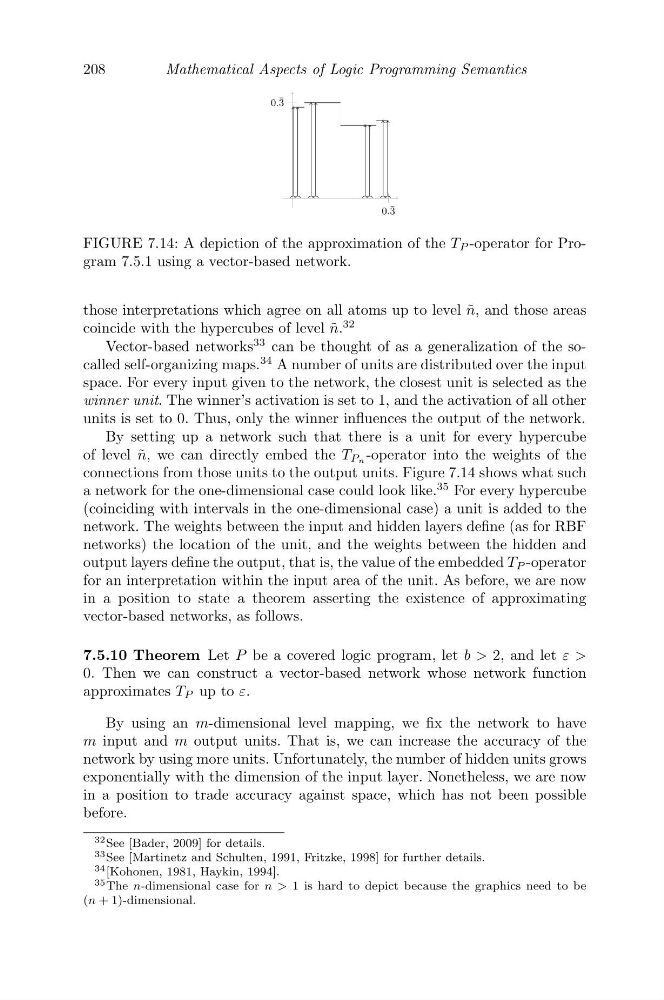
FIGURE 7.14: A depiction of the approximation of the T P -operator for Program 7.5.1 using a vector-based network.
those interpretations which agree on all atoms up to level ˜
n, and those areas
32
coincide with the hypercubes of level ˜
n.
Vector-based networks
33 can be thought of as a generalization of the socalled self-organizing maps.
34 A number of units are distributed over the input
space. For every input given to the network, the closest unit is selected as the
winner unit. The winner’s activation is set to 1, and the activation of all other
units is set to 0. Thus, only the winner influences the output of the network.
By setting up a network such that there is a unit for every hypercube
of level ˜
n, we can directly embed the T Pn -operator into the weights of the
connections from those units to the output units. Figure 7.14 shows what such
a network for the one-dimensional case could look like.
35 For every hypercube
(coinciding with intervals in the one-dimensional case) a unit is added to the
network. The weights between the input and hidden layers define (as for RBF
networks) the location of the unit, and the weights between the hidden and
output layers define the output, that is, the value of the embedded T P -operator
for an interpretation within the input area of the unit. As before, we are now
in a position to state a theorem asserting the existence of approximating
vector-based networks, as follows.
7.5.10 Theorem Let P be a covered logic program, let b > 2, and let ε >
0. Then we can construct a vector-based network whose network function
approximates T P up to ε.
By using an m-dimensional level mapping, we fix the network to have
m input and m output units. That is, we can increase the accuracy of the
network by using more units. Unfortunately, the number of hidden units grows
exponentially with the dimension of the input layer. Nonetheless, we are now
in a position to trade accuracy against space, which has not been possible
before.
32 See [Bader, 2009] for details.
33 See [Martinetz and Schulten, 1991, Fritzke, 1998] for further details.
34 [Kohonen, 1981, Haykin, 1994].
35 The n-dimensional case for n > 1 is hard to depict because the graphics need to be
(n + 1)-dimensional.
Mathematical Aspects of Logic Programming Semantics
0. ¯ 3
0. ¯ 3
FIGURE 7.14: A depiction of the approximation of the T P -operator for Program 7.5.1 using a vector-based network.
those interpretations which agree on all atoms up to level ˜
n, and those areas
32
coincide with the hypercubes of level ˜
n.
Vector-based networks
33 can be thought of as a generalization of the socalled self-organizing maps.
34 A number of units are distributed over the input
space. For every input given to the network, the closest unit is selected as the
winner unit. The winner’s activation is set to 1, and the activation of all other
units is set to 0. Thus, only the winner influences the output of the network.
By setting up a network such that there is a unit for every hypercube
of level ˜
n, we can directly embed the T Pn -operator into the weights of the
connections from those units to the output units. Figure 7.14 shows what such
a network for the one-dimensional case could look like.
35 For every hypercube
(coinciding with intervals in the one-dimensional case) a unit is added to the
network. The weights between the input and hidden layers define (as for RBF
networks) the location of the unit, and the weights between the hidden and
output layers define the output, that is, the value of the embedded T P -operator
for an interpretation within the input area of the unit. As before, we are now
in a position to state a theorem asserting the existence of approximating
vector-based networks, as follows.
7.5.10 Theorem Let P be a covered logic program, let b > 2, and let ε >
0. Then we can construct a vector-based network whose network function
approximates T P up to ε.
By using an m-dimensional level mapping, we fix the network to have
m input and m output units. That is, we can increase the accuracy of the
network by using more units. Unfortunately, the number of hidden units grows
exponentially with the dimension of the input layer. Nonetheless, we are now
in a position to trade accuracy against space, which has not been possible
before.
32 See [Bader, 2009] for details.
33 See [Martinetz and Schulten, 1991, Fritzke, 1998] for further details.
34 [Kohonen, 1981, Haykin, 1994].
35 The n-dimensional case for n > 1 is hard to depict because the graphics need to be
(n + 1)-dimensional.