

207
Logic Programming and Artificial Neural Networks
x
0. ¯ 3
y
0. ¯ 3
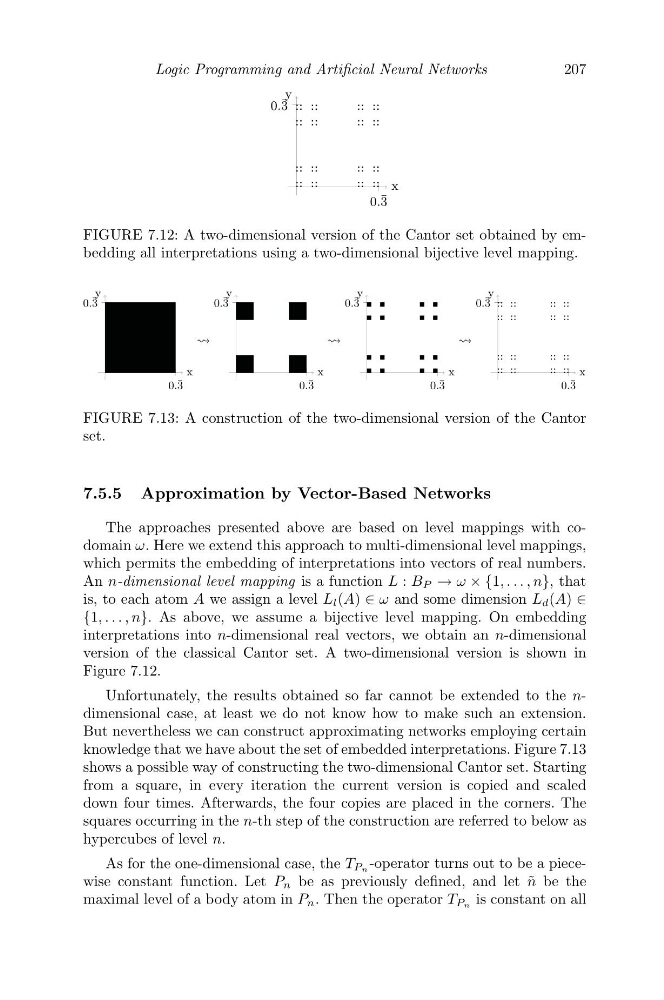
FIGURE 7.12: A two-dimensional version of the Cantor set obtained by embedding all interpretations using a two-dimensional bijective level mapping.
x
0. ¯ 3
y
0. ¯ 3
x
0. ¯ 3
y
0. ¯ 3
x
0. ¯ 3
y
0. ¯ 3
x
0. ¯ 3
y
0. ¯ 3
FIGURE 7.13: A construction of the two-dimensional version of the Cantor
set.
7.5.5 Approximation by Vector-Based Networks
The approaches presented above are based on level mappings with codomain ω. Here we extend this approach to multi-dimensional level mappings,
which permits the embedding of interpretations into vectors of real numbers.
An n-dimensional level mapping is a function L : B P → ω × {1, . . . , n}, that
is, to each atom A we assign a level L l (A) ∈ ω and some dimension L d (A) ∈
{1, . . . , n}. As above, we assume a bijective level mapping. On embedding
interpretations into n-dimensional real vectors, we obtain an n-dimensional
version of the classical Cantor set. A two-dimensional version is shown in
Figure 7.12.
Unfortunately, the results obtained so far cannot be extended to the ndimensional case, at least we do not know how to make such an extension.
But nevertheless we can construct approximating networks employing certain
knowledge that we have about the set of embedded interpretations. Figure 7.13
shows a possible way of constructing the two-dimensional Cantor set. Starting
from a square, in every iteration the current version is copied and scaled
down four times. Afterwards, the four copies are placed in the corners. The
squares occurring in the n-th step of the construction are referred to below as
hypercubes of level n.
As for the one-dimensional case, the T Pn -operator turns out to be a piecewise constant function. Let P n be as previously defined, and let ˜
n be the
maximal level of a body atom in P n . Then the operator T Pn is constant on all
Logic Programming and Artificial Neural Networks
x
0. ¯ 3
y
0. ¯ 3
FIGURE 7.12: A two-dimensional version of the Cantor set obtained by embedding all interpretations using a two-dimensional bijective level mapping.
x
0. ¯ 3
y
0. ¯ 3
x
0. ¯ 3
y
0. ¯ 3
x
0. ¯ 3
y
0. ¯ 3
x
0. ¯ 3
y
0. ¯ 3
FIGURE 7.13: A construction of the two-dimensional version of the Cantor
set.
7.5.5 Approximation by Vector-Based Networks
The approaches presented above are based on level mappings with codomain ω. Here we extend this approach to multi-dimensional level mappings,
which permits the embedding of interpretations into vectors of real numbers.
An n-dimensional level mapping is a function L : B P → ω × {1, . . . , n}, that
is, to each atom A we assign a level L l (A) ∈ ω and some dimension L d (A) ∈
{1, . . . , n}. As above, we assume a bijective level mapping. On embedding
interpretations into n-dimensional real vectors, we obtain an n-dimensional
version of the classical Cantor set. A two-dimensional version is shown in
Figure 7.12.
Unfortunately, the results obtained so far cannot be extended to the ndimensional case, at least we do not know how to make such an extension.
But nevertheless we can construct approximating networks employing certain
knowledge that we have about the set of embedded interpretations. Figure 7.13
shows a possible way of constructing the two-dimensional Cantor set. Starting
from a square, in every iteration the current version is copied and scaled
down four times. Afterwards, the four copies are placed in the corners. The
squares occurring in the n-th step of the construction are referred to below as
hypercubes of level n.
As for the one-dimensional case, the T Pn -operator turns out to be a piecewise constant function. Let P n be as previously defined, and let ˜
n be the
maximal level of a body atom in P n . Then the operator T Pn is constant on all