

199
Logic Programming and Artificial Neural Networks
0. ¯ 3
0. ¯ 3
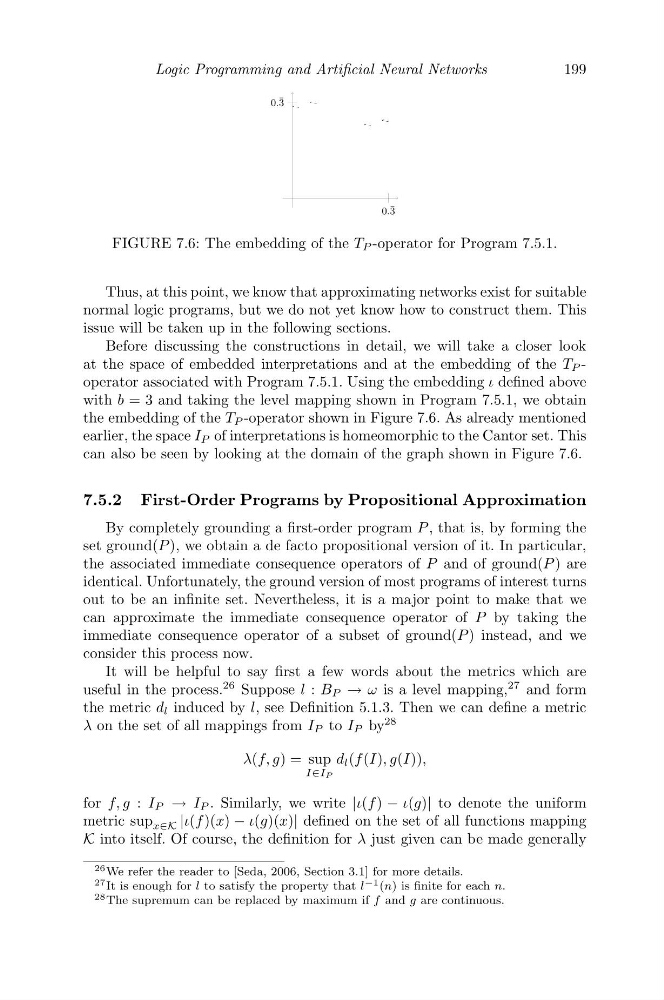
FIGURE 7.6: The embedding of the T P -operator for Program 7.5.1.
Thus, at this point, we know that approximating networks exist for suitable
normal logic programs, but we do not yet know how to construct them. This
issue will be taken up in the following sections.
Before discussing the constructions in detail, we will take a closer look
at the space of embedded interpretations and at the embedding of the T P
operator associated with Program 7.5.1. Using the embedding ι defined above
with b = 3 and taking the level mapping shown in Program 7.5.1, we obtain
the embedding of the T P -operator shown in Figure 7.6. As already mentioned
earlier, the space I P of interpretations is homeomorphic to the Cantor set. This
can also be seen by looking at the domain of the graph shown in Figure 7.6.
7.5.2 First-Order Programs by Propositional Approximation
By completely grounding a first-order program P , that is, by forming the
set ground(P ), we obtain a de facto propositional version of it. In particular,
the associated immediate consequence operators of P and of ground(P ) are
identical. Unfortunately, the ground version of most programs of interest turns
out to be an infinite set. Nevertheless, it is a major point to make that we
can approximate the immediate consequence operator of P by taking the
immediate consequence operator of a subset of ground(P ) instead, and we
consider this process now.
It will be helpful to say first a few words about the metrics which are
useful in the process.
26 Suppose l : B P → ω is a level mapping,
27 and form
the metric d l induced by l, see Definition 5.1.3. Then we can define a metric
λ on the set of all mappings from I P to I P by
28
λ(f, g) = sup d l (f (I), g(I)),
I∈I P
for f, g : I P → I P . Similarly, we write |ι(f ) − ι(g)| to denote the uniform
metric sup x∈K |ι(f )(x) − ι(g)(x)| defined on the set of all functions mapping
K into itself. Of course, the definition for λ just given can be made generally
26 We refer the reader to [Seda, 2006, Section 3.1] for more details.
27 It is enough for l to satisfy the property that l −1 (n) is finite for each n.
28 The supremum can be replaced by maximum if f and g are continuous.
Logic Programming and Artificial Neural Networks
0. ¯ 3
0. ¯ 3
FIGURE 7.6: The embedding of the T P -operator for Program 7.5.1.
Thus, at this point, we know that approximating networks exist for suitable
normal logic programs, but we do not yet know how to construct them. This
issue will be taken up in the following sections.
Before discussing the constructions in detail, we will take a closer look
at the space of embedded interpretations and at the embedding of the T P
operator associated with Program 7.5.1. Using the embedding ι defined above
with b = 3 and taking the level mapping shown in Program 7.5.1, we obtain
the embedding of the T P -operator shown in Figure 7.6. As already mentioned
earlier, the space I P of interpretations is homeomorphic to the Cantor set. This
can also be seen by looking at the domain of the graph shown in Figure 7.6.
7.5.2 First-Order Programs by Propositional Approximation
By completely grounding a first-order program P , that is, by forming the
set ground(P ), we obtain a de facto propositional version of it. In particular,
the associated immediate consequence operators of P and of ground(P ) are
identical. Unfortunately, the ground version of most programs of interest turns
out to be an infinite set. Nevertheless, it is a major point to make that we
can approximate the immediate consequence operator of P by taking the
immediate consequence operator of a subset of ground(P ) instead, and we
consider this process now.
It will be helpful to say first a few words about the metrics which are
useful in the process.
26 Suppose l : B P → ω is a level mapping,
27 and form
the metric d l induced by l, see Definition 5.1.3. Then we can define a metric
λ on the set of all mappings from I P to I P by
28
λ(f, g) = sup d l (f (I), g(I)),
I∈I P
for f, g : I P → I P . Similarly, we write |ι(f ) − ι(g)| to denote the uniform
metric sup x∈K |ι(f )(x) − ι(g)(x)| defined on the set of all functions mapping
K into itself. Of course, the definition for λ just given can be made generally
26 We refer the reader to [Seda, 2006, Section 3.1] for more details.
27 It is enough for l to satisfy the property that l −1 (n) is finite for each n.
28 The supremum can be replaced by maximum if f and g are continuous.