

T P
I P
I P
ι
ι
K
K
f P
198
Mathematical Aspects of Logic Programming Semantics
_ _
1
1
_ _
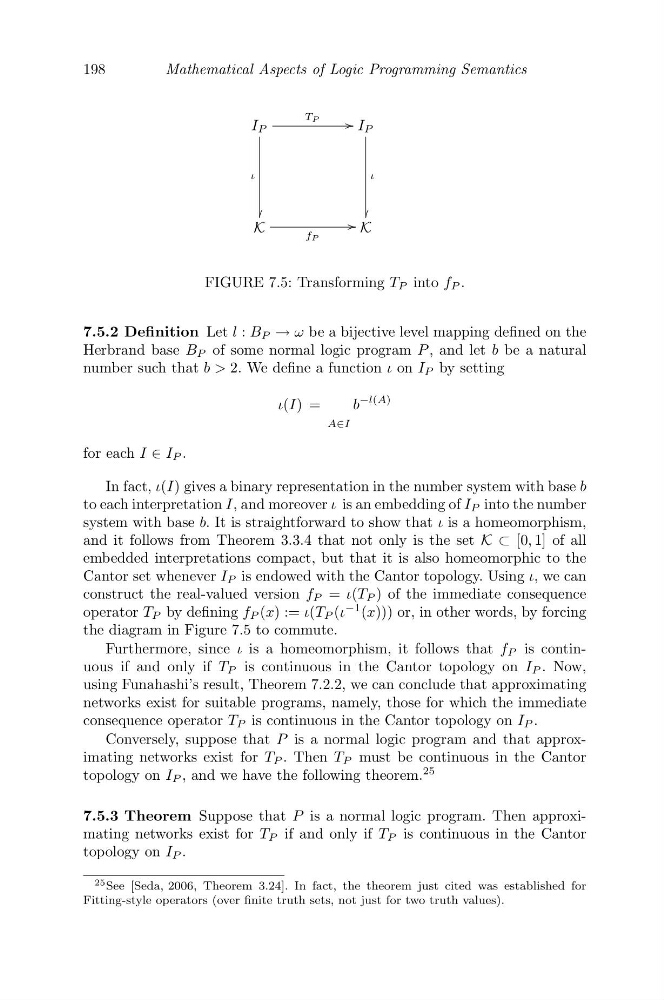
FIGURE 7.5: Transforming T P into f P .
7.5.2 Definition Let l : B P → ω be a bijective level mapping defined on the
Herbrand base B P of some normal logic program P , and let b be a natural
number such that b > 2. We define a function ι on I P by setting
ι(I) =
A
b
−l(A)
∈I
for each I ∈ I P .
In fact, ι(I) gives a binary representation in the number system with base b
to each interpretation I, and moreover ι is an embedding of I P into the number
system with base b. It is straightforward to show that ι is a homeomorphism,
and it follows from Theorem 3.3.4 that not only is the set K ⊂ [0, 1] of all
embedded interpretations compact, but that it is also homeomorphic to the
Cantor set whenever I P is endowed with the Cantor topology. Using ι, we can
construct the real-valued version f P = ι(T P ) of the immediate consequence
operator T P by defining f (x) := ι(T
1
P
P (ι
− (x))) or, in other words, by forcing
the diagram in Figure 7.5 to commute.
Furthermore, since ι is a homeomorphism, it follows that f P is continuous if and only if T P is continuous in the Cantor topology on I P . Now,
using Funahashi’s result, Theorem 7.2.2, we can conclude that approximating
networks exist for suitable programs, namely, those for which the immediate
consequence operator T P is continuous in the Cantor topology on I P .
Conversely, suppose that P is a normal logic program and that approximating networks exist for T P . Then T P must be continuous in the Cantor
topology on I
25
P , and we have the following theorem.
7.5.3 Theorem Suppose that P is a normal logic program. Then approximating networks exist for T P if and only if T P is continuous in the Cantor
topology on I P .
25 See [Seda, 2006, Theorem 3.24]. In fact, the theorem just cited was established for
Fitting-style operators (over finite truth sets, not just for two truth values).
I P
I P
ι
ι
K
K
f P
198
Mathematical Aspects of Logic Programming Semantics
_ _
1
1
_ _
FIGURE 7.5: Transforming T P into f P .
7.5.2 Definition Let l : B P → ω be a bijective level mapping defined on the
Herbrand base B P of some normal logic program P , and let b be a natural
number such that b > 2. We define a function ι on I P by setting
ι(I) =
A
b
−l(A)
∈I
for each I ∈ I P .
In fact, ι(I) gives a binary representation in the number system with base b
to each interpretation I, and moreover ι is an embedding of I P into the number
system with base b. It is straightforward to show that ι is a homeomorphism,
and it follows from Theorem 3.3.4 that not only is the set K ⊂ [0, 1] of all
embedded interpretations compact, but that it is also homeomorphic to the
Cantor set whenever I P is endowed with the Cantor topology. Using ι, we can
construct the real-valued version f P = ι(T P ) of the immediate consequence
operator T P by defining f (x) := ι(T
1
P
P (ι
− (x))) or, in other words, by forcing
the diagram in Figure 7.5 to commute.
Furthermore, since ι is a homeomorphism, it follows that f P is continuous if and only if T P is continuous in the Cantor topology on I P . Now,
using Funahashi’s result, Theorem 7.2.2, we can conclude that approximating
networks exist for suitable programs, namely, those for which the immediate
consequence operator T P is continuous in the Cantor topology on I P .
Conversely, suppose that P is a normal logic program and that approximating networks exist for T P . Then T P must be continuous in the Cantor
topology on I
25
P , and we have the following theorem.
7.5.3 Theorem Suppose that P is a normal logic program. Then approximating networks exist for T P if and only if T P is continuous in the Cantor
topology on I P .
25 See [Seda, 2006, Theorem 3.24]. In fact, the theorem just cited was established for
Fitting-style operators (over finite truth sets, not just for two truth values).