

187
Logic Programming and Artificial Neural Networks
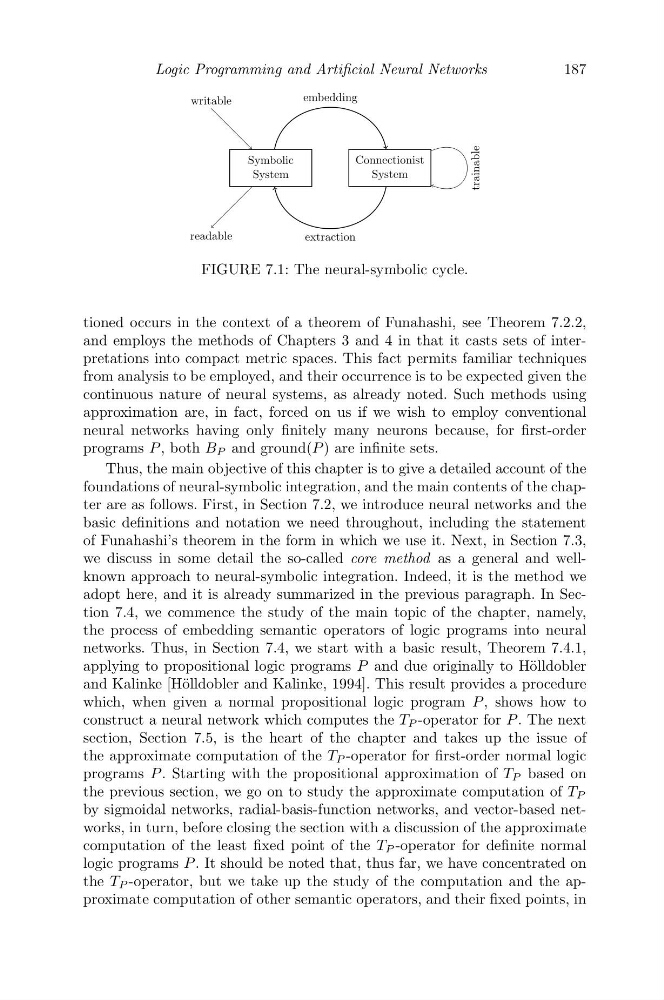
Symbolic
System
Connectionist
System
embedding
extraction
writable
readable
trainable
FIGURE 7.1: The neural-symbolic cycle.
tioned occurs in the context of a theorem of Funahashi, see Theorem 7.2.2,
and employs the methods of Chapters 3 and 4 in that it casts sets of interpretations into compact metric spaces. This fact permits familiar techniques
from analysis to be employed, and their occurrence is to be expected given the
continuous nature of neural systems, as already noted. Such methods using
approximation are, in fact, forced on us if we wish to employ conventional
neural networks having only finitely many neurons because, for first-order
programs P , both B P and ground(P ) are infinite sets.
Thus, the main objective of this chapter is to give a detailed account of the
foundations of neural-symbolic integration, and the main contents of the chapter are as follows. First, in Section 7.2, we introduce neural networks and the
basic definitions and notation we need throughout, including the statement
of Funahashi’s theorem in the form in which we use it. Next, in Section 7.3,
we discuss in some detail the so-called core method as a general and wellknown approach to neural-symbolic integration. Indeed, it is the method we
adopt here, and it is already summarized in the previous paragraph. In Section 7.4, we commence the study of the main topic of the chapter, namely,
the process of embedding semantic operators of logic programs into neural
networks. Thus, in Section 7.4, we start with a basic result, Theorem 7.4.1,
applying to propositional logic programs P and due originally to H¨ olldobler
and Kalinke [H¨ olldobler and Kalinke, 1994]. This result provides a procedure
which, when given a normal propositional logic program P , shows how to
construct a neural network which computes the T P -operator for P . The next
section, Section 7.5, is the heart of the chapter and takes up the issue of
the approximate computation of the T P -operator for first-order normal logic
programs P . Starting with the propositional approximation of T P based on
the previous section, we go on to study the approximate computation of T P
by sigmoidal networks, radial-basis-function networks, and vector-based networks, in turn, before closing the section with a discussion of the approximate
computation of the least fixed point of the T P -operator for definite normal
logic programs P . It should be noted that, thus far, we have concentrated on
the T P -operator, but we take up the study of the computation and the approximate computation of other semantic operators, and their fixed points, in
Logic Programming and Artificial Neural Networks
Symbolic
System
Connectionist
System
embedding
extraction
writable
readable
trainable
FIGURE 7.1: The neural-symbolic cycle.
tioned occurs in the context of a theorem of Funahashi, see Theorem 7.2.2,
and employs the methods of Chapters 3 and 4 in that it casts sets of interpretations into compact metric spaces. This fact permits familiar techniques
from analysis to be employed, and their occurrence is to be expected given the
continuous nature of neural systems, as already noted. Such methods using
approximation are, in fact, forced on us if we wish to employ conventional
neural networks having only finitely many neurons because, for first-order
programs P , both B P and ground(P ) are infinite sets.
Thus, the main objective of this chapter is to give a detailed account of the
foundations of neural-symbolic integration, and the main contents of the chapter are as follows. First, in Section 7.2, we introduce neural networks and the
basic definitions and notation we need throughout, including the statement
of Funahashi’s theorem in the form in which we use it. Next, in Section 7.3,
we discuss in some detail the so-called core method as a general and wellknown approach to neural-symbolic integration. Indeed, it is the method we
adopt here, and it is already summarized in the previous paragraph. In Section 7.4, we commence the study of the main topic of the chapter, namely,
the process of embedding semantic operators of logic programs into neural
networks. Thus, in Section 7.4, we start with a basic result, Theorem 7.4.1,
applying to propositional logic programs P and due originally to H¨ olldobler
and Kalinke [H¨ olldobler and Kalinke, 1994]. This result provides a procedure
which, when given a normal propositional logic program P , shows how to
construct a neural network which computes the T P -operator for P . The next
section, Section 7.5, is the heart of the chapter and takes up the issue of
the approximate computation of the T P -operator for first-order normal logic
programs P . Starting with the propositional approximation of T P based on
the previous section, we go on to study the approximate computation of T P
by sigmoidal networks, radial-basis-function networks, and vector-based networks, in turn, before closing the section with a discussion of the approximate
computation of the least fixed point of the T P -operator for definite normal
logic programs P . It should be noted that, thus far, we have concentrated on
the T P -operator, but we take up the study of the computation and the approximate computation of other semantic operators, and their fixed points, in