

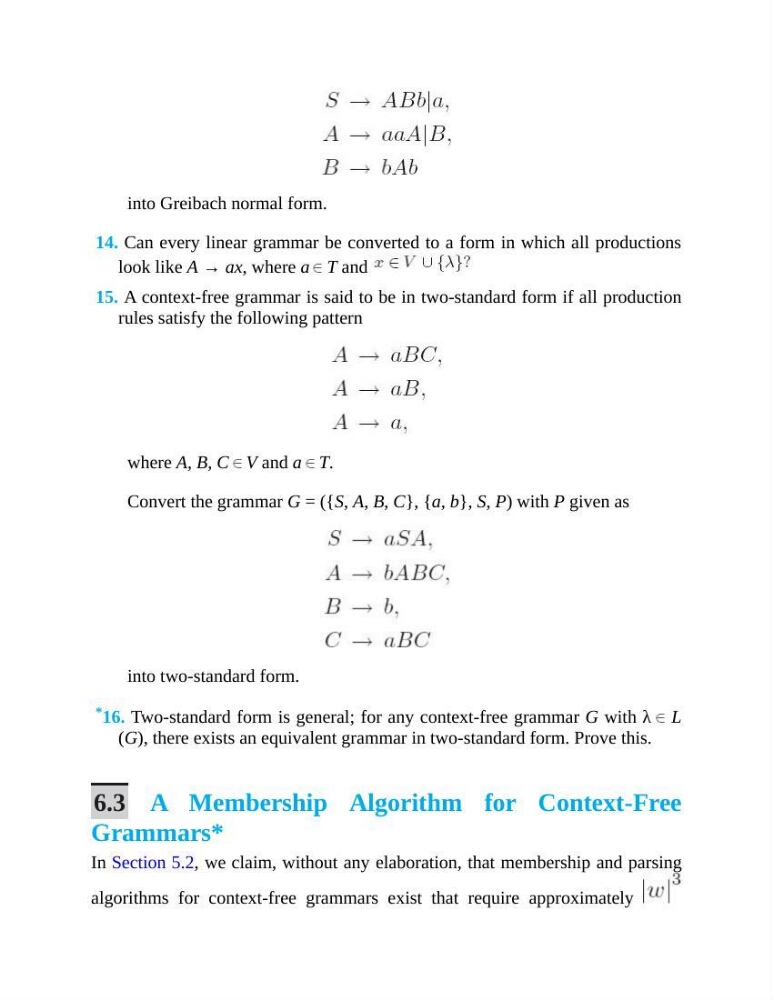
into Greibach normal form.
14. Can every linear grammar be converted to a form in which all productions
look like A → ax, where a T and
15. A context-free grammar is said to be in two-standard form if all production
rules satisfy the following pattern
where A, B, C V and a T.
Convert the grammar G = ({S, A, B, C}, {a, b}, S, P) with P given as
into two-standard form.
* 16. Two-standard form is general; for any context-free grammar G with λ L
(G), there exists an equivalent grammar in two-standard form. Prove this.
6.3 A Membership Algorithm for Context-Free
Grammars*
In Section 5.2, we claim, without any elaboration, that membership and parsing
algorithms for context-free grammars exist that require approximately
14. Can every linear grammar be converted to a form in which all productions
look like A → ax, where a T and
15. A context-free grammar is said to be in two-standard form if all production
rules satisfy the following pattern
where A, B, C V and a T.
Convert the grammar G = ({S, A, B, C}, {a, b}, S, P) with P given as
into two-standard form.
* 16. Two-standard form is general; for any context-free grammar G with λ L
(G), there exists an equivalent grammar in two-standard form. Prove this.
6.3 A Membership Algorithm for Context-Free
Grammars*
In Section 5.2, we claim, without any elaboration, that membership and parsing
algorithms for context-free grammars exist that require approximately