

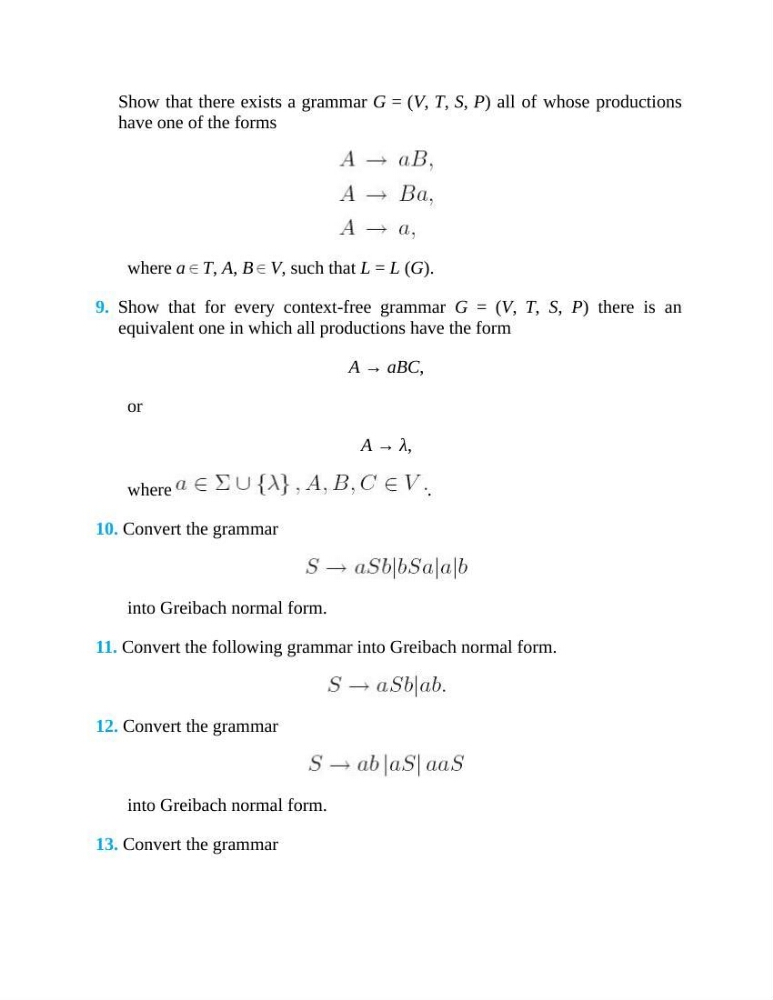
Show that there exists a grammar G = (V, T, S, P) all of whose productions
have one of the forms
where a T, A, B V, such that L = L (G).
9. Show that for every context-free grammar G = (V, T, S, P) there is an
equivalent one in which all productions have the form
A → aBC,
or
A → λ,
where
.
10. Convert the grammar
into Greibach normal form.
11. Convert the following grammar into Greibach normal form.
12. Convert the grammar
into Greibach normal form.
13. Convert the grammar
have one of the forms
where a T, A, B V, such that L = L (G).
9. Show that for every context-free grammar G = (V, T, S, P) there is an
equivalent one in which all productions have the form
A → aBC,
or
A → λ,
where
.
10. Convert the grammar
into Greibach normal form.
11. Convert the following grammar into Greibach normal form.
12. Convert the grammar
into Greibach normal form.
13. Convert the grammar