

of S; we write this as
S 1 ⊂ S.
If S 1 and S 2 have no common element, that is, S 1 ∩ S 2 = ø, then the sets are said
to be disjoint.
A set is said to be finite if it contains a finite number of elements; otherwise
it is infinite. The size of a finite set is the number of elements in it; this is
denoted by |S|.
A given set normally has many subsets. The set of all subsets of a set S is
called the powerset of S and is denoted by 2 s . Observe that 2 s is a set of sets.
Example 1.1
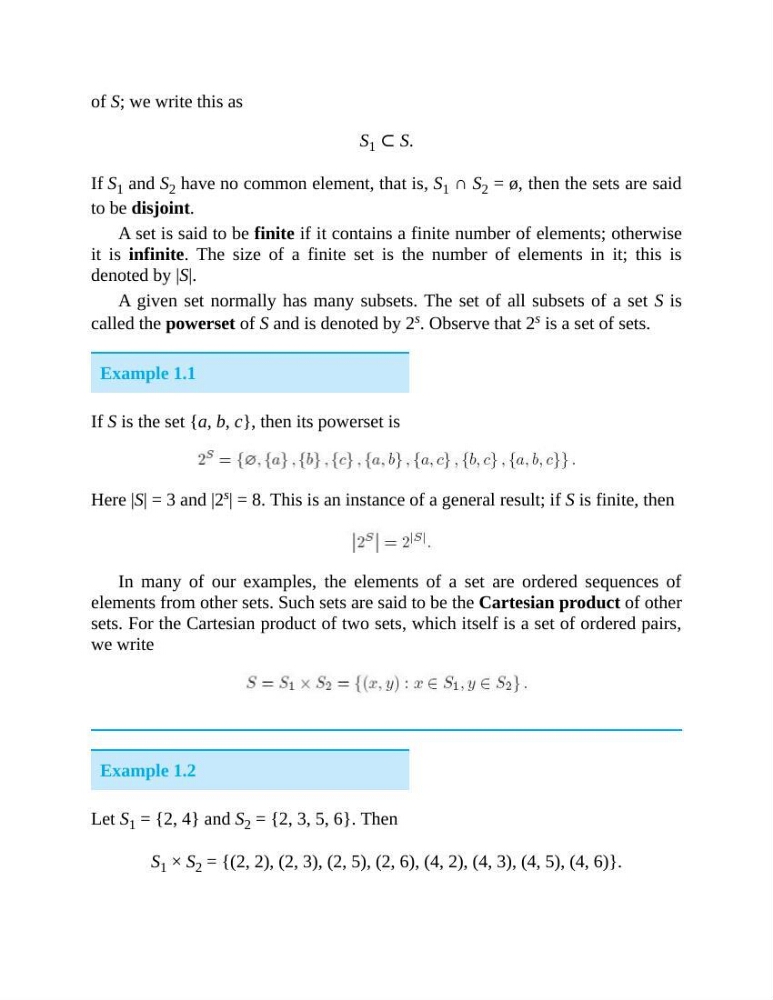
If S is the set {a, b, c}, then its powerset is
Here |S| = 3 and |2 s | = 8. This is an instance of a general result; if S is finite, then
In many of our examples, the elements of a set are ordered sequences of
elements from other sets. Such sets are said to be the Cartesian product of other
sets. For the Cartesian product of two sets, which itself is a set of ordered pairs,
we write
Example 1.2
Let S 1 = {2, 4} and S 2 = {2, 3, 5, 6}. Then
S 1 × S 2 = {(2, 2), (2, 3), (2, 5), (2, 6), (4, 2), (4, 3), (4, 5), (4, 6)}.
S 1 ⊂ S.
If S 1 and S 2 have no common element, that is, S 1 ∩ S 2 = ø, then the sets are said
to be disjoint.
A set is said to be finite if it contains a finite number of elements; otherwise
it is infinite. The size of a finite set is the number of elements in it; this is
denoted by |S|.
A given set normally has many subsets. The set of all subsets of a set S is
called the powerset of S and is denoted by 2 s . Observe that 2 s is a set of sets.
Example 1.1
If S is the set {a, b, c}, then its powerset is
Here |S| = 3 and |2 s | = 8. This is an instance of a general result; if S is finite, then
In many of our examples, the elements of a set are ordered sequences of
elements from other sets. Such sets are said to be the Cartesian product of other
sets. For the Cartesian product of two sets, which itself is a set of ordered pairs,
we write
Example 1.2
Let S 1 = {2, 4} and S 2 = {2, 3, 5, 6}. Then
S 1 × S 2 = {(2, 2), (2, 3), (2, 5), (2, 6), (4, 2), (4, 3), (4, 5), (4, 6)}.