

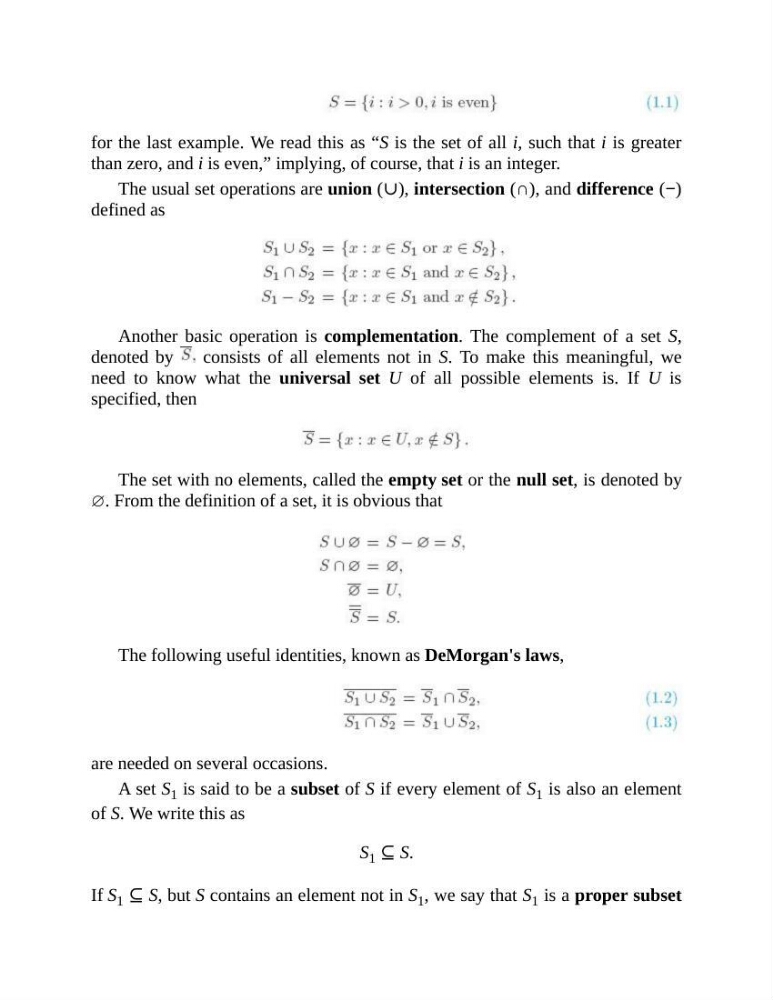
for the last example. We read this as “S is the set of all i, such that i is greater
than zero, and i is even,” implying, of course, that i is an integer.
The usual set operations are union (∪), intersection (∩), and difference (−)
defined as
Another basic operation is complementation. The complement of a set S,
denoted by consists of all elements not in S. To make this meaningful, we
need to know what the universal set U of all possible elements is. If U is
specified, then
The set with no elements, called the empty set or the null set, is denoted by
∅. From the definition of a set, it is obvious that
The following useful identities, known as DeMorgan's laws,
are needed on several occasions.
A set S 1 is said to be a subset of S if every element of S 1 is also an element
of S. We write this as
S 1 ⊆ S.
If S 1 ⊆ S, but S contains an element not in S 1 , we say that S 1 is a proper subset
than zero, and i is even,” implying, of course, that i is an integer.
The usual set operations are union (∪), intersection (∩), and difference (−)
defined as
Another basic operation is complementation. The complement of a set S,
denoted by consists of all elements not in S. To make this meaningful, we
need to know what the universal set U of all possible elements is. If U is
specified, then
The set with no elements, called the empty set or the null set, is denoted by
∅. From the definition of a set, it is obvious that
The following useful identities, known as DeMorgan's laws,
are needed on several occasions.
A set S 1 is said to be a subset of S if every element of S 1 is also an element
of S. We write this as
S 1 ⊆ S.
If S 1 ⊆ S, but S contains an element not in S 1 , we say that S 1 is a proper subset