

Data Conversion Circuits – D/A and A/D Converters
521
1
24
1
2
3
4
5
6
7
8
9
10
11
12
13
14
15
16
17
18
19
20
40
39
38
37
36
35
34
33
32
31
30
29
28
27
26
25
24
23
22
21
Intersil
7107
R 4
C 11
P 1
R 3
C 9
R 2
+
Input
C 8
C 7
R 1
-5V
+5V
C 10
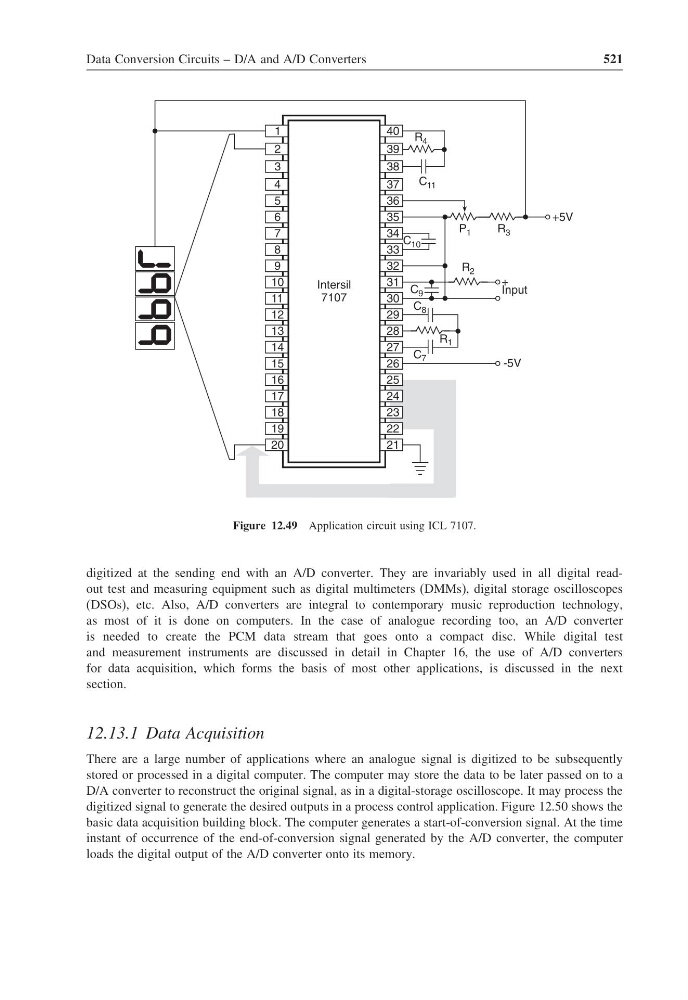
Figure 12.49 Application circuit using ICL 7107.
digitized at the sending end with an A/D converter. They are invariably used in all digital readout test and measuring equipment such as digital multimeters (DMMs), digital storage oscilloscopes
(DSOs), etc. Also, A/D converters are integral to contemporary music reproduction technology,
as most of it is done on computers. In the case of analogue recording too, an A/D converter
is needed to create the PCM data stream that goes onto a compact disc. While digital test
and measurement instruments are discussed in detail in Chapter 16, the use of A/D converters
for data acquisition, which forms the basis of most other applications, is discussed in the next
section.
12.13.1 Data Acquisition
There are a large number of applications where an analogue signal is digitized to be subsequently
stored or processed in a digital computer. The computer may store the data to be later passed on to a
D/A converter to reconstruct the original signal, as in a digital-storage oscilloscope. It may process the
digitized signal to generate the desired outputs in a process control application. Figure 12.50 shows the
basic data acquisition building block. The computer generates a start-of-conversion signal. At the time
instant of occurrence of the end-of-conversion signal generated by the A/D converter, the computer
loads the digital output of the A/D converter onto its memory.
521
1
24
1
2
3
4
5
6
7
8
9
10
11
12
13
14
15
16
17
18
19
20
40
39
38
37
36
35
34
33
32
31
30
29
28
27
26
25
24
23
22
21
Intersil
7107
R 4
C 11
P 1
R 3
C 9
R 2
+
Input
C 8
C 7
R 1
-5V
+5V
C 10
Figure 12.49 Application circuit using ICL 7107.
digitized at the sending end with an A/D converter. They are invariably used in all digital readout test and measuring equipment such as digital multimeters (DMMs), digital storage oscilloscopes
(DSOs), etc. Also, A/D converters are integral to contemporary music reproduction technology,
as most of it is done on computers. In the case of analogue recording too, an A/D converter
is needed to create the PCM data stream that goes onto a compact disc. While digital test
and measurement instruments are discussed in detail in Chapter 16, the use of A/D converters
for data acquisition, which forms the basis of most other applications, is discussed in the next
section.
12.13.1 Data Acquisition
There are a large number of applications where an analogue signal is digitized to be subsequently
stored or processed in a digital computer. The computer may store the data to be later passed on to a
D/A converter to reconstruct the original signal, as in a digital-storage oscilloscope. It may process the
digitized signal to generate the desired outputs in a process control application. Figure 12.50 shows the
basic data acquisition building block. The computer generates a start-of-conversion signal. At the time
instant of occurrence of the end-of-conversion signal generated by the A/D converter, the computer
loads the digital output of the A/D converter onto its memory.