

Counters and Registers
425
Table 11.5 Reverse or downward count sequence synchronous counter.
Count
Q 3
Q 2
Q 1
Q 0
Count
Q 3
Q 2
Q 1
Q 0
0
0
0
0
0
8
1
0
0
0
1
1
1
1
1
9
0
1
1
1
2
1
1
1
0
10
0
1
1
0
3
1
1
0
1
11
0
1
0
1
4
1
1
0
0
12
0
1
0
0
5
1
0
1
1
13
0
0
1
1
6
1
0
1
0
14
0
0
1
0
7
1
0
0
1
15
0
0
0
1
11.6 UP/DOWN Counters
Counters are also available in integrated circuit form as UP/DOWN counters, which can be made
to operate as either UP or DOWN counters. As outlined in Section 11.5, an UP counter is one that
counts upwards or in the forward direction by one LSB every time it is clocked. A four-bit binary
UP counter will count as 0000, 0001, 0010, 0011, 0100, 0101, 0110, 0111, 1000, 1001, 1010, 1011,
1100, 1101, 1110, 1111, 0000, 0001, and so on. A DOWN counter counts in the reverse direction
or downwards by one LSB every time it is clocked. The four-bit binary DOWN counter will count as
0000, 1111, 1110, 1101, 1100, 1011, 1010, 1001, 1000, 0111, 0110, 0101, 0100, 0011, 0010, 0001,
0000, 1111, and so on.
Some counter ICs have separate clock inputs for UP and DOWN counts, while others have a single
clock input and an UP/DOWN control pin. The logic status of this control pin decides the counting
mode. As an example, ICs 74190 and 74191 are four-bit UP/DOWN counters in the TTL family with
a single clock input and an UP/DOWN control pin. While IC 74190 is a BCD decade counter, IC
74191 is a binary counter. Also, ICs 74192 and 74193 are four-bit UP/DOWN counters in the TTL
family, with separate clock input terminals for UP and DOWN counts. While IC 74192 is a BCD
decade counter, IC 74193 is a binary counter.
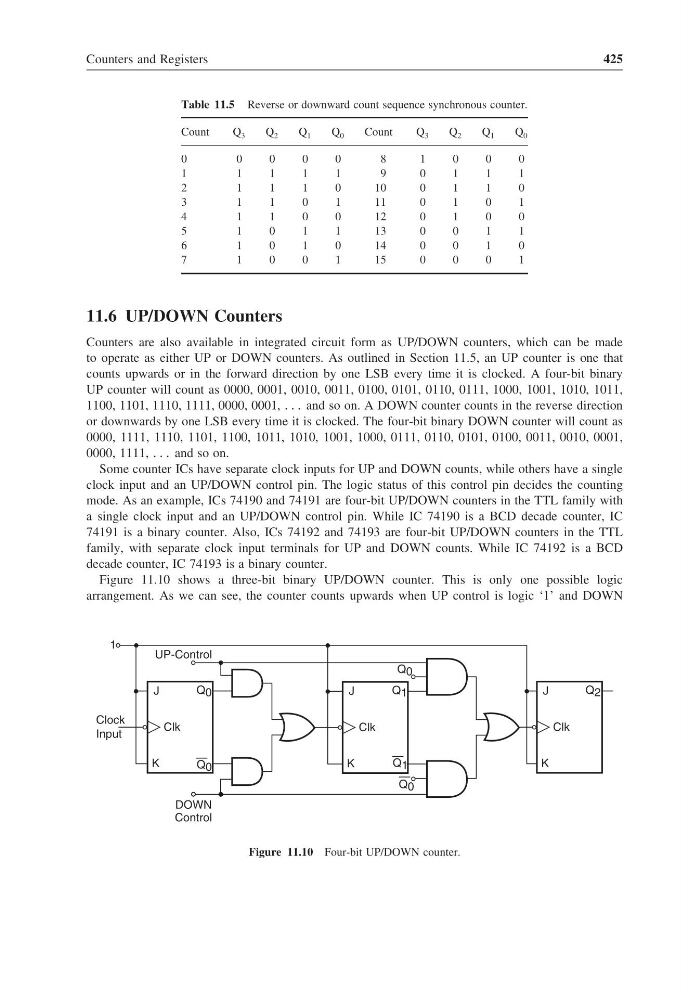
Figure 11.10 shows a three-bit binary UP/DOWN counter. This is only one possible logic
arrangement. As we can see, the counter counts upwards when UP control is logic ‘1’ and DOWN
Q 0
J
K
1
Clk
Q 0
Q 1
J
K
Clk
Q 1
Q 0
Q 0
Q 2
J
K
Clk
Clock
Input
UP-Control
DOWN
Control
Figure 11.10 Four-bit UP/DOWN counter.
425
Table 11.5 Reverse or downward count sequence synchronous counter.
Count
Q 3
Q 2
Q 1
Q 0
Count
Q 3
Q 2
Q 1
Q 0
0
0
0
0
0
8
1
0
0
0
1
1
1
1
1
9
0
1
1
1
2
1
1
1
0
10
0
1
1
0
3
1
1
0
1
11
0
1
0
1
4
1
1
0
0
12
0
1
0
0
5
1
0
1
1
13
0
0
1
1
6
1
0
1
0
14
0
0
1
0
7
1
0
0
1
15
0
0
0
1
11.6 UP/DOWN Counters
Counters are also available in integrated circuit form as UP/DOWN counters, which can be made
to operate as either UP or DOWN counters. As outlined in Section 11.5, an UP counter is one that
counts upwards or in the forward direction by one LSB every time it is clocked. A four-bit binary
UP counter will count as 0000, 0001, 0010, 0011, 0100, 0101, 0110, 0111, 1000, 1001, 1010, 1011,
1100, 1101, 1110, 1111, 0000, 0001, and so on. A DOWN counter counts in the reverse direction
or downwards by one LSB every time it is clocked. The four-bit binary DOWN counter will count as
0000, 1111, 1110, 1101, 1100, 1011, 1010, 1001, 1000, 0111, 0110, 0101, 0100, 0011, 0010, 0001,
0000, 1111, and so on.
Some counter ICs have separate clock inputs for UP and DOWN counts, while others have a single
clock input and an UP/DOWN control pin. The logic status of this control pin decides the counting
mode. As an example, ICs 74190 and 74191 are four-bit UP/DOWN counters in the TTL family with
a single clock input and an UP/DOWN control pin. While IC 74190 is a BCD decade counter, IC
74191 is a binary counter. Also, ICs 74192 and 74193 are four-bit UP/DOWN counters in the TTL
family, with separate clock input terminals for UP and DOWN counts. While IC 74192 is a BCD
decade counter, IC 74193 is a binary counter.
Figure 11.10 shows a three-bit binary UP/DOWN counter. This is only one possible logic
arrangement. As we can see, the counter counts upwards when UP control is logic ‘1’ and DOWN
Q 0
J
K
1
Clk
Q 0
Q 1
J
K
Clk
Q 1
Q 0
Q 0
Q 2
J
K
Clk
Clock
Input
UP-Control
DOWN
Control
Figure 11.10 Four-bit UP/DOWN counter.