

Flip-Flops and Related Devices
377
S
Q
R
(b)
S
Q
R
(a)
Q
Q
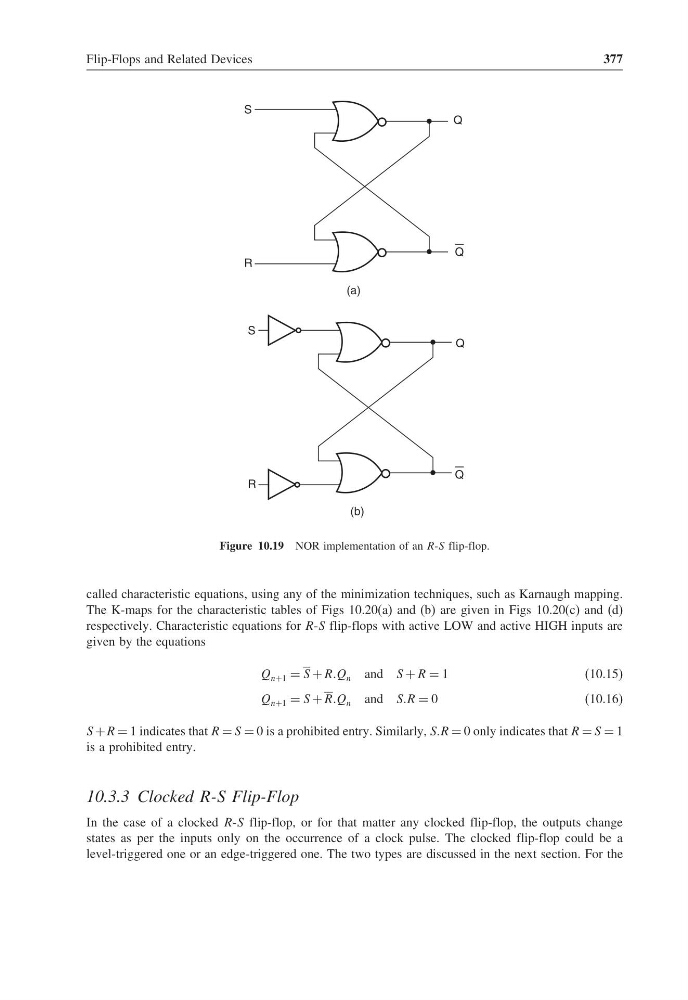
Figure 10.19 NOR implementation of an R-S flip-flop.
called characteristic equations, using any of the minimization techniques, such as Karnaugh mapping.
The K-maps for the characteristic tables of Figs 10.20(a) and (b) are given in Figs 10.20(c) and (d)
respectively. Characteristic equations for R-S flip-flops with active LOW and active HIGH inputs are
given by the equations
Q n+1 = S + RRQ n and S + R = 1
(10.15)
Q n+1 = S + RRQ n and SSR = 0
(10.16)
S +R = 1 indicates that R = S = 0 is a prohibited entry. Similarly, SSR = 0 only indicates that R = S = 1
is a prohibited entry.
10.3.3 Clocked R-S Flip-Flop
In the case of a clocked R-S flip-flop, or for that matter any clocked flip-flop, the outputs change
states as per the inputs only on the occurrence of a clock pulse. The clocked flip-flop could be a
level-triggered one or an edge-triggered one. The two types are discussed in the next section. For the
377
S
Q
R
(b)
S
Q
R
(a)
Q
Q
Figure 10.19 NOR implementation of an R-S flip-flop.
called characteristic equations, using any of the minimization techniques, such as Karnaugh mapping.
The K-maps for the characteristic tables of Figs 10.20(a) and (b) are given in Figs 10.20(c) and (d)
respectively. Characteristic equations for R-S flip-flops with active LOW and active HIGH inputs are
given by the equations
Q n+1 = S + RRQ n and S + R = 1
(10.15)
Q n+1 = S + RRQ n and SSR = 0
(10.16)
S +R = 1 indicates that R = S = 0 is a prohibited entry. Similarly, SSR = 0 only indicates that R = S = 1
is a prohibited entry.
10.3.3 Clocked R-S Flip-Flop
In the case of a clocked R-S flip-flop, or for that matter any clocked flip-flop, the outputs change
states as per the inputs only on the occurrence of a clock pulse. The clocked flip-flop could be a
level-triggered one or an edge-triggered one. The two types are discussed in the next section. For the