

288
Digital Electronics
Y
3-to-8
Decoder
2
2
2
1
2
0
0
1
2
3
4
5
6
7
A
B
C
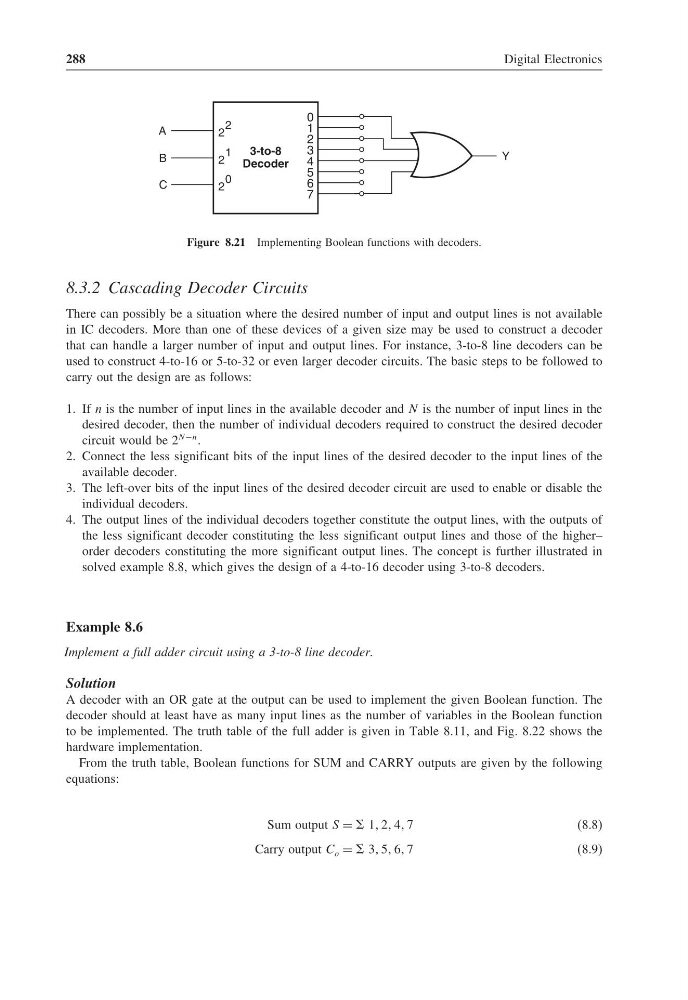
Figure 8.21 Implementing Boolean functions with decoders.
8.3.2 Cascading Decoder Circuits
There can possibly be a situation where the desired number of input and output lines is not available
in IC decoders. More than one of these devices of a given size may be used to construct a decoder
that can handle a larger number of input and output lines. For instance, 3-to-8 line decoders can be
used to construct 4-to-16 or 5-to-32 or even larger decoder circuits. The basic steps to be followed to
carry out the design are as follows:
1. If n is the number of input lines in the available decoder and N is the number of input lines in the
desired decoder, then the number of individual decoders required to construct the desired decoder
circuit would be 2
N −n .
2. Connect the less significant bits of the input lines of the desired decoder to the input lines of the
available decoder.
3. The left-over bits of the input lines of the desired decoder circuit are used to enable or disable the
individual decoders.
4. The output lines of the individual decoders together constitute the output lines, with the outputs of
the less significant decoder constituting the less significant output lines and those of the higher–
order decoders constituting the more significant output lines. The concept is further illustrated in
solved example 8.8, which gives the design of a 4-to-16 decoder using 3-to-8 decoders.
Example 8.6
Implement a full adder circuit using a 3-to-8 line decoder.
Solution
A decoder with an OR gate at the output can be used to implement the given Boolean function. The
decoder should at least have as many input lines as the number of variables in the Boolean function
to be implemented. The truth table of the full adder is given in Table 8.11, and Fig. 8.22 shows the
hardware implementation.
From the truth table, Boolean functions for SUM and CARRY outputs are given by the following
equations:
Sum output S = 1 2 4 7
(8.8)
Carry output C o = 3 5 6 7
(8.9)
Digital Electronics
Y
3-to-8
Decoder
2
2
2
1
2
0
0
1
2
3
4
5
6
7
A
B
C
Figure 8.21 Implementing Boolean functions with decoders.
8.3.2 Cascading Decoder Circuits
There can possibly be a situation where the desired number of input and output lines is not available
in IC decoders. More than one of these devices of a given size may be used to construct a decoder
that can handle a larger number of input and output lines. For instance, 3-to-8 line decoders can be
used to construct 4-to-16 or 5-to-32 or even larger decoder circuits. The basic steps to be followed to
carry out the design are as follows:
1. If n is the number of input lines in the available decoder and N is the number of input lines in the
desired decoder, then the number of individual decoders required to construct the desired decoder
circuit would be 2
N −n .
2. Connect the less significant bits of the input lines of the desired decoder to the input lines of the
available decoder.
3. The left-over bits of the input lines of the desired decoder circuit are used to enable or disable the
individual decoders.
4. The output lines of the individual decoders together constitute the output lines, with the outputs of
the less significant decoder constituting the less significant output lines and those of the higher–
order decoders constituting the more significant output lines. The concept is further illustrated in
solved example 8.8, which gives the design of a 4-to-16 decoder using 3-to-8 decoders.
Example 8.6
Implement a full adder circuit using a 3-to-8 line decoder.
Solution
A decoder with an OR gate at the output can be used to implement the given Boolean function. The
decoder should at least have as many input lines as the number of variables in the Boolean function
to be implemented. The truth table of the full adder is given in Table 8.11, and Fig. 8.22 shows the
hardware implementation.
From the truth table, Boolean functions for SUM and CARRY outputs are given by the following
equations:
Sum output S = 1 2 4 7
(8.8)
Carry output C o = 3 5 6 7
(8.9)